Cross-border prefunding: what it costs and how to cut it

Prefunding is the money a payment company parks with banks and payout partners before it can pay anyone abroad. Stablecoin settlement cuts how much each corridor needs, and a vault can earn on what stays.
Visa told banks and remitters at Sibos on 30 September 2025 that they could soon prefund Visa Direct with stablecoins, including on weekends when banks are shut. Prefunding in cross-border payments is cash deposited with a payout partner ahead of time to cover several days of payouts in each currency, and it costs the capital tied up times the company's cost of capital. Stablecoin cross border payment solutions such as Circle Payments Network, Bridge, BVNK, zerohash and Ripple Payments cut those days of cover, and Upshift vaults earn on the float that remains.
For B2B cross border payments the idle balance repeats in every corridor a company pays into. Visa's pilot was due to reach limited availability in April 2026, and in August 2026 zerohash said eligible Visa Direct clients can prefund and pay out in stablecoins through its platform.
Solution | What it is | What it does to prefunded capital | Hours |
Upshift | Vault infrastructure for stablecoin balances, with credit through the Upshift prime stack | Earns on the float that stays; credit lines against settlement balances cover peaks | Daily redemptions; instant exit on most vaults for a fee, subject to liquidity |
Circle Payments Network | Network of banks and payment firms settling in USDC and EURC, live since May 2025 | Replaces local cash reserves with stablecoin settlement between members | 24/7 |
Bridge (Stripe) | API to move, hold, accept and issue stablecoins | Funds payout partners in minutes from one dollar balance | 24/7 onchain; fiat legs on banking hours |
BVNK | Stablecoin payments platform with 40+ licences in 130+ countries | Holds fiat and stablecoins in one wallet and converts on demand | 24/7 onchain; fiat legs on banking hours |
zerohash | Stablecoin payout and prefunding infrastructure, including for Visa Direct | Lets Visa Direct clients prefund in stablecoins | 24/7 |
Ripple Payments | Payout network settling with RLUSD and XRP across 60+ markets | Settles through one unified account in place of an account per market | 24/7 |
Visa Direct | Visa's push-payment network, with stablecoin prefunding in pilot | Accepts USDC and other stablecoins as prefunding, credited as dollars | Top-ups accepted at weekends |
Payment rails set how many days of cover a corridor holds. Vaults and credit lines work on the balance left after that.
Step 1: count the days of cover in each corridor
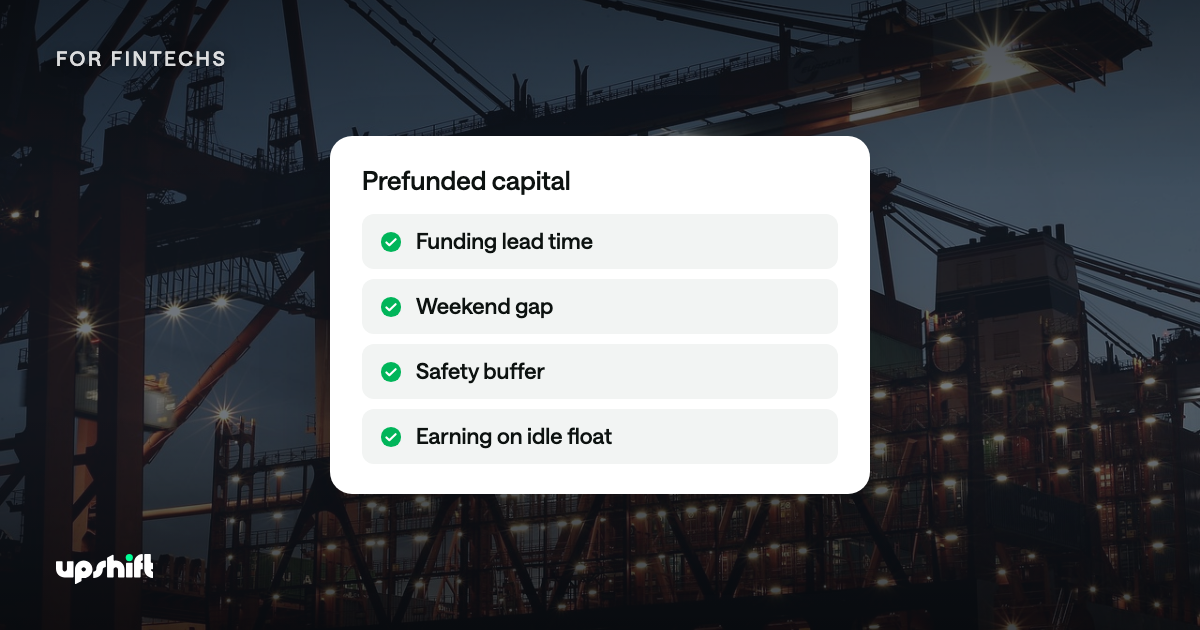
A remittance company or B2B payout platform can't pay a supplier in Manila until pesos are sitting with its local partner. It funds that balance ahead of time, and the amount is set by days of cover: how many days of payouts the balance has to carry before the next top-up lands. The first part of that number is funding lead time, the 1 to 2 business days a wire can take to reach a correspondent or payout partner. The second is the weekend and public holiday gap, when wires don't move and Friday's top-up has to carry Saturday, Sunday and Monday morning. The third is a safety buffer for payout spikes, a late wire or a partner outage, and it rarely gets smaller once a corridor has had a bad week. Lead time and the weekend gap come from the rail, while the buffer is a treasury call.
Across the banking system the numbers get very large. Circle, citing a BIS estimate, puts the money held in nostro and vostro accounts to support cross-border settlement at roughly $27 trillion. Artemis Analytics tracked stablecoin prefunding as its own payments category in 2025, at a $3.6 billion annualised run rate in August 2025, next to $76 billion for B2B stablecoin payments.
Step 2: put a price on the capital
The cost of prefunding is the return the company gives up, or the interest it pays, on every dollar parked in a corridor. The formula has two lines:
- Prefunded capital = daily payout volume × days of cover
- Annual cost = prefunded capital × cost of capital
Cost of capital is the rate that applies to the money. For a company funding corridors from its own cash, the floor is the rate that cash would earn in Treasury bills. The 13-week bill yielded 4.11% on 2 October 2026, per the US Treasury's daily bill rates. A company that draws on a working-capital line to fund payouts pays its lender's rate, which is usually well above that. Costs scale in a straight line, and a corridor paying $3M a day costs three times the figure in its row.
Days of cover | Capital per $1M of daily payouts | Annual cost at 4.11% | At 8% | At 12% |
1 | $1M | $41,100 | $80,000 | $120,000 |
2 | $2M | $82,200 | $160,000 | $240,000 |
3 | $3M | $123,300 | $240,000 | $360,000 |
5 | $5M | $205,500 | $400,000 | $600,000 |
7 | $7M | $287,700 | $560,000 | $840,000 |
Take a payout platform with three corridors: $2M a day to Mexico, $1M a day to the Philippines and $500,000 a day to Nigeria. On wires it holds 4, 5 and 6 days of cover, which comes to $8M, $5M and $3M, or $16M in all. Funded by stablecoin top-ups, the same corridors need roughly 1.25, 1.5 and 2 days ($2.5M, $1.5M and $1M), and the Nigeria buffer stays larger because local currency liquidity at the off-ramp is thinner. That's $5M in place of $16M. At a 10% cost of capital the corridors cost $500,000 a year to carry against $1.6M before (all figures illustrative; your own lead times and buffers will differ).
Step 3: move top-ups from nostro accounts to stablecoin settlement
A nostro account is a bank's account held at a correspondent bank abroad, in that country's currency ("ours, with you"). The same account, seen from the correspondent's books, is a vostro account ("yours, with us"). Payment companies run a version of the same setup with their payout partners. Stablecoin settlement changes the funding leg of that arrangement more than the payout leg.
Nostro and vostro accounts | Stablecoin settlement | |
Where the balance sits | In local currency at a correspondent or payout partner, one account per currency | In USDC or another stablecoin, moved to the partner when needed |
Top-up time | 1 to 2 business days by wire | Minutes onchain, plus the partner's conversion time |
Weekends and holidays | No top-ups; Friday's balance carries the weekend | Top-ups arrive any day, subject to the off-ramp's local hours |
Capital per corridor | Several days of payouts in every currency | Hours to a day or two of payouts, plus a buffer |
Visibility | Bank statements and status messages | Each transfer visible onchain from send to arrival |
Idle balance | Earns whatever the holding bank pays | Can sit in a stablecoin vault until it's sent |
Stablecoins settle onchain at any hour, weekends included. The off-ramp is where it slows down, since a partner converting USDC into pesos or naira still relies on local banks for the final payout in many markets. US dollar wires stay on a weekday schedule for now. The Fedwire Funds Service runs 22 hours a day, Monday to Friday, and the Federal Reserve plans to add Sundays and weekday holidays in 2028 or 2029, with Saturdays still closed. Visa's pilot was built around that gap. Mark Nelsen, who runs product for Visa's money movement business, told American Banker that a client could "simply send us stablecoins" to top up its account.
Circle Payments Network connects originating and beneficiary institutions that settle with each other in USDC or EURC, and Circle says it settles 24/7 without prefunded accounts or cash parked in local markets. Bridge and BVNK sell the conversion and transfer layer through an API, and BVNK lists Worldpay, Deel and Flywire among its customers. Ripple Payments runs its own payout network and says it has processed over $100 billion. The flow behind all of them (fiat in, stablecoin across, local currency out) is the stablecoin sandwich, and stablecoin cross-border payments covers the corridor costs and the four corridor models.
Step 4: earn on the float that stays
Faster top-ups shrink prefunding without taking it to zero. A payment company still keeps a USDC reserve of its own to fund the next top-ups, cover a holiday peak or switch to a second off-ramp if the first one fails. In the three-corridor example that reserve might be $2M of the $5M. That reserve can sit in a stablecoin vault between payouts.
Upshift is onchain yield infrastructure that lets fintechs and asset managers offer yield inside their own products, from 24/7 tokenized money market funds to DeFi strategies. A payment company usually starts in the Conservative band, where the vault holds tokenized money market funds and earns close to the T-bill rate, including on weekends. On $2M at 4.11%, that's about $82,000 a year (rates move daily and aren't guaranteed). All Upshift vaults process redemptions daily, each with its own lag, and most offer an instant exit for a fee, subject to available liquidity. A payment company can also use a whitelisted vault where it's the only depositor, which keeps its float out of a shared exit queue; segregated vs co-mingled vault accounts explains the difference.
Card programs hit the same timing problem at the point of sale, covered in how card programs earn yield on customer float, and the payments and card float page shows the setup for a payments business.
Step 5: borrow against settlement balances for peaks
The last step trims the safety buffer. A payment company holding several days of cover for month-end or holiday spikes can hold less if it can borrow on the day a spike arrives. Through the Upshift prime stack, partners can reach a network of institutional lenders, including credit lines for card and payment programs. A line can be structured to use prefunded settlement balances as collateral. The line gets drawn for the Friday before a long weekend and repaid once payouts settle, and the buffer the rest of the month is smaller. Pricing depends on the collateral and the program, and terms are agreed per partner.
A stablecoin can trade below $1 for a period, an off-ramp partner can lose its banking access, a vault or protocol contract can have a bug, and a large withdrawal may wait for liquidity. Upshift's contracts have been through 11 smart contract audits by 6 independent firms, and a finance or compliance team will usually run a vault provider review before moving corridor float. Vault yields float with the market and aren't guaranteed. Always make sure to do your own research and be aware of the above and any other risks before depositing.
Carrying prefunded float across corridors? Tell us your daily payouts and days of cover per corridor, and we'll send back what the float could earn and how a credit line would size against it.
Frequently asked questions
What is prefunding in cross-border payments and what does it cost?
It's cash a payment company deposits with a bank or payout partner before sending money abroad. Its annual cost is daily payouts times days of cover times cost of capital: $1M a day held 5 days costs $205,500 a year at the 4.11% T-bill rate of 2 October 2026.
How can payment companies cut prefunded capital in corridors with stablecoins?
They top up payout partners in stablecoins, which arrive in minutes on any day, and drop the lead time and weekend gap from their days of cover. The reserve that stays can earn in a vault, and a credit line against settlement balances replaces part of the safety buffer.
Best B2B cross-border payment solutions using stablecoins
The main stablecoin rails for B2B payouts are Circle Payments Network, Bridge, BVNK, zerohash, Ripple Payments and Visa Direct's stablecoin prefunding. Circle named BVNK, Flutterwave, Yellow Card and Zepz among the first payment companies working on CPN in April 2025. Upshift sits alongside the rails, earning on the float they leave and lending against settlement balances.
Nostro vostro accounts vs stablecoin settlement: what changes?
The funding leg changes most. Nostro and vostro come from the Italian for "ours" and "yours". A nostro balance is topped up by wire over 1 to 2 business days and has to carry the weekend, while a stablecoin balance can be topped up in minutes on a Sunday. The local payout still depends on the off-ramp partner's banks.
Can stablecoin payments settle on weekends and outside banking hours?
Yes, the onchain transfer settles at any hour, every day. Fedwire is shut on weekends until at least 2028, and even then only Sundays are added. Local payout timing depends on the off-ramp partner in each country.
Can a payment company borrow against its prefunded settlement balances?
Yes. A credit line can be structured to use prefunded settlement balances as collateral. The company draws it ahead of peaks and repays it once payouts settle. Upshift partners can reach these lines through the Upshift prime stack.
Keep reading
- Stablecoin cross-border payments: how corridors work and where the float earns.
- What is PayFi: payment finance and where payment balances sit.
- Stablecoin treasury management: liquidity tiers, custody and approvals for stablecoin balances.
- Stablecoin yield without DeFi: the 24/7 T-bill rate on dollar balances.
Launch a vault with Upshift
Upshift builds custom, permissioned vaults for custodians, exchanges, neobanks and asset managers. Tell us what you are building and the team will follow up.
Create a vault with Upshift
Share your use case and we’ll get back to you shortly