Embedded yield in 2026: how apps distribute vaults

In 2026 exchanges, brokerages, wallets and custodians put onchain vaults inside their own apps, and most of their customers never touch a DeFi front end. The app owns the customer, while a vault platform runs the contracts and a curator runs the strategy.
Bitget opened yield vaults to its 125 million users on 31 July 2026, the same day Uniswap launched Earn with three curated vaults. Robinhood had added a USDG Earn product on its own chain a month earlier, and Coinbase opened a curated USDC vault in June. Embedded yield means a vault shown inside an app the customer uses for something else, and it's how a lot of depositors generated yield on their stablecoin and crypto assets this year. The vault itself stays onchain, and the app decides what customers see.
Total DeFi TVL fell about 39% in the first half of 2026, from roughly $115B in January to just over $70B, according to Cointelegraph citing CryptoRank data. Most of that drop came from falling token prices. Stablecoin supply held at about $310B over the same months, per DefiLlama, and apps kept adding Earn products on top of those balances. Most integrated vaults built and run by specialists.
Which apps added yield vaults in 2026?
At least nine large apps added onchain vaults behind their own interface between January and September 2026. They span consumer exchanges, a brokerage, a DEX, a crypto neobank, a wallet and institutional platforms.
App | Live | What customers deposit | Strategy run by |
Kraken DeFi Earn | 26 Jan 2026 | Deposits converted to USDC | Aave lending, through a vault on Ink |
Tria | Jan 2026 | USD stablecoins and BTC | Sentora, on Upshift |
Fireblocks Earn | 15 Apr 2026 | Stablecoins, for 2,400+ institutional clients | Sentora, plus a lending market |
Coinbase | Jun 2026 | USDC | Steakhouse |
Robinhood | 1 Jul 2026 | USDG, about 7% at launch | Steakhouse |
Kraken Institutional | 15 Jul 2026 | Stablecoins, ETH and BTC from qualified custody | Vetted asset managers, on Upshift |
Uniswap | 31 Jul 2026 | USDC, USDT and ETH | Gauntlet |
Bitget | 31 Jul 2026 | BTC, then USDC from 3 Aug | Gauntlet |
Zerion | 3 Sep 2026 | AUSD (earnAUSD on Monad) | Gamma Research, on Upshift |
The launches are documented by Aave on Kraken DeFi Earn, Bankless on Coinbase, Robinhood's newsroom, crypto.news on Uniswap and FF News on Bitget. Robinhood's 7% is its own launch figure from 1 July, and rates float. Coinbase's USDC vault held $453.5M on 2 October 2026, the Steakhouse USDG vault on Robinhood Chain held $522.6M, and Bitget's vaults passed $55M in their first week, per Blockhead.
What are the five routes from a vault to a depositor?
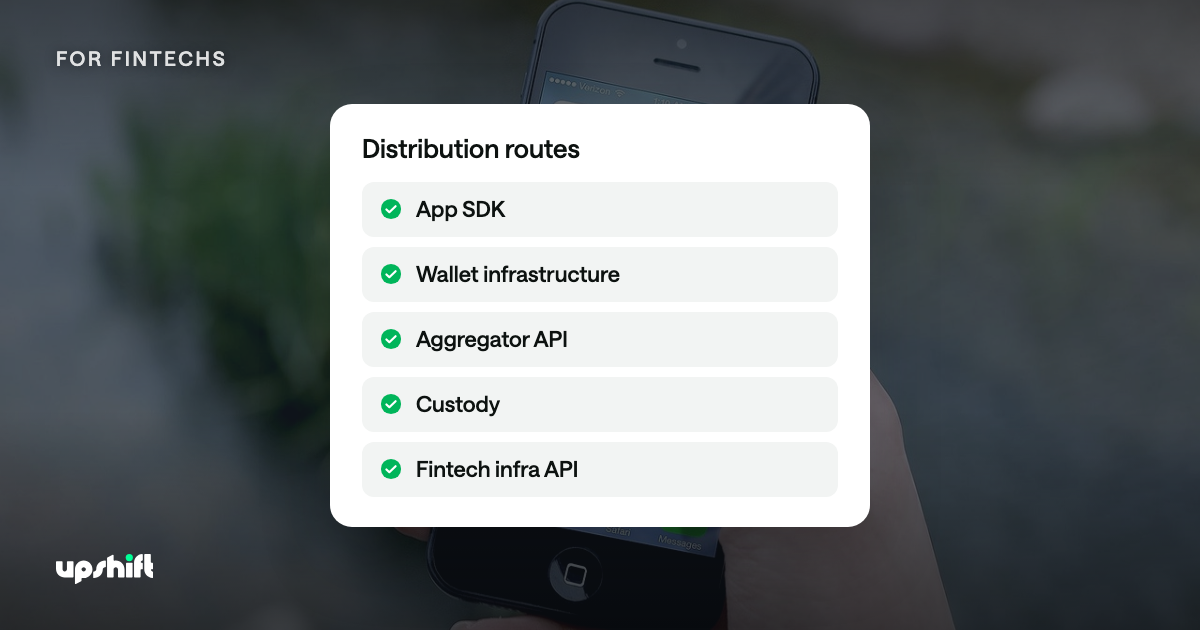
A vault reaches depositors through five kinds of distribution in 2026, and one vault can sit behind several of them at once.
- Consumer app SDK. The app integrates a vault provider's SDK and shows the vault in its own Earn tab. Tria went live this way two weeks after starting its Upshift SDK integration.
- Wallet infrastructure. A wallet-infrastructure company adds Earn for every app built on it. Turnkey Earn, launched in September, connects wallets to ERC-4626 vaults and lets each app set its own fee.
- Aggregator API. One listing reaches many apps. Zerion lists earnAUSD in its Earn tab through Yield.xyz's API, and Jumper lists the earnAUSD Looping Vault through LI.FI.
- Custody. A custodian lets clients allocate without moving assets out. Kraken Institutional clients deploy from their qualified custody account, and Fireblocks Earn opened curated vaults to its institutional clients.
- Fintech infrastructure API. Companies that power banks, brokerages and card programmes add Earn as one more endpoint. zerohash runs staking for Interactive Brokers and Public through its API, and a card processor could expose a vault the same way to the card programmes it serves.
Every route splits the same jobs. The app runs onboarding, compliance and support, the vault platform runs the contracts, pricing and withdrawals, and the curator runs the strategy. How exchanges build an Earn product covers how the fees split between them.
Who supplies the capital?
Consumer apps bring the users, though large wallets still bring most of the money. Keyrock's research, as cited by Lagoon in March 2026, found that wallets above $100,000 hold between 70% and 99% of vault assets across most protocols. Wallets under $10,000 hold less than 1%.
That split shapes what an Earn product needs. Retail users want a simple balance. They also want a rate they can read at a glance. The capital, at least in the vaults Keyrock studied, comes from treasuries, funds and high-balance individuals. Those depositors ask for diligence answers, withdrawal terms and reporting before they move money. A product built for both usually offers one conservative vault for everyone and keeps higher-yield bands for customers who opt in, as tiered stablecoin yield lays out.
How concentrated is vault curation?
A small number of curators run most of the curated money onchain. On Morpho, one of the largest lending venues for vaults, 41 named curators ran $6.19B of vault assets on 2 October 2026, by our count from Morpho's public API. The top two held 58.8% of that and the top ten held 93.6%.
Curator | Vault assets on Morpho, 2 Oct 2026 | Share of named-curator assets |
Steakhouse | $2.31B | 37.4% |
Sentora | $1.33B | 21.5% |
Gauntlet | About $0.97B | 15.7% |
Spark | About $0.56B | 9.1% |
Method: every V1 and V2 Morpho vault from api.morpho.org, with $84.6M of vault-into-vault deposits removed and co-curated vaults split evenly. The same curators also run vaults on other platforms. Sentora, for example, curates on Morpho and on Upshift. A curator's decisions therefore reach every app that lists its vaults, which makes curator diligence as important as diligence on the vault contracts.
Where does vault yield come from?
No one publishes an industry-wide breakdown of vault yield by source, though a few platforms disclose enough to see the mix. Spark's liquidity layer reported $2.92B under management on 2 October 2026, earning a blended 3.33% against a 3.87% cost of capital. It spreads that money across its own lending market (54.8%), Morpho (23.4%), Anchorage (7.2%), PayPal (6.7%), Uniswap (3.5%) and Ripple (3.3%), per Spark's data page.
Tokenized Treasuries set the floor most stablecoin vaults measure against. They held $14.75B across 25 funds and 85,710 holders on 2 October 2026, with a 7-day yield of 3.60%, according to rwa.xyz. Higher bands add lending, credit and market-neutral strategies on top. The guide to where stablecoin yield comes from breaks down each source.
What should an app check before listing a vault?
An app that lists a vault takes on the customer's questions about it. These are the checks we see most often in diligence:
- Who can upgrade the vault contracts, and is there a delay before an upgrade takes effect
- How the share price is calculated, and whether anyone other than the curator checks it
- Withdrawal terms, including how instant exits are funded
- Which protocols and counterparties the curator can use, and how that list is enforced
- The audit history, and the curator's track record on other platforms
Vault provider due diligence has the full question set with our answers. Every vault carries smart contract and strategy risk, and rates float.
Always make sure to do your own research and be aware of the above and any other risks before depositing.
How Upshift fits into embedded yield
Upshift is onchain yield infrastructure that lets fintechs and asset managers offer yield inside their own products. Partners start with 24/7 tokenized money market funds and add higher-yield strategies, from lending to basis trades, on the same integration. A professional curator runs each stablecoin, BTC or ETH vault within risk limits set in advance, and depositors keep custody of their vault shares throughout.
Upshift vaults reach depositors through four of the five routes: the SDK in Tria, custody at Kraken Institutional, aggregator APIs at Zerion and Jumper, and wallet infrastructure, where an August USDC vault is available through Turnkey Earn. Upshift vaults held $423.4M on 2 October 2026, summed vault by vault. Every Upshift vault is priced and settled by Upshift, which validates the curator's net asset value before it reaches depositors, and the contracts have been through 11 smart contract audits by 6 independent firms.
Adding Earn to your app? Tell us which assets your customers hold and which route fits your product, and we'll send a vault menu and a launch timeline.
Frequently asked questions
What is embedded yield?
A yield product shown inside an exchange, wallet or brokerage app, while the vault behind it runs onchain. Coinbase, Robinhood, Uniswap and Bitget all launched one in 2026.
Who runs the strategy in an embedded yield product?
Usually a curator, an asset manager that allocates the vault within limits the app approves. On Morpho in October 2026, the top ten curators ran 93.6% of named-curator vault assets.
Do consumer apps bring most of the deposits?
They bring most of the new users. Keyrock's research found wallets above $100,000 hold 70% to 99% of vault assets across most protocols.
How long does it take an app to add vaults?
Tria went live two weeks after starting its SDK integration. Routes through an aggregator API or a wallet-infrastructure partner can be quicker, since the partner has done the integration once for many apps.
What yield do the most conservative vaults earn?
Tokenized Treasury funds yielded 3.60% over 7 days on 2 October 2026, per rwa.xyz. Vaults built on them earn close to that before fees.
Launch a vault with Upshift
Upshift builds custom, permissioned vaults for custodians, exchanges, neobanks and asset managers. Tell us what you are building and the team will follow up.
Create a vault with Upshift
Share your use case and we’ll get back to you shortly