Stablecoin invoicing: how B2B invoices settle in USDC

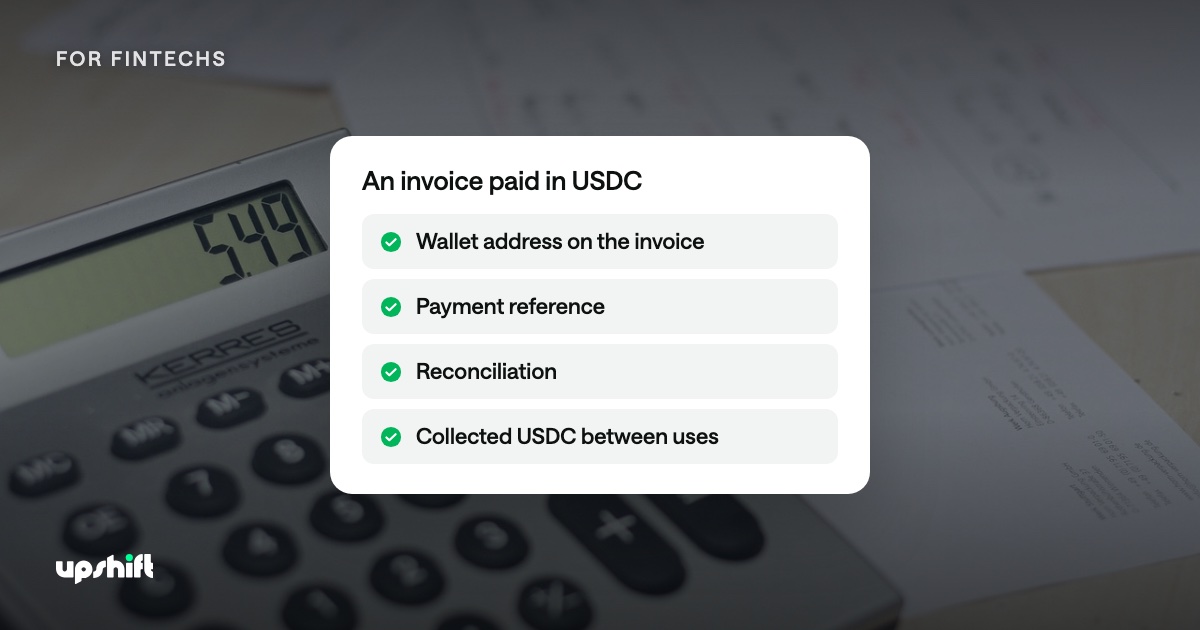
A USDC invoice settles once the payer's transfer to the address it names confirms onchain. The seller then matches the payment, books it and picks where the money waits.
Take a design agency in Austin that sends a $48,000 invoice to a client in São Paulo on a Thursday afternoon. With stablecoin invoicing, the invoice names USDC on Base, a wallet address and a payment reference, and the client pays from its own wallet that evening.
The agency's invoicing tool matches the transfer to the open invoice, and the USDC then converts to dollars or stays in a wallet until the agency pays its own suppliers. Stripe, Request Finance, Coinbase Business and Acctual all support a version of this flow as of October 2026. Across the payment firms in its August 2025 sample, B2B made up $76B of a $122B annualised run rate for stablecoin payments, according to Artemis.
How does a USDC invoice settle?
- The seller issues the invoice with the token, the network and a wallet address, or a hosted pay link that carries all three.
- The buyer sends the stablecoin. A confirmed transfer is final, and Stripe lists no dispute support for stablecoin payments.
- The seller's tool matches the transfer to the invoice.
- The USDC converts to dollars, or stays as USDC.
- Bookkeeping records the receipt at its USD value on the day it lands.
In words: the invoice carries the token, network, address and reference, the transfer is final once confirmed, and the seller's tool matches it and books the dollar value. The money then converts to USD, or stays in USDC until accounts payable spends it.
Request Network creates a 16-character payment reference for every request. Its subgraphs scan supported chains for transactions that carry the reference, check the amount, currency and recipient, and mark the request paid. A short payment triggers a separate "partial" webhook. Stripe matches through a hosted flow instead: the payer goes to crypto.stripe.com, connects a wallet and pays a session tied to the invoice.
Without either tool, someone in finance compares the transaction hash, amount and sending address against open invoices by hand, which gets slow once two customers pay the same amount on the same day. The invoice also needs to name the network, because a payment sent on Ethereum won't appear in a tool that only watches Base.
Which tools support stablecoin invoicing in October 2026?
Tool | What the payer gets | How payments are matched | Where the money lands |
Stripe | Invoices, Payment Links and Billing in USDC on Tempo, Ethereum, Solana, Polygon or Base; USDP and USDG for US payers | Hosted payment page at crypto.stripe.com | The Stripe balance, in local currency. $10,000 limit per transaction. US businesses, with the EU, Hong Kong, Mexico and Switzerland in private preview (Stripe docs, 14 Oct 2026) |
Request Finance | An invoice payable in USDC, USDT and 25+ other currencies | Payment reference scanned onchain, with webhooks | Stablecoin or local currency, with invoicing, payouts and accounting records kept in one account (Request Finance, 12 Sep 2026) |
Coinbase Business | A payment link for a set USDC amount | Inside the Coinbase Business account | A USDC balance, which can be cashed out by wire or ACH, with QuickBooks and Xero sync through CoinTracker (Coinbase, 16 Oct 2025) |
Acctual | One invoice link payable by wire, SEPA, USDC or USDT | The invoice link | Fiat or crypto, with QuickBooks sync (acctual.com, 14 Oct 2026) |
Brex | Stablecoin acceptance, announced 30 Sep 2025 | Not described in the announcement | Announced as automatic conversion into USD in the Brex business account; no launch date given (Brex, 30 Sep 2025) |
Stripe hands the seller dollars, and Brex announced the same for its business accounts. Coinbase Business leaves the balance in USDC until someone moves it, and Request Finance lets the seller take stablecoins or local currency.
How do accounts payable teams pay suppliers in stablecoins?
Ramp opened stablecoin accounts to all customers on 21 July 2026, built on Stripe's Bridge and Privy. Businesses hold stablecoins, pay vendors and employees in stablecoins from stablecoin, checking or linked accounts with no pre-funding, and every transaction syncs to their accounting system; more than 150 customers used it in the beta. Coinbase Business sends USDC to any onchain or email address.
Kyriba's stablecoin guide for treasury lists six payment models, including the "sandwich", where dollars become a stablecoin for the trip and both sides deal only in fiat. A company that collects in USDC and pays some suppliers in USDC skips both conversions. The USDC sits on its books between the two dates (our stablecoin treasury management guide covers the policy for that balance).
How are stablecoin receipts accounted for under US GAAP?
General information, not accounting advice, current as of 14 October 2026.
- Bookkeeping. Breezing's QuickBooks and Xero guide posts the payment to a USDC asset account (not the bank account), at its USD value when received, with any difference mapped to FX gains and losses. USDC and USDT go in separate asset accounts.
- ASU 2023-08. The standard measures in-scope crypto assets at fair value through net income, for fiscal years beginning after 15 December 2024. One scope test is that the holder has no enforceable rights to or claims on underlying assets. Deloitte's FAQ (updated 21 July 2025) says some stablecoins are financial assets, and others may fail the scope criteria, which means each coin needs its own review.
- The FASB proposal. On 18 August 2026 FASB proposed examples of when a stablecoin counts as a cash equivalent: a direct, on-demand right to redeem at $1 with the issuer, no significant fees or restrictions, and segregated reserves of cash and Treasury bills of three months or less, at least 1:1. It also asks for more disclosure on what cash equivalents contain. Comments close 19 November 2026, and the proposal isn't final (Mayer Brown).
Where does collected USDC sit until it is spent?
Stripe converts collected USDC on arrival, and Brex announced automatic conversion on 30 September 2025. Coinbase Business enrols USDC balances in its USDC Rewards program, and Ramp customers earn rewards on stablecoin balances (the release gives no rate). A company can also hold the USDC in a stablecoin vault until accounts payable needs it.
For example, a company that collects $2M a month in USDC, spread evenly, and holds each receipt for 20 days on average before paying suppliers carries about $1.3M on a typical day ($2M ÷ 30 days × 20 days).
Upshift runs stablecoin vaults that take USDC and issue shares, while curators, typically asset managers, run the strategy inside each vault within limits set per vault. Collected USDC can start in a Cash vault holding 24/7 tokenized money market funds, and the same integration reaches Core and Enhanced vaults later.
Most vaults use a 72-hour withdrawal period, with instant exit up to the vault's USDC buffer for a fee. A treasury can get a vault limited to its own allow-listed wallets. Vault shares are a different asset from the coin, and finance teams should confirm their accounting treatment with their auditor. How companies earn yield on treasury cash compares the other places a balance can sit.
Each of these carries risk: smart contract and depeg risk on the coin and the vault, platform risk on exchange balances, and no yield is guaranteed.
Collecting invoices in USDC? Add stablecoin yield to your product, from 24/7 tokenized money market funds to DeFi. Tell us the monthly volume and how long it sits, and we'll show you which vaults fit.
See how Upshift works for treasuries and payments companies.
Frequently asked questions
How do I pay with stablecoin?
Open the seller's pay link, or send the exact amount to the invoice address on the network it names. Include the payment reference if there is one.
Who are the leading stablecoin payment processors for B2B transactions?
Stripe, Coinbase Business, Request Finance and Acctual handle stablecoin invoices in October 2026, and Ramp covers payables. Stripe accepts USDC on five networks and caps each transaction at $10,000.
Who accepts stablecoin as payment?
Any US business on Stripe can switch on stablecoin payments in its dashboard, and businesses in the EU, Hong Kong, Mexico and Switzerland can join a private preview. Customers can pay from anywhere outside sanctioned countries.
How do I reconcile a USDC invoice payment in QuickBooks or Xero?
In QuickBooks Online, a credit memo mapped to the FX account clears any difference between invoice and receipt, and Xero prompts you to post it. Coinbase Business syncs through CoinTracker.
Are stablecoins cash equivalents under US GAAP?
FASB hasn't settled it. Its 18 August 2026 proposal gives examples where a coin with a direct $1 redemption right and short-dated cash and T-bill reserves would qualify, and the comment period runs to 19 November 2026.
What should we do with USDC we collect from customers?
Match the balance to the payables calendar. A vault with a 72-hour withdrawal period suits USDC due out at least three days ahead, and instant exit covers amounts up to the vault's USDC buffer, for a fee.
Launch a vault with Upshift
Upshift builds custom, permissioned vaults for custodians, exchanges, neobanks and asset managers. Tell us what you are building and the team will follow up.
Create a vault with Upshift
Share your use case and we’ll get back to you shortly