Stablecoin issuance platforms: 8 issuers compared (2026)

Paxos, Bridge, Brale, Agora, M0, Anchorage Digital, Coinbase and Ethena will each mint a dollar coin under another company's name and share part of the reserve income. After launch, the coin still needs somewhere to earn and be used.
Imagine a wallet with 2 million users that wants its own dollar token live before US stablecoin rules take effect, on 18 January 2027 at the latest. The usual route is a stablecoin issuance platform. Paxos, Bridge (Stripe's Open Issuance), Brale, Agora, M0, Anchorage Digital, Coinbase and Ethena all mint a coin under a partner's brand, hold or arrange the reserves and pass back part of the reserve income. A company can also apply to become a permitted issuer itself, which takes longer and keeps all of the reserve yield in-house.
Stablecoin issuers for a branded coin, side by side
Platform | Model | Reserve assets | Who holds the reserves | Chains | Who keeps the reserve yield | Published timeline |
Paxos | White-label: the brand's name is on the token, and Paxos is the issuer under its OCC trust charter, MAS licence or MiCA authorisation | US dollar deposits, Treasuries and similar cash equivalents (PYUSD) | Paxos, in segregated, bankruptcy-remote accounts, attested monthly | USDG: Arbitrum, Ethereum, Ink, Mantle, Robinhood Chain, Solana, X Layer | Shared with the brand under contract; split not published | Not published |
Bridge (Stripe) Open Issuance | Self-serve platform: the business designs the coin, the reserve mix and the chains | Cash and Treasury money market funds, in a mix the issuer picks | Reserve management through BlackRock, Fidelity Investments and Superstate | 13 listed, including Ethereum, Base, Solana, Stellar, Monad, HyperEVM and Tempo | The issuing business earns the rewards and can stream them daily | "A few days" (Bridge, 26 Sep 2025) |
Brale | Issuance, custody and on/off-ramps from one vendor | US Treasury bills of 90 days or less, government money market funds, bank deposits | Segregated accounts spread across several institutions, reconciled daily | 27+ | Reserve revenue share with the program | Not published |
Agora | A branded coin launched on AUSD, Agora's own dollar; AUSD is issued by Agora Bermuda (BMA-licensed) | Short-term Treasuries, overnight repo and other liquid assets | Managed by VanEck, custodied by State Street, attested by Grant Thornton | AUSD on Ethereum, Solana, Base, Avalanche, Monad and others | Shared with the partners building on AUSD | Not published |
M0 | Modular stack: the brand picks an issuer and can switch later, or becomes its own issuer | Set by the chosen issuer | The chosen issuer | Multi-chain through M0's orchestration layer | The brand sets its own rewards model | Depends on the issuer |
Anchorage Digital Bank | Federally chartered bank that issues coins for other companies (USAT for Tether, USDPT for Western Union) | Cash, high-quality liquid assets and short-dated Treasuries, 1:1 | U.S. Bank, selected October 2025 as custodian for Anchorage's payment stablecoin reserves | Any chain the partner needs (USDPT runs on Solana) | Set per deal; not published | Not published |
Coinbase Custom Stablecoins | Coinbase issues a branded coin for the partner | USDC and other dollar stablecoins, 1:1 | Coinbase | USDF (Flipcash) on Solana | USDC rewards to the partner that scale with supply | Not published |
Ethena Whitelabel | Ethena runs the backing and infrastructure; the brand designs and distributes the coin | USDe (a hedged crypto position), USDtb (issued by Anchorage) or other stablecoins | Ethena, through the backing assets | jupUSD on Solana, USDm on MegaETH, suiUSDe on Sui | Backing rewards go to the program to use or pass on | Not published |
Each row comes from the provider's own site or announcement, read on 6 October 2026, and the sources sit in the audit notes. None of the eight publishes a standard price or a fixed revenue split.
Brands usually choose an issuer on four points. The first is cost, mostly the share of reserve income the issuer keeps. The second is chain support, which sets where the coin can circulate at launch. The third is control of the reserve mix: most reserves hold cash and short-dated Treasuries, and the difference lies in who sets the split. The fourth is the model, which decides who is the legal issuer and who runs KYC, minting and redemptions.
Three issuer models: white-label, open platform and modular
The eight split into three shapes. In a white-label deal (Paxos, Anchorage, Coinbase) the licensed company is the legal issuer, mints and redeems every coin, and runs KYC and sanctions checks. The brand gets its name on the token and a share of the economics. Anchorage Digital Bank issued Tether's USAT in January 2026 and Western Union's USDPT on Solana in May, and U.S. Bank custodies the reserves behind its payment stablecoins. PayPal's PYUSD runs this way and had more than $4 billion in circulation in 70+ markets, according to Paxos.
Open platforms (Bridge, Brale, Agora) hand the brand more of the dials. On Bridge's design docs the issuer picks its cash-to-fund split, with roughly 20% cash suggested to start, and the same ticker shares one reserve pool across every chain. Bridge says coins on Open Issuance interoperate with each other. Phantom's CASH and Hyperliquid's USDH were named at the Open Issuance launch in September 2025, and Sui's USDsui followed in November.
- M0 sits underneath an issuer. The brand configures token behaviour and rewards in an "extension", and MetaMask USD, KAST Dollar and a MoneyGram coin run on it. In April 2026 Anchorage partnered with M0 to issue coins built on it.
- Ethena Whitelabel stands apart on backing. Part of a coin can sit in USDe, a delta-hedged crypto position. Ethena's site showed 8.25% potential rewards for a 50/50 USDtb and USDe mix on 6 October 2026 (not guaranteed), and USDe carries funding-rate and exchange risk that cash reserves don't.
Reserve assets and who holds them
Every cash-backed platform here keeps reserves in some mix of bank deposits, short-dated Treasuries, repo and government money market funds. Those are the assets the GENIUS Act allows a US payment stablecoin to hold. What differs is the name on the account. Agora's reserves are managed by VanEck and custodied by State Street. Bridge routes reserve management through BlackRock, Fidelity and Superstate. Brale keeps segregated accounts across several institutions and publishes a monthly CPA attestation, and Paxos holds PYUSD reserves as customer property, separate from its own balance sheet.
Where stablecoin issuers keep their reserves compares the reserve reports themselves.
Coinbase works differently. Its custom coins are backed 1:1 by USDC and other dollar stablecoins, which fits a chain or app that wants its own ticker backed by USDC reserves. Flipcash's USDF, live on Solana since May 2026, is the first one.
Chains a branded coin can launch on
Bridge lists 13 chains in its docs and adds more on demand, Brale says 27+, and Paxos issues USDG on seven, from Ethereum and Solana to Robinhood Chain and X Layer. Anchorage's USDGO announcement describes "end-to-end issuance on any blockchain". Liquidity on the chain on day one sits outside every issuer's contract.
Who keeps the reserve yield
Reserve interest is almost all of an issuer's revenue. At a T-bill rate near 4%, every $100 million of coins earns about $4 million a year before costs, and how stablecoins make money breaks that income down.
On a partner platform the income is split, and none of the eight publishes the split. Bridge lets the issuing business earn rewards and stream them daily. Brale and Agora share reserve revenue with partners, Coinbase pays USDC rewards that grow with supply, and Paxos describes reserve economics as "a revenue line for your business". The holders of the coin get nothing from the issuer. Section 4(a)(11) of the GENIUS Act bars a permitted issuer from paying holders "any form of interest or yield" for holding the coin, and the OCC's February 2026 proposal presumes a breach where the yield is routed through an affiliate or a related third party. Brands that pay their own users a reward out of their share should check that structure with counsel. Stablecoin regulation by country covers the rules outside the US.
Timelines: days for the token, longer for the rest
Only Bridge publishes a launch speed: "a few days". Deploying the token contracts is fast on every platform. The slower steps are the commercial agreement, KYB on the brand, the reserve setup and the first exchange and wallet integrations. No platform publishes how long those take.
Becoming a permitted issuer yourself takes longer. The GENIUS Act takes effect on the earlier of 18 January 2027 or 120 days after final rules, and Comptroller Jonathan Gould said in August that the OCC wants a final rule out by November so it can "start processing applications within the new year" (PYMNTS). Agora's own national trust bank won preliminary conditional OCC approval on 18 September 2026 and has 18 months to open. How to create a stablecoin walks through the self-issuance decision step by step.
White-label stablecoin vs USDC for a fintech
A fintech that only needs to move dollars can hold USDC and skip issuance entirely. A branded coin earns its cost when the balances are large and sticky, because the brand then collects a share of the reserve income that would otherwise go to Circle and its distribution partners. It also controls where the coin lists and which chains it runs on. The trade-off is liquidity: a new ticker starts with no market makers, no pools and no exchange listings. Bridge's interoperable Open Issuance coins and Coinbase's USDC backing both shorten that gap. A white-label coin also adds a dependency on one issuer's licence, custodian and banks, and M0's switchable issuer model is one answer to that. A fintech can also run both, with USDC for settlement and a branded coin for customer balances.
What happens to the stablecoin after launch
A coin with no lending market or vault tends to sit idle in wallets. Since the issuer can't pay holders, chains and issuers usually build that demand onchain, through DEX pools, lending markets and an anchor stablecoin vault: a dedicated vault for one coin that allocates deposits across lending and liquidity on its home chain, with a receipt token other protocols accept as collateral.
The issuer and the brand earn on the reserves. Holders earn only when they put the coin to work, for example in an anchor stablecoin vault.
Agora's AUSD on Monad is the public example. The earnAUSD vault on Upshift takes AUSD and allocates it across Monad lending and liquidity markets. It peaked at $80.6 million in January 2026, according to Upshift's backend. An onchain count on 16 September found 84% of earnAUSD shares deposited in other Monad protocols, mainly Pendle, Morpho, Curvance and Neverland. In September a second vault, the earnAUSD Looping Vault, started looping earnAUSD through Morpho and Curvance, with Jumper Earn listing it from launch.
Upshift builds these anchor stablecoin vaults for issuers and chains on 30+ chains, with a curator (typically a hedge fund or asset manager) running the strategy inside limits fixed in the vault contract. Apps can show the vault in their own Earn tab through the Upshift SDK or API. Upshift vaults have had 11 smart contract audits by 6 independent firms and reached $550 million+ in peak deposits from 66,000+ users. Upshift for chains and protocols shows the setup, and how to bootstrap TVL on a new chain covers the chain's side.
Risks of launching a branded stablecoin
- Issuer concentration: a white-label coin depends on one issuer's licence, custodian and banks, and a switch later means migrating every holder.
- Thin liquidity: a new coin with shallow pools can trade below $1 even with full reserves.
- Backing risk: coins backed by other stablecoins carry those stablecoins' risk, and USDe-backed coins add funding-rate and exchange exposure.
- Rules still moving: the OCC's final GENIUS rule isn't out yet, and MiCA applies to coins offered in the EU.
- Vault risk: an anchor vault adds smart contract, oracle and liquidity risk, and its yield varies and isn't guaranteed.
Always make sure to do your own research and be aware of the above and any other risks before depositing.
Launching a stablecoin and need somewhere for it to earn? Tell us the chain, the issuer and the launch date. We'll come back with an anchor vault design, the curator and the integrations it plugs into.
Frequently asked questions
Can we build a branded stablecoin?
Yes. Most companies do it through a licensed partner that mints the coin under their name, such as Paxos, Bridge, Brale, Agora, Anchorage Digital or Coinbase, with the partner holding the reserves. In the US, a company issuing on its own needs to become a permitted payment stablecoin issuer under the GENIUS Act, and the OCC expects to start processing applications in 2027.
How to launch a custom stablecoin: issuers, cost and timeline
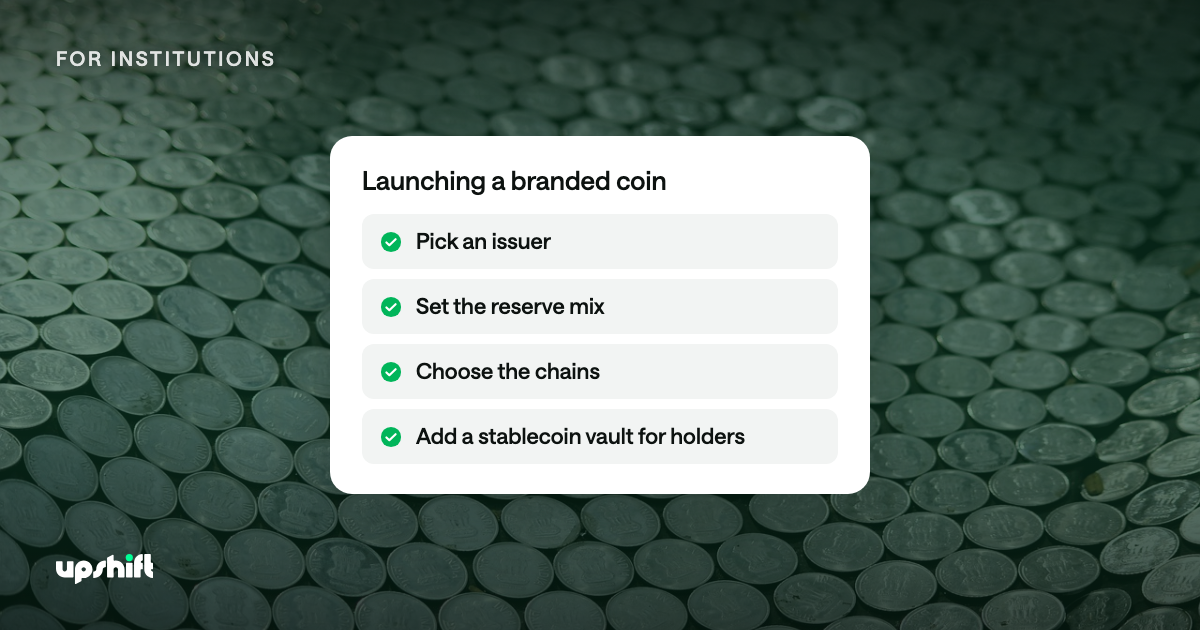
Pick an issuer, a reserve mix and the chains, then sign the commercial terms. Bridge quotes "a few days" for the token itself. None of the eight platforms publishes a price; the cost is mostly the share of reserve income the issuer keeps, plus market making and liquidity if the coin has to trade outside the brand's own app.
Best stablecoin issuance platforms compared (Paxos, Bridge, Brale, Agora)
Paxos issues as the legal issuer under an OCC trust charter, Bridge lets the business configure its own coin with BlackRock, Fidelity and Superstate on reserves, Brale bundles issuance with on/off-ramps across 27+ chains, and Agora launches branded coins on AUSD with VanEck and State Street behind the reserves.
White-label stablecoin vs USDC: which should a fintech use?
USDC suits settlement and payments, where liquidity matters most. A white-label coin pays off when the fintech holds large, stable customer balances and wants a share of the reserve income, accepting the work of building liquidity for a new ticker.
How can a blockchain launch a native stablecoin backed by USDC reserves?
Coinbase's Custom Stablecoins platform issues branded coins backed 1:1 by USDC and other dollar stablecoins, and Ethena's platform accepts other stablecoins as backing. Chains that want T-bill reserves instead have used Bridge (Sui's USDsui, Hyperliquid's USDH) or Agora (AUSD on Monad), and often pair the launch with an anchor vault such as earnAUSD on Monad.
Who earns the interest on a branded stablecoin's reserves?
The issuer and the brand, split by contract. The GENIUS Act bars a US permitted issuer from paying interest to holders. Holders who want a return deposit the coin into a lending market or a stablecoin vault.
Launch a vault with Upshift
Upshift builds custom, permissioned vaults for custodians, exchanges, neobanks and asset managers. Tell us what you are building and the team will follow up.
Create a vault with Upshift
Share your use case and we’ll get back to you shortly