DeFi risk management: stablecoin vault controls compared

Stablecoin vault providers write their risk controls into the vault contracts. Seven publish theirs, from deposit caps and timelocks to who can pause a vault.
Imagine a treasury lead at a neobank with $50M of customer USDC, at 6pm on a Thursday, with a vendor committee at 9am that wants to know which keys can move that money. For a stablecoin vault, DeFi risk management sits in the contracts: allow-lists, caps, timelocks, multisigs, a pause and share-price checks. Upshift, Morpho, Aera, Lagoon, Mellow, Veda and IPOR Fusion publish theirs. Monitoring tools such as Hypernative and Chainalysis Hexagate run outside the vault.
Each provider's own documentation, read on 4 October 2026, is the source for every cell in the table. "Not listed" means the docs didn't describe the control that day; the contracts may still support it.
Which vault platforms have built-in risk controls?
Provider | Limits on where the money goes | Who can change the vault | Who can deposit | Emergency stop | Share price checks |
Upshift | Policy engine by chain, protocol, token and contract function (curators on Upshift prime accounts) | Owner Gnosis Safe; parameter timelock set per vault; code upgrades signed by a 4 of 6 ProxyAdmin multisig | Allow-listed and sole-depositor vaults; deposit caps | Owner pauses deposits and withdrawals separately | Limit on share price change per update; Upshift validates the curator's NAV |
Morpho Vault V2 | Absolute and relative caps per market or collateral, set by the curator | Curator changes that add risk wait 0 to 3 weeks; vault contracts immutable | Optional gates on deposits, withdrawals and share transfers | Sentinel revokes pending changes, cuts caps and moves funds to idle | Allocator sets a maximum rate of share price growth |
Aera V3 | Merkle tree of allowed operations per guardian, plus hooks on slippage, protocols and assets | Owner; vault contracts immutable, modules upgradable | Not listed | Owner or guardian pauses | Price must be fresh and inside tolerance bounds, or the update reverts or pauses the vault |
Lagoon | Strategy assets sit with the curator's address (a Safe with a roles module, or MPC) | Vault Admin; fee changes follow cooldown rules where configured | Whitelist or blacklist mode, optional sanctions list | Vault Admin pauses | Security Council sets annual rate bounds on price per share |
Mellow Core Vaults | Verifier per subvault checks calls against an allowlist or Merkle proofs; RiskManager limits | Role-based access; timelock not listed | Not listed | Not listed | Price reports past a deviation limit revert; suspicious ones wait for approval |
Veda BoringVault | Manager checks every strategy call against a Merkle proof | Core vault non-proxy; modules upgradable | Teller deny lists and transfer hooks; deposit cap in source code | Teller pause; Accountant pauses on out-of-bounds rates | Exchange rate bounds and a minimum update delay |
IPOR Fusion | Fuses whitelisted by the IPOR DAO; substrates limit assets and markets | Execution delays per role (docs recommend 14 days for Owner, 3 for Atomist) | Whitelist role | Guardian closes contracts at once | Not listed |
Where do the risk controls sit on a stablecoin vault?
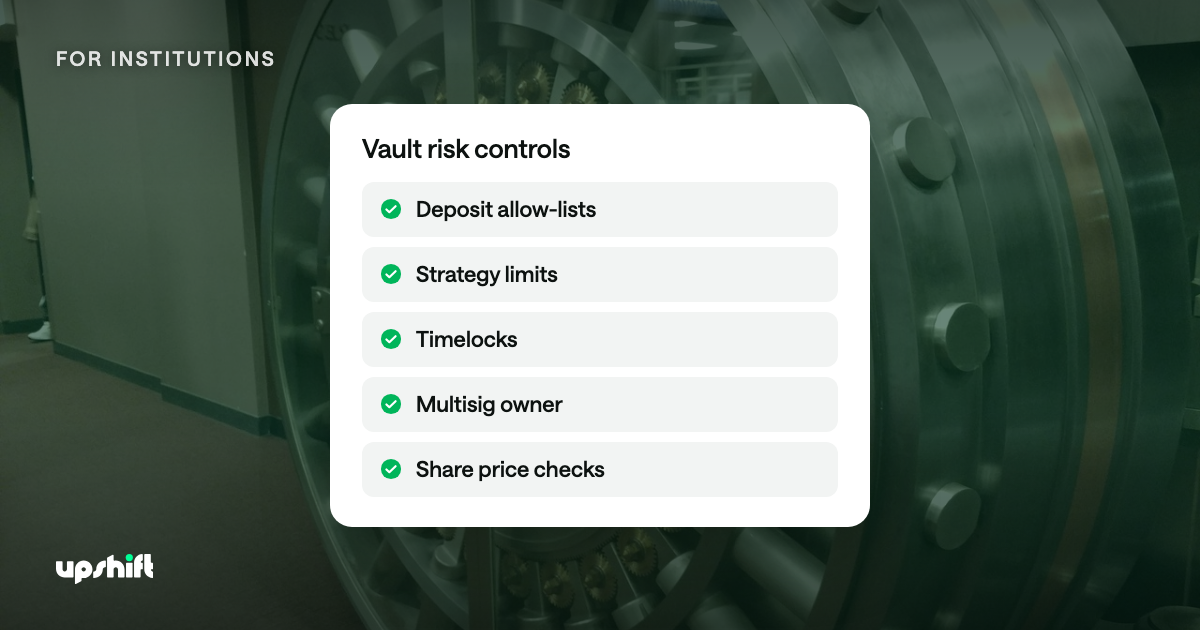
An allow-list sets which wallets can deposit, and a cap limits how much. Inside the vault contract sit the timelock, the pause, the share price check and the redemption queue. Around the strategy, a policy engine or an onchain verifier limits which protocols, tokens and contract functions the curator can touch. Above the vault, multisigs sign changes, while monitoring tools outside the vault watch every transaction and can trigger a pause.
Where each control sits: deposit limits, the vault contract and the strategy limits, with signers above and monitoring outside.
Most vaults follow the ERC-4626 tokenized vault standard for deposits and shares, and Lagoon uses its asynchronous extension, ERC-7540, where deposits and redemptions settle in batches. Neither standard sets any risk control. Who does what in an onchain vault maps the owner, curator and operator roles that hold these keys.
Which controls limit where a curator can send the money?
A curator, typically a hedge fund or asset manager, runs the strategy inside limits written into the contracts. Providers use one of two designs: a list of allowed calls checked onchain, or caps on how much can sit in each market.
- Upshift: curators who run through Upshift prime accounts act inside a policy engine that restricts each vault by chain, protocol, token and contract function. The same account reaches onchain protocols and centralized venues. The Upshift risk management framework also keeps funds moving only between the vault and whitelisted strategy contracts.
- Morpho Vault V2: the curator sets absolute and relative caps on risk ids, such as one collateral token or one market's collateral, oracle and loan-to-value setting. Cap cuts take effect at once.
- Aera V3: each guardian gets a Merkle root of allowed operations, and hooks can limit per-trade and daily slippage. A guardian can't withdraw funds or change its own permissions, according to Aera's guardian docs.
- Mellow Core Vaults: a Verifier on each subvault accepts a call only if it matches an onchain allowlist, a Merkle proof or a custom check.
- Veda: the BoringVault Manager checks every strategy call against a Merkle leaf that names the target, the function and the allowed arguments, per Veda's core components page.
- IPOR Fusion: strategies run through fuses, stateless adapters drawn from a whitelist the IPOR DAO keeps.
Lagoon takes a third route. The vault sends strategy assets to the curator's address at settlement, and that address can be a Safe with a roles module or an MPC wallet, according to Lagoon's contract reference. The limits then live in whatever wallet the curator picks.
A Morpho vault mainly lends into Morpho markets. Its risk sits in each market's collateral, oracle and loan-to-value setting, and caps per market cover most of it. An Upshift vault can also hold tokenized funds, lend on several protocols, run fixed-rate or basis positions and, on an Upshift prime account, reach centralized venues. A cap per market can't describe that mix of assets. Upshift checks each curator transaction against a policy engine on prime accounts and validates the curator's net asset value before it reaches depositors.
Who can change a vault, and how long does a change take?
Vaults have two kinds of change: parameter changes (fees, caps, who can deposit) and code changes. On Upshift, each vault's owner is a Gnosis Safe multisig, and it sets fee levels, caps and the limit on share price moves. Parameter changes wait out a timelock whose length is set per vault, which gives depositors time to exit. Management fee changes wait out the timelock, while performance, withdrawal and instant-redemption fee changes take effect without one. Code changes go through a proxy upgrade, which skips the timelock and needs 4 of 6 signatures on a ProxyAdmin multisig, two each from the asset issuer, Upshift and the curator. The owner also appoints the operator that runs daily jobs.
Morpho Vault V2 timelocks each curator function on its own, from zero to three weeks. Adding an adapter, raising a cap, changing fees and changing gates all wait, and a curator can call abdicate to switch off a timelocked action for good, per Morpho's roles docs.
IPOR Fusion runs on OpenZeppelin's AccessManager with a delay per role, and its timelock guide recommends 14 days for the Owner and 3 for the Atomist. Aera and Morpho keep the vault contracts immutable (Aera's modules can still be upgraded).
The Safe smart account sits behind most of these owner keys, and OpenZeppelin's TimelockController is the common building block for delays. MPC vs multisig compares the two signing setups.
What happens when something breaks?
Most providers in the table can pause a vault. On most Upshift vaults only the owner, a Gnosis Safe multisig, can pause, and deposits and withdrawals pause separately. The owner can also call emergencyWithdraw, which moves assets held in the vault contract to an address the owner names; it doesn't reach funds deployed in a strategy subaccount.
- Morpho Vault V2: a sentinel can revoke pending changes, cut caps and pull funds back to idle, and any depositor can call
forceDeallocateto exit in kind for a penalty of up to 2%. - Aera V3: the owner or a guardian can pause.
- Lagoon: the Vault Admin pauses the vault, and the curator can cap total assets.
- IPOR Fusion: a guardian with no delay closes a target contract at once, which freezes deposits and withdrawals, per its pause docs.
At Upshift, automated jobs such as fee charges and share price updates sign through Fireblocks MPC wallets, Fordefi is used where an outside party co-signs, and the admin portal simulates each transaction before a second person approves it (a maker-checker flow). How onchain yield vaults are secured goes through each layer.
How do vaults check the share price and pay withdrawals?
Upshift validates each curator's net asset value (NAV) before it reaches depositors, and every vault carries a maximum percentage change that caps how far the share price can move in one update.
Lagoon's Security Council sets upper and lower annual rate bounds and rejects a price outside them. Mellow reverts a price report past its maximum deviation and holds a merely suspicious one until a second role accepts it, per its oracle docs. Veda's Accountant pauses when the exchange rate moves outside its bounds, according to the BoringVault repository.
Every Upshift vault processes redemptions daily, each with its own lag, and most offer instant redemption for a fee, paid from a liquidity buffer and subject to the liquidity on hand. Mellow batches redemptions in a queue where requests can't be cancelled, Veda's BoringQueue pays after a maturity period, and Lagoon settles requests in batches under ERC-7540.
Which DeFi risk management tools sit outside the vault?
Monitoring and risk firms sell to the team running the vault and never hold deposits. Hypernative runs onchain monitoring with automated response and a transaction guard, and lists 75+ chains and 350+ customers on its site. Chainalysis Hexagate watches for exploits, key compromises and governance attacks, and simulates transactions before signing. Gauntlet curates vaults with model-driven risk management and offers Aera's contracts to clients. An alert from any of them still needs a key holder or an automated role inside the vault to pause it.
The Bank for International Settlements' 2021 review of DeFi risks named concentrated governance and admin keys among them.
How does Upshift set up controls for an institutional vault?
Partners usually start with a conservative stablecoin vault holding 24/7 tokenized money market funds, then add Core or Enhanced vaults on the same SDK integration. A partner can pick a whitelisted or sole-depositor vault, set deposit caps and choose the timelock length, and the curator runs the strategy inside the policy engine.
Upshift runs 50+ vaults on 30+ chains, including Solana and Stellar, for 66,000+ users, with $550M+ in peak deposits. The contracts have been through 11 smart contract audits by 6 independent firms. Vault provider due diligence lists the questions fintechs send, and how to tier vault strategies by risk covers offering more than one band.
Vault yields vary and aren't guaranteed. Vaults carry smart contract, strategy and counterparty risk, and there's no deposit insurance.
Always make sure to do your own research and be aware of the above and any other risks before depositing.
Running DD on a stablecoin vault provider? Tell us which balances you hold and what your committee asks for, and we'll walk through the controls on a live vault.
Frequently asked questions
What are the best institutional risk control platforms for DeFi vaults?
Upshift, Morpho Vault V2, Aera, Lagoon, Mellow, Veda and IPOR Fusion all write risk controls into their vault contracts. Upshift adds a policy engine and CeFi reach for curators on its prime accounts, and Morpho's controls center on caps and timelocks for lending vaults.
What are the top DeFi risk management providers?
Vault providers such as Upshift and Morpho build the controls into the contracts, while Hypernative, Chainalysis Hexagate and Gauntlet sell monitoring, transaction screening and curation to the teams running those vaults.
What are the top risk management tools for stablecoin yield vaults?
The working tools are deposit allow-lists, deposit caps, a timelock on parameter changes, a multisig owner, a pause, a limit on share price moves and a redemption buffer. A Safe multisig and an MPC wallet from Fireblocks or Fordefi hold most of the keys.
Which DeFi risk control solutions support multi-chain?
Upshift runs vaults on 30+ chains, including about $30M on Stellar and about $9M on Solana (Upshift API, 4 October 2026). Hypernative lists 75+ chains for monitoring, and Chainalysis Hexagate covers exchanges, protocols and chains.
Who are the best providers for compliance and risk controls in decentralized finance yield products?
For deciding who can hold a vault, Upshift offers whitelisted and sole-depositor vaults, Lagoon offers whitelist or blacklist modes with an optional sanctions list, and Morpho Vault V2 has gates on deposits, withdrawals and transfers. Each list is enforced by the vault contract, which rejects a deposit from a wallet that isn't on it.
What should an exchange look for in smart contract security, audits and operational risk controls?
An exchange's DD usually asks for the audit list with dates and firms, who signs code upgrades and whether they wait out a delay, which fees can change without a timelock, how the share price is validated and how signing keys are held. DeFi insurance covers losses from exploits that an audit missed.
Keep reading
- How traditional asset managers are controlling risk in DeFi. The policy engine in more depth.
- Upshift, Mellow and Lagoon compared. Three vault platforms curators use.
- What is Morpho. How Morpho's lending markets and vaults work.
- Institutional DeFi. Live examples of banks and asset managers onchain, with sizes.
Launch a vault with Upshift
Upshift builds custom, permissioned vaults for custodians, exchanges, neobanks and asset managers. Tell us what you are building and the team will follow up.
Create a vault with Upshift
Share your use case and we’ll get back to you shortly