
What is Pump.fun? How the memecoin launchpad works

Pump.fun lets anyone launch a token on Solana for free, prices it on a bonding curve, and moves the few that take off to its own exchange, a model that has earned it more than $1.3 billion in revenue.
Pump.fun is a token launchpad on Solana. Anyone can create a coin in a few clicks at no cost, and it trades immediately on an automated price curve with no order book. Since launching in January 2024 it has become the largest memecoin factory in crypto, with more than 7 million tokens created by May 2025 and $1.31 billion in cumulative revenue by September 2026, according to DefiLlama.
How Pump.fun works
- Launch: a creator names a coin and uploads an image. Creating it is free.
- Bonding curve: the coin trades on a curve where the price rises as people buy and falls as they sell, set by a formula instead of market makers.
- Graduation: if buying pushes the coin past a set market cap, the curve closes and its liquidity moves automatically into a permanent pool on PumpSwap, Pump.fun's own exchange, launched in March 2025.
Most coins never get that far. Between roughly 1% and 3% of new launches graduate, depending on market conditions (Cryptopolitan, citing Dune data).
How Pump.fun makes money
- Bonding-curve trades: a 1.25% fee, of which 0.95% goes to the protocol and 0.30% to the coin's creator
- Graduation: a flat 0.015 SOL
- PumpSwap trades: fees starting at 1.25% and tapering to 0.30% as a coin's market cap grows
Revenue was $321 million in 2024 and $653 million in 2025, per DefiLlama. It was lower in 2026, at $340 million by 22 September, though August 2026 came in 28% above August 2025. The protocol has spent $364 million buying back its own PUMP token.
The PUMP token
Pump.fun sold its PUMP token in July 2025, raising more than $500 million in its public sale, which sold out in 12 minutes (CoinDesk). The protocol uses part of its revenue to buy PUMP on the market.
fomo vs Pump.fun
The two compete and connect at the same time. Both want the same retail memecoin trader: Pump.fun runs its own mobile app and, since buying the Padre trading terminal in October 2025, a trading terminal (Crypto Briefing). fomo is a trading app first, and it lists coins launched on Pump.fun, including ones still on the bonding curve, so the two also feed each other. Our fomo explainer covers the other side in full.
fomo | Pump.fun | |
What it is | Social trading app | Token launchpad, exchange (PumpSwap), app and trading terminal |
Launched | May 2025 | January 2024 |
Launches tokens | No | Yes, anyone can create one for free |
Trading fee | About 0.5% per trade | 1.25% on the bonding curve, lower on PumpSwap |
Custody | Embedded self-custody wallet (Privy) | Your own wallet on the web; the app creates one at sign-up |
Chains | Solana, Base, BNB Chain | Solana, with the terminal covering other chains |
Revenue, 30 days to 22 Sep 2026 | $31.7 million | $51.0 million |
Revenue from DefiLlama. Pump.fun's figure combines its bonding curve, PumpSwap and terminal. fomo's is rising faster: $14.6 million in August 2026 and $25.3 million in the first 22 days of September.
How memecoin trading has grown and shifted
- The 2024 boom: memecoins passed $130 billion in total market value in late 2024. CoinGecko's meme category stood at about $35 billion on 23 September 2026.
- The TRUMP token, January 2025: it passed $13 billion in market value within two days of launch and pushed Solana DEX volume to daily records (Helius).
- The launchpad war, 2025: in July 2025 rival launchpad LetsBonk briefly overtook Pump.fun, with more than 18,000 tokens a day against Pump.fun's 9,535 (Crypto Times). Pump.fun won the share back, and over the 30 days to 22 September 2026 it earned about ten times Bonk.fun's revenue.
- A smaller share of Solana trading: memecoins made up more than 60% of Solana DEX volume in late 2024 and early 2025. By June 2026 they were down to 12%, when tokenised stocks overtook them (Solana Compass), before rebounding to 29% in late July 2026.
- From launchpads to apps: growth has moved towards consumer trading apps like fomo, which make buying a memecoin feel like using a stock app, with card payments and a social feed.
Where Pump.fun fits: onchain is going barbell-shaped
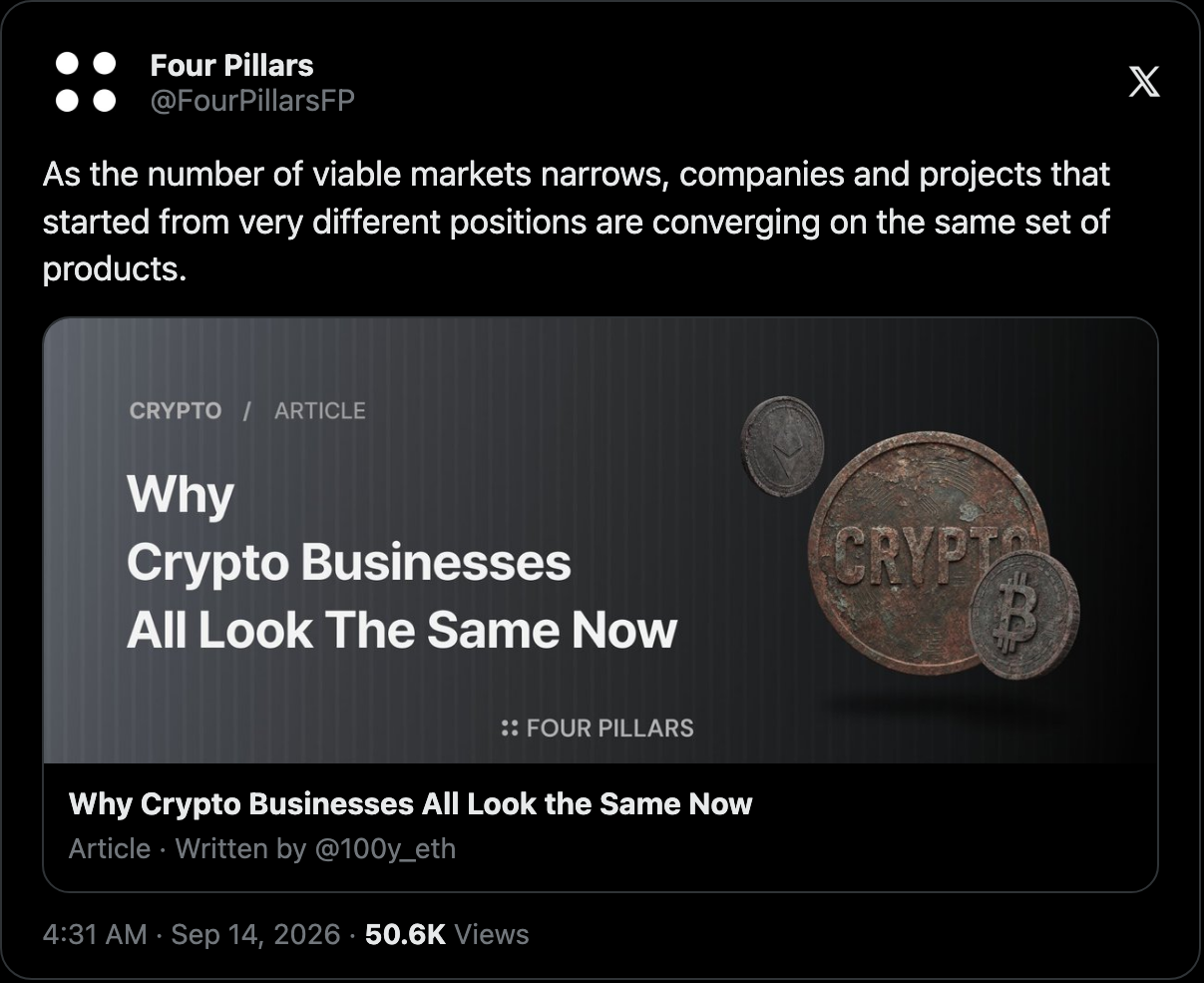
Research firm Four Pillars describes the crypto market as a barbell in its report Why Crypto Businesses All Look the Same Now. Its chart, with data as of 19 August 2026, shows growth at both ends and decline in the middle:
- Speculative apps: Pump.fun graduations up 313% year on year and revenue up 25%, alongside social trading app fomo and prediction markets
- Onchain-native activity: DEX spot volume down 66% and liquid staking deposits down 56%
- TradFi-linked assets: tokenised stocks, private credit and Treasuries up, and stablecoin card payments up 147%
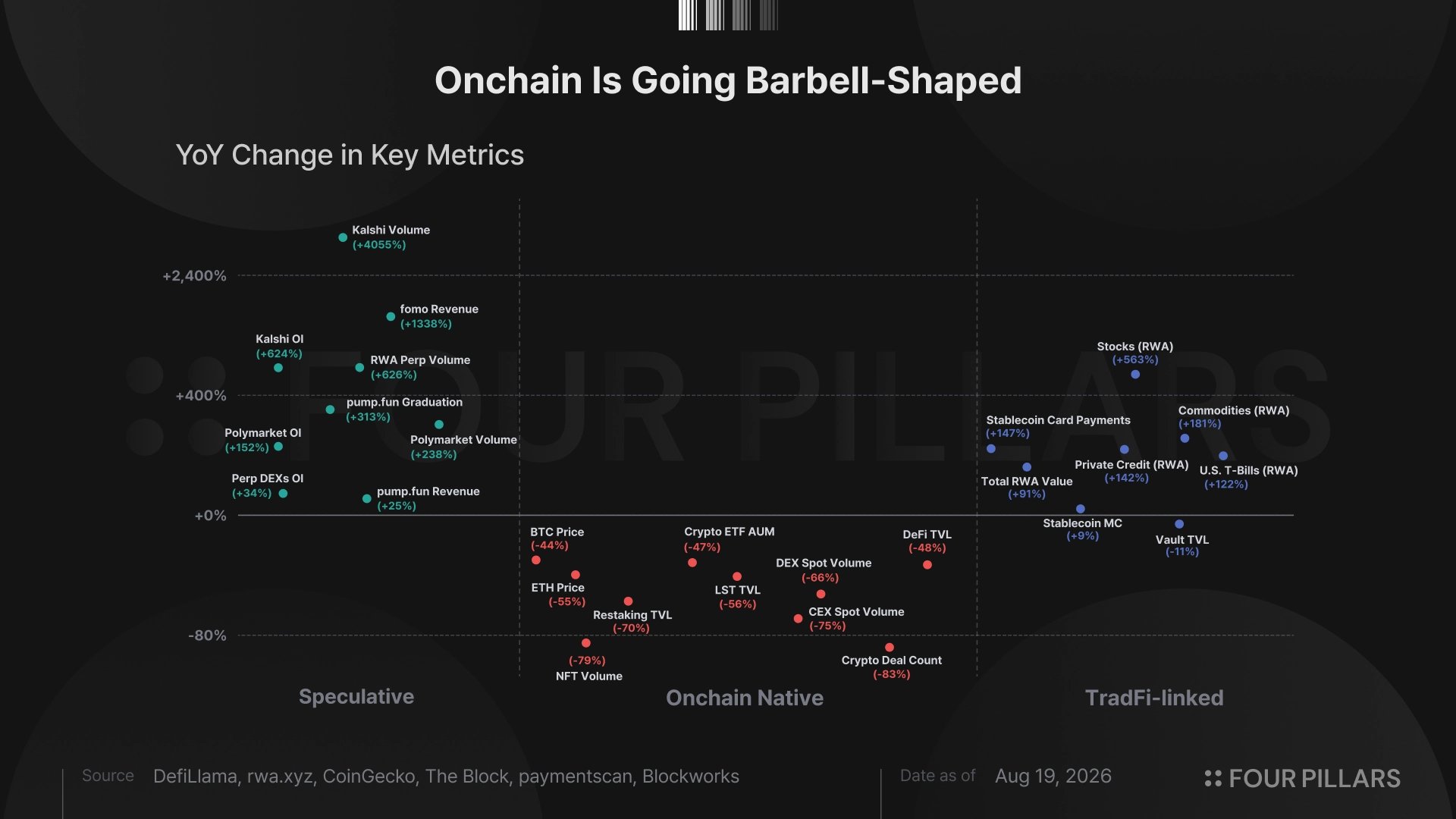
Pump.fun sits at the speculative end. At the other end, the same report notes that curated vault deposits sat only 4% below their all-time high on 28 August, while bitcoin was 35% below its own. Stablecoins and tokenised real-world assets are growing there too, covered in our explainers on USDC vs USDT and RWA-backed stablecoins.
Risks
- Most tokens fail: a 2025 Solidus Labs report found 98.6% of more than 7 million Pump.fun tokens showed signs of rug pulls or pump-and-dump schemes, which Pump.fun disputed (CoinDesk)
- Creator dumping: creators and early holders can sell into later buyers, and the app shows holder distribution to help spot it
- Bots: automated traders buy new launches within seconds, ahead of most people
- Legal: a US class action alleging racketeering against Pump.fun's operator and founders is ongoing. In August 2026 a judge dismissed the securities claims and the claims against Solana Labs, and let some racketeering claims continue (Crypto Times)
- Access: Pump.fun blocked UK users in December 2024 after a warning from the Financial Conduct Authority
Memecoins are highly speculative, and most lose nearly all their value. Always make sure to do your own research and be aware of the above and any other risks before trading.
Frequently asked questions
What is Pump.fun used for?
Launching and trading memecoins on Solana. Anyone can create a token for free and it starts trading at once.
How does a Pump.fun token graduate?
When buying pushes its market cap past a threshold, the bonding curve closes and its liquidity moves into a permanent pool on PumpSwap.
What are the risks of using Pump.fun?
Most tokens fail or are dumped by early holders, bots front-run new launches, and prices swing sharply.
Is Pump.fun legal in the US?
It operates for US users, and it faces an ongoing class action. It blocked UK users after an FCA warning.
How much money has Pump.fun made?
About $1.31 billion in revenue by September 2026, according to DefiLlama.
What is the PUMP token?
Pump.fun's own token, sold in July 2025 for more than $500 million. The protocol buys it back with part of its revenue.
Keep reading
- How Solana vaults work. The other side of Solana DeFi: managed yield.
- USDC vs USDT in 2026. The stablecoins at the other end of the barbell.
- DeFi yield strategies. Where onchain returns come from, and the risks.
- Pump.fun on Wikipedia. History and background.
Create a vault with Upshift
Share your use case and we’ll get back to you shortly