
What is the fomo app? The social crypto trading app

fomo is a mobile app for buying memecoins and other tokens with Apple Pay and following other traders, and it grew its revenue more than 13-fold in a year.
The fomo app is a social crypto trading app from FOMO Labs, launched in May 2025. It lets people buy tokens, mostly memecoins, with Apple Pay or a card, see what other traders are buying, and get alerts when they trade. It's the fomo at fomo.family, not the Shopify app or the general term. By June 2026 it had more than 625,000 traders and $4 billion in trading volume (Cointelegraph).
How fomo works
- One account across chains: a single balance works on Solana, Base and BNB Chain, and fomo pays the network fees
- Buying: card, Apple Pay and Google Pay purchases run through Crossmint's checkout, so a first-time buyer doesn't need an exchange account
- Social feed: leaderboards show top traders, and you can follow them and get alerts when they buy or sell
- Copy trading: following a trader sends alerts, and you place each trade yourself. Trades aren't copied automatically (Datawallet)
- Perpetual futures: trading with borrowed funds through Hyperliquid, not available to US users
Who holds your funds
fomo uses an embedded self-custody wallet from Privy. You sign in with email or an Apple ID instead of a seed phrase, and the key to the wallet is split so fomo can't move funds on its own. Fortune reported that fomo "doesn't handle customers' money" (Fortune).
How fomo makes money
fomo charges a fee on each trade, about 0.5% on spot trades, with a small builder fee on perpetual futures (Datawallet). DefiLlama tracked $31.7 million of fomo revenue in the 30 days to 22 September 2026, and $15.2 million in August 2026 against about $1 million a year earlier. DefiLlama only tracks part of the app, so the true figures are higher.
Funding and backers
- Founders: Paul Erlanger, Se Yong Park and Prashan Dharmasena, who previously worked at dYdX
- Series A: $17 million led by Benchmark in 2025
- Series B: $75 million at a $550 million valuation in June 2026, led by Index Ventures with Union Square Ventures and Benchmark (Fortune)
fomo vs Pump.fun
The two compete and connect at the same time. Both want the same retail memecoin trader: Pump.fun runs its own mobile app and, since buying the Padre trading terminal in October 2025, a trading terminal (Crypto Briefing). fomo is a trading app first, and it lists coins launched on Pump.fun, including ones still on the bonding curve, so the two also feed each other. Our Pump.fun explainer covers the other side in full.
fomo | Pump.fun | |
What it is | Social trading app | Token launchpad, exchange (PumpSwap), app and trading terminal |
Launched | May 2025 | January 2024 |
Launches tokens | No | Yes, anyone can create one for free |
Trading fee | About 0.5% per trade | 1.25% on the bonding curve, lower on PumpSwap |
Custody | Embedded self-custody wallet (Privy) | Your own wallet on the web; the app creates one at sign-up |
Chains | Solana, Base, BNB Chain | Solana, with the terminal covering other chains |
Revenue, 30 days to 22 Sep 2026 | $31.7 million | $51.0 million |
Revenue from DefiLlama. Pump.fun's figure combines its bonding curve, PumpSwap and terminal. fomo's is rising faster: $14.6 million in August 2026 and $25.3 million in the first 22 days of September.
How memecoin trading has grown and shifted
- The 2024 boom: memecoins passed $130 billion in total market value in late 2024. CoinGecko's meme category stood at about $35 billion on 23 September 2026.
- The TRUMP token, January 2025: it passed $13 billion in market value within two days of launch and pushed Solana DEX volume to daily records (Helius).
- The launchpad war, 2025: in July 2025 rival launchpad LetsBonk briefly overtook Pump.fun, with more than 18,000 tokens a day against Pump.fun's 9,535 (Crypto Times). Pump.fun won the share back, and over the 30 days to 22 September 2026 it earned about ten times Bonk.fun's revenue.
- A smaller share of Solana trading: memecoins made up more than 60% of Solana DEX volume in late 2024 and early 2025. By June 2026 they were down to 12%, when tokenised stocks overtook them (Solana Compass), before rebounding to 29% in late July 2026.
- From launchpads to apps: growth has moved towards consumer trading apps like fomo, which make buying a memecoin feel like using a stock app, with card payments and a social feed.
Where fomo fits: onchain is going barbell-shaped
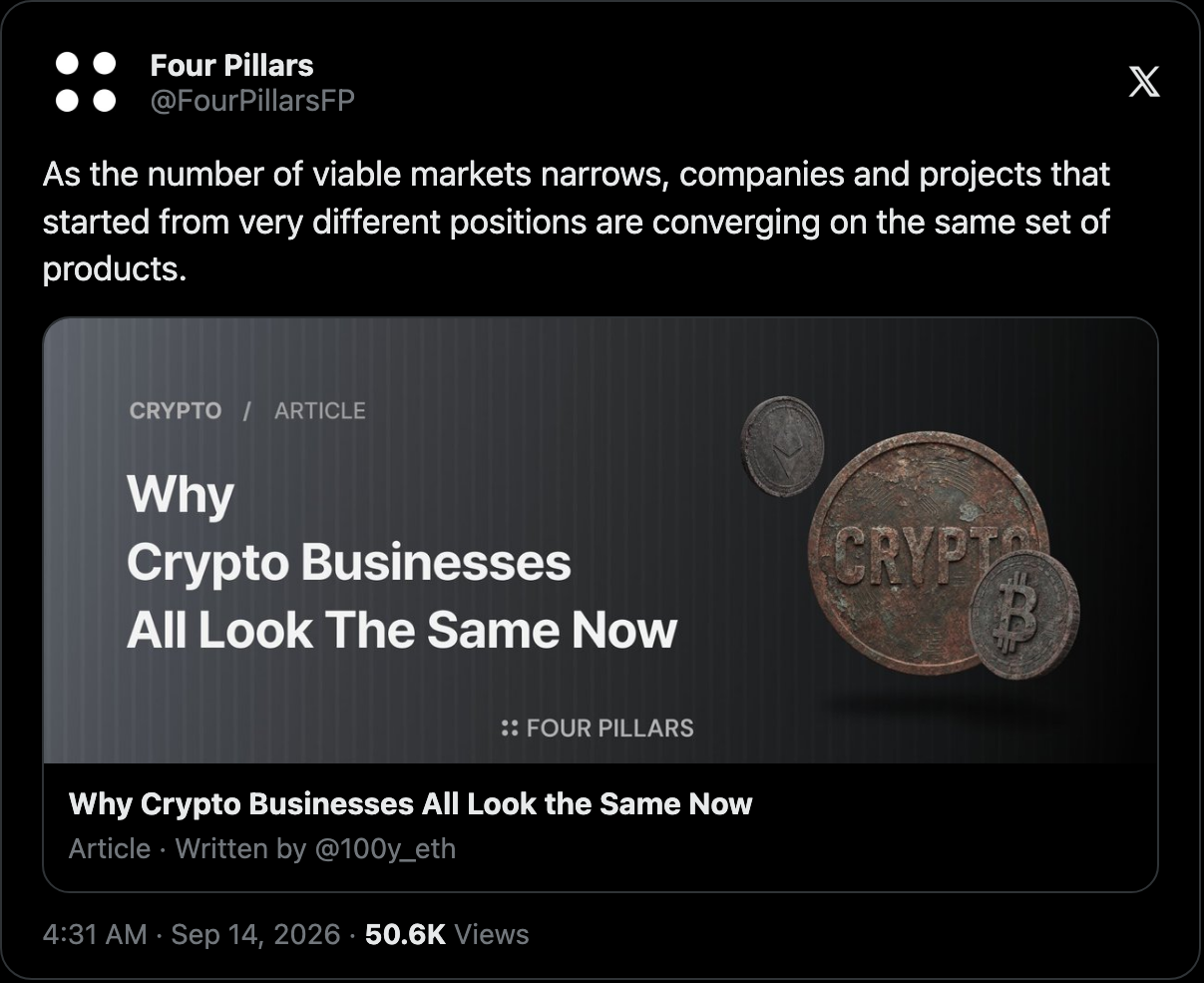
Research firm Four Pillars uses fomo as an example of a split in crypto in its report Why Crypto Businesses All Look the Same Now. Its chart, with data as of 19 August 2026, puts fomo's revenue up 1,338% year on year, the fastest-growing speculative app after prediction market Kalshi. The report credits fomo's growth to a simple interface, faster memecoin discovery, a social feed and Apple Pay.
- Speculative apps grew: fomo, Pump.fun and prediction markets
- Onchain-native activity shrank: DEX spot volume down 66% and liquid staking deposits down 56%
- TradFi-linked assets grew: tokenised stocks, private credit, Treasuries and stablecoin card payments
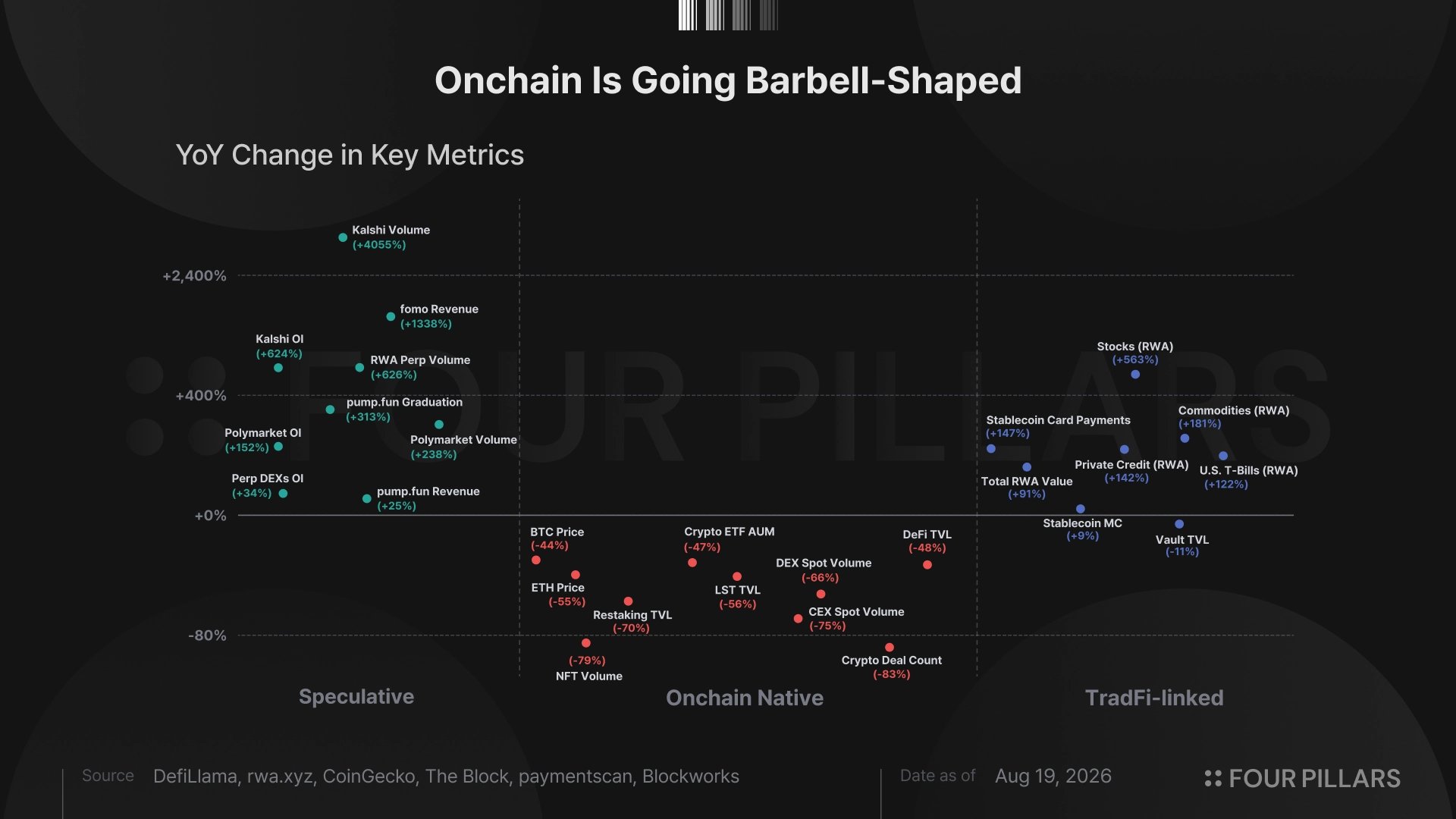
The same report notes that curated vault deposits sat only 4% below their all-time high on 28 August, while bitcoin was 35% below its own. Our Pump.fun explainer covers the other big speculative app, and our USDC vs USDT guide covers the stablecoins at the other end.
Risks
- Memecoin volatility: most memecoins lose nearly all their value, and prices can fall faster than you can sell
- Following traders: a leaderboard shows past results, and a trader you follow can lose money as easily as make it
- Perpetual futures: positions opened with borrowed funds can be liquidated quickly
- No recovery: it's a self-custody app, so there's no deposit protection and mistaken trades can't be reversed
- Phishing: fake sites copying fomo.family have been used to drain wallets (PCrisk). Download it only from the official app stores
Always make sure to do your own research and be aware of the above and any other risks before trading.
Frequently asked questions
Is the fomo app a real thing?
Yes. It's made by FOMO Labs, listed on the App Store and Google Play, and backed by Benchmark, Index Ventures and Union Square Ventures.
Can you make real money on the fomo app?
Some users make money and many lose it, as with any memecoin trading. Past results on the leaderboard don't predict future ones.
What is the fomo app used for?
Buying and selling tokens, mostly memecoins, following other traders, and, outside the US, trading perpetual futures.
Does the fomo app cost money?
The app is free to download. Trades carry a fee of about 0.5%, and fomo covers the network fees.
Is fomo custodial?
No. It uses a self-custody wallet from Privy, and fomo can't move users' funds on its own.
Which chains does fomo support?
Solana, Base and BNB Chain for spot trading, with perpetual futures through Hyperliquid.
Keep reading
- What is Pump.fun? How the Solana memecoin launchpad works.
- How Solana vaults work. Managed yield on Solana.
- Where USDC yield comes from. The low-volatility end of onchain.
- DeFi yield strategies. Where onchain returns come from, and the risks.
Create a vault with Upshift
Share your use case and we’ll get back to you shortly