What Upshift does and doesn't do

For teams shortlisting vault infrastructure. Upshift covers part of the stack, and you appoint the rest.
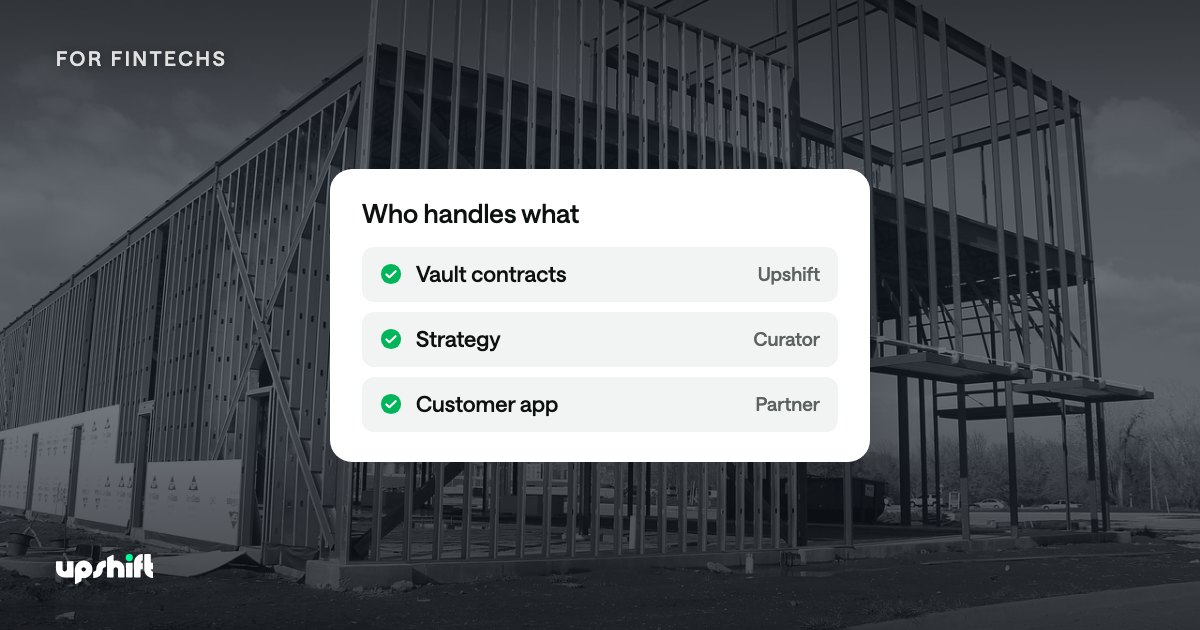
Upshift helps fintechs build and offer savings products that earn yield on stablecoins. You get vault contracts, risk controls, NAV accounting, fee logic and withdrawal processing without building any of it. Upshift doesn't hold your customers' assets or pick the strategy day to day. Your custodian, fund administrator and compliance function stay where they are.
Most vendor comparisons in this category are written by the vendor, and everything scores well. That's not much use when you're building a shortlist. The tables below mark where Upshift fits badly as clearly as where it fits well. Better to find the gap now than halfway through legal review. Figures are current as of 29 September 2026.
What is Upshift built to do?
Upshift runs five vault products, all on the same contracts and the same policy engine. What separates them is where the yield comes from and who the depositor is.
Product line | What it does | Typical user |
A curator allocates across whitelisted DeFi protocols under a mandate you approve | Exchanges, wallets and neobanks adding an earn product | |
Loans to institutional borrowers, with the policy engine enforcing limits onchain | Treasuries and allocators wanting credit exposure with onchain controls | |
Card and settlement float earns in the vault until it settles at the point of sale | Card programmes, payment companies, settlement corridors | |
RWA and credit vaults | Private credit, warehouse lending, index rebalancing and insurance underwriting | Asset issuers, funds, insurance underwriters |
Instant USDC exit for tokenised assets that normally settle on an issuer calendar, priced off a live oracle | RWA holders needing faster exit, plus LPs funding the redemption pool |
Vault-as-a-Service is the wrapper around all of it. Any of the products above can launch as a vault under your own brand and front end, scoped in weeks. A fintech that wants a custom DeFi yield vault gets it that way.
The contracts underneath are ERC-4626, the Ethereum standard for tokenised vaults. That buys you portability. Your position is a receipt token other protocols already know how to read. A custodian can hold it or a lending market can take it as collateral with no bespoke integration. The OpenZeppelin implementation notes are a reasonable primer if your engineers haven't worked with the standard before.
Deposits are stablecoins or crypto assets. If your product holds customer money in dollars today, something has to convert it first. That conversion sits outside the vault. USDC is the most common deposit asset across our vaults, though multi-asset vaults accept several deposit assets against a single reference asset for redemption.
What does Upshift deliberately not do?
This is the half of the map that usually gets left out. Each row below is a job that has to happen for a yield product to work, and that Upshift doesn't perform.
Job | Who owns it | Why it sits there |
Holding customer assets | Your custodian, or the depositor | Depositors stay self-custodied. A curator can only move funds between the protocols the vault whitelists, and only the owner multisig can withdraw vault-held assets elsewhere, in an emergency. Upshift does build custom vaults with qualified custodians like Kraken Institutional, where deposits arrive straight from custody. |
Choosing the strategy day to day | The curator | Curators like Sentora run the mandate. Upshift enforces its limits. |
Fund administration and audited financials | A fund administrator | Upshift works with Securitize Fund Services for this. |
Fiat rails and banking | Your bank or payments provider | Vaults take stablecoins and crypto assets. Fiat conversion happens before the vault. |
Smart contract insurance | A specialist underwriter | Upshift carries 11 audits by 6 firms, and no policy of its own. Cover gets written by an insurer we can introduce you to. |
Guaranteeing a return | No party | Yields move with the strategies underneath, and every vault can lose value. |
On insurance, Upshift has relationships with underwriters and can point LPs and curators to them. The insurer writes the cover itself. The audit reports are published in full on the smart contract audits page.
Who else do you need on the deal?
A live vault normally involves four or five parties. Knowing which ones you already have shortens the scoping conversation considerably.
Role | Usually | What they control |
Depositor | You, your customers, or your treasury | Whether capital goes in, and when it comes out |
Curator | A hedge fund or asset manager | Allocation inside the approved protocol set |
Upshift | Infrastructure provider | Contracts, policy engine, NAV, fees, withdrawal processing |
Custodian | Your existing provider | Holds the receipt token on your behalf and sits as a counterparty on every deal map |
Fund administrator | Appointed for regulated wrappers | Books, records and investor reporting |
The step teams miss is the custodian. Your custodian has to be willing to hold the vault's receipt token, and that approval takes longer than the technical integration in most cases. Start it in parallel with the integration. There's a fuller walk through the sequence in who does what in an onchain vault.
Does your use case actually fit?
The table marks fit against the use cases we're asked about most often.
Use case | Fit | Reasoning |
Stablecoin balances earning inside your app | Strong | The core case. Multi-chain, SDK integration, branded front end. |
Company treasury holding stablecoins | Strong | Whitelisted or sole-depositor vaults, with mandates set at the policy layer. |
Card or settlement float | Strong | Atomic vaults keep balances earning until they settle at the point of sale. |
A fund or mandate that needs an onchain wrapper | Strong | ERC-4626 wrapper with fund administration bolted on through a partner. |
A chain bootstrapping ecosystem liquidity | Strong | Anchor stablecoin vaults routing into the chain's own protocols. |
Tokenised assets that need faster exit | Partial | Upshift Clear handles redemption timing. The underlying asset still has to be eligible. |
Managing fiat cash | Not a fit | You need a bank or a money market fund. Vaults take stablecoins and crypto. |
Custody of customer assets | Not a fit | Sits alongside Upshift. Appoint a custodian. |
What controls sit on the money?
Capital routes into segregated subaccounts that the curator manages. Every transaction gets checked against Upshift's policy engine before it executes. The engine enforces restrictions at four levels:
- Chain. Which networks the mandate can touch at all.
- Protocol. Which venues are approved, keeping a curator out of unvetted ones.
- Token. Which assets can be held or swapped.
- Function. Which specific contract calls are permitted, which is finer-grained than most allowlists go.
A curator who tries to interact with something outside that set has the transaction rejected onchain before it executes. The risk management framework documents how the restrictions are set and changed. For how the underlying strategies behave, the strategy reference covers mechanics, risk and historical returns. Tiering strategies by risk sorts them the way most treasury teams do.
Policy enforcement covers curator behaviour. The audit programme covers bugs in the contracts themselves, and those bugs are why the general limits of smart contract security are worth understanding before you size a first allocation.
Separately, Upshift's prime stack can structure a credit facility against a vault. As of July 2026 it serves over $7B in monthly transaction volume and more than $800M in loans originated. That facility, paired with the vault contract, is what makes settlement financing and card float work.
Always make sure to do your own research and be aware of the above and any other risks before depositing.
How do redemptions work?
Every Upshift vault processes claimable redemptions daily. Each vault carries its own lag, set by how long the underlying strategy needs to unwind a position. Most vaults also offer instant redemption for a fee, subject to available liquidity in the buffer.
In practice a request placed on a Friday afternoon runs on that day's cycle. If you need the money sooner, the instant path exists and costs a fee. Ask for the lag on the specific vault during scoping. The number varies by strategy.
This is one of the sharper differences between a vault and a fund wrapper. A tokenised money market fund typically settles on the issuer's calendar, which puts the exit window in the issuer's hands. Redemption timing is worth writing into your own product spec before you pick a structure.
How big is Upshift, and does that matter?
Scale matters here mainly as evidence that the operational machinery has been exercised. Upshift has taken in over $550M in deposits at peak, and as of September 2026 it runs 50+ vaults on 30+ chains for more than 66,000 users. Current deposits for each vault are shown on the Upshift app. The contracts have been through 11 audits by 6 independent firms, and Upshift raised a $10M Series A led by Dragonfly in March 2025.
Treat public aggregator figures for any vault provider with care. Third-party trackers cover a subset of chains and tend to understate multi-chain deployments by a wide margin. If a number matters to your committee, ask the provider for it and ask which vaults it includes.
Where does this sit against the regulatory picture?
Upshift supplies infrastructure. The regulated product, and the perimeter question that comes with it, sits with you or with the partner you appoint. What that means in practice varies by market. In the EU, firms distributing to retail generally work through a licensed asset-management entity, and the MiCA framework sets the baseline. In the US, consumer-facing distribution usually runs through a broker-dealer partner.
The wider direction of travel is well documented by the standard setters. The Bank for International Settlements has published work on tokenisation and the future financial system that's a useful primer if your risk committee wants a source with no commercial interest in the answer. Bring your counsel in early, because the licensing question decides your distribution model.
Scoping a whitelisted or sole-depositor vault? The treasuries use case shows how Upshift deploys a vault with your wallets as the only depositor. The Upshift team can map which roles you appoint and which ones Upshift covers.
Frequently asked questions
Is Upshift custodial?
No. Depositors remain self-custodied throughout. Curators are limited to the whitelisted protocols, and only the owner multisig can withdraw vault-held assets elsewhere, in an emergency. Assets route to segregated subaccounts governed by the policy engine.
Can we run a vault only our own balance sheet can deposit into?
Yes. Whitelisted and sole-depositor vaults are a standard configuration, and the depositor list is a parameter change rather than a contract change.
Do we have to use a curator you choose?
No. You can select from curators already on the platform, bring your own, or curate the mandate yourself if you have the capability in house.
What happens if we want to replace the curator?
Curator replacement is handled at the vault parameter level. Agree the mechanism during contracting, because the answer depends on who controls the whitelist.
Does a vault deposit make us a securities buyer?
That's a question for your counsel, and the answer depends on your jurisdiction and the wrapper you use.
How long does a launch take?
Vault-as-a-Service deployments are scoped in weeks. The long pole is usually custodian approval and your own legal review.
Which chains are supported?
More than 30 as of September 2026, spanning major EVM networks plus Solana and Stellar. Check the current list during scoping, since new deployments are added regularly.
Keep reading
- What is Upshift: the plain-language introduction to the platform and the vault model.
- Who does what in an onchain vault: the end-to-end workflow, from capital to NAV to signatories.
- What an onchain vault is, for a treasury team: the same structure explained for a treasury audience.
- How to launch an onchain vault: mandate to live, including what to decide first.
- Upshift FAQ: custody, redemptions, fees, risk and integrations in detail.
Launch a vault with Upshift
Upshift builds custom, permissioned vaults for custodians, exchanges, neobanks and asset managers. Tell us what you are building and the team will follow up.
Create a vault with Upshift
Share your use case and we’ll get back to you shortly