Best treasury management software: 13 systems compared

Treasury management software now does two jobs: it shows a finance team where every dollar sits, and more and more it moves the spare dollars somewhere that pays, from money market funds to tokenized funds that can move at weekends.
At KyribaLive 2026, Kyriba added Circle's USDC for stablecoin settlement and J.P. Morgan's Morgan Money platform for money market funds, both inside its treasury software. The best treasury management software for your company depends on its size and where the spare cash should go. Kyriba, Ripple Treasury, SAP and Coupa lead the enterprise systems, Trovata, Embat, Agicap, Nilus and Statement cover the mid-market, and Rho, Mercury, Meow and Ramp combine a business account with a treasury sweep.
We checked every product against its own website, pricing page or a funding announcement on 3 October 2026, and we didn't test them. Systems are grouped by company size and aren't ranked. Upshift isn't on the list, because it doesn't sell treasury software.
Treasury management systems compared
Software | Best for | Cash visibility and forecasting | Where idle cash can go | Stablecoin or tokenized fund support | Published price |
Kyriba | Large multinationals | Yes, with AI agent layer (TAI) | J.P. Morgan money market funds through Morgan Money | USDC settlement with Circle | Not published |
Ripple Treasury (GTreasury) | Enterprises holding cash and digital assets | Yes | Overnight repo; tokenized money market funds | RLUSD payments; BlackRock BUIDL access | Not published |
SAP Treasury and Risk Management | Companies running SAP S/4HANA | Yes, inside the ERP | Through bank and fund connections | Not listed | Not published |
Coupa Treasury | Coupa spend-management customers | Yes | Through bank connections | Not listed | Not published |
Trovata | Mid-market, US | Yes | Investments module | Not listed | $24,000 a year (base) |
Embat | Mid-market, Europe | Yes | Not listed | Not listed | Not published |
Agicap | SMB and mid-market, Europe | Yes | Not listed | Not listed | Not published |
Nilus | Mid-market finance teams | Yes | Money market funds and term deposits | Not listed | Not published |
Statement (Tipalti) | Tipalti customers | Yes | Not listed | Not listed | Not published |
Rho Treasury | Startups from $50,000 | Basic | T-bills and money market funds, 3.21% to 3.96% net | Not listed | 0.15% to 0.60% a year |
Mercury Treasury | Startups from $250,000 | Basic | Government money market fund and ultra-short portfolio, 3.11% to 3.96% net | Not listed | 0.15% to 0.60% a year |
Meow | Startups from $100,000 | Basic | Commercial paper account at 3.73% to 3.97%; T-bills, UK gilts, Bunds | USDC and USDT payments, no yield on them | Not published |
Ramp Treasury | Ramp card and bill pay customers | Basic | 2% business account; managed investment account | Not listed | No account fees |
Rates are net of fees as published by Rho on 26 September 2026 and Mercury on 25 September 2026, and they move with short-term US rates. "Not listed" means the vendor's site didn't mention the feature when we checked.
What does treasury management software do?
Treasury management software pulls balances and transactions from every bank account a company holds and shows them in one place, usually updated daily or in real time. From there it builds a cash forecast, sends payments, reconciles them, and tracks investments, debt and currency exposure. Enterprise systems add hedging, bank fee analysis and intercompany loans. Mid-market tools focus on visibility and forecasting.
Think of it as air traffic control for cash. The software doesn't own the planes (the banks hold the money), though it knows where each one is, where it's due next and which ones are circling with nothing to do.
The circling cash is getting more attention. In the 2026 AFP Liquidity Survey, bank deposits fell to 42% of corporate short-term investments, the lowest share since 2011, as treasurers moved more into money market funds and Treasuries. Only 1% of the 309 organisations surveyed were piloting or using stablecoins.
Enterprise treasury management systems
Kyriba: best for large multinationals
Kyriba is a cloud treasury and liquidity platform used by large companies with many banks, entities and currencies. At KyribaLive 2026 it announced three additions. Circle's USDC is now built into Kyriba for cross-border stablecoin settlement, governed by its TAI AI layer with a full audit trail. J.P. Morgan's Morgan Money lets treasurers move idle cash into money market funds from inside Kyriba, and a "Stablecoin in Treasury" certificate built with the AFP launched in June 2026. Kyriba doesn't publish prices. It suits treasury teams at multinationals that want one system for payments, cash, risk and now stablecoins.
Ripple Treasury: best for enterprises holding cash and digital assets
Ripple bought GTreasury, a Chicago treasury software company, for $1 billion in October 2025 and launched Ripple Treasury in January 2026. The platform keeps GTreasury's cash and risk tools and adds RLUSD, Ripple's dollar stablecoin, for cross-border payments that settle in 3 to 5 seconds. It also connects treasurers to overnight repo and to tokenized money market funds such as BlackRock's BUIDL. It suits large companies that hold digital assets or want 24/7 settlement next to their bank cash.
SAP Treasury and Risk Management: best for companies running SAP
SAP's treasury module runs inside S/4HANA, with cash positions, payments and hedges in the same system as the general ledger. That removes a separate integration. It also means a long implementation, usually run by a systems integrator. Eco's 2026 treasury software guide estimates mid-market SAP treasury costs from about $100,000 to more than $250,000 a year. It suits companies that already run their finance on SAP.
Coupa Treasury: best for Coupa spend-management customers
Coupa bought BELLIN, a German treasury software company, in June 2020 and sells it as Coupa Treasury. Thoma Bravo took Coupa private for about $8 billion in February 2023. The treasury product covers cash visibility, payments, bank account management and forecasting. It's the natural pick for companies already running procurement and invoices on Coupa.
Mid-market cash management software
Trovata: best for US mid-market teams that want a published price
Trovata is the only treasury software vendor here that publishes a price for its core product. Its pricing page lists a base package at $24,000 a year, covering 1 bank connection, up to 100 accounts, 1 million transactions and 10 users. Forecasting, cash positioning, reconciliation, payments and an investments module are included, and more banks or users cost extra. It suits mid-market companies outgrowing spreadsheets.
Embat: best for European mid-market treasury
Embat is a Madrid treasury software company founded in 2021. It raised a €30 million Series B led by Cathay Innovation in May 2026, bringing total funding to €50 million, and says it serves more than 400 European companies. The software covers bank connectivity, cash positioning, payments, accounting and reconciliation. It fits European groups with several banks and entities.
Agicap: best for European SMBs that need cash forecasting
Agicap is a Lyon company that started with cash flow forecasting for smaller businesses and moved up to the mid-market. It raised a €45 million Series C led by AVP in November 2024 and serves about 8,000 companies. It connects to banks through local protocols, APIs and Swift, and to ERPs and accounting tools. It suits European SMBs that want forecasting first.
Nilus: best for mid-market teams that want to invest idle cash
Nilus connects treasury with accounts receivable and payable, and its investments module puts idle cash into money market funds and term deposits while tracking maturities and counterparties against the company's investment policy, according to its website. Named customers include Taboola, Wiz and StackAdapt. It suits growing companies that want forecasting and investing in one tool.
Statement: best for Tipalti customers
Tipalti, the accounts payable and payouts company, acquired Statement in June 2025. Statement was a New York startup founded in 2022 that automates cash forecasting and cash positioning with machine learning. Inside Tipalti it adds a treasury view to payables. It's mostly relevant if you already run payables on Tipalti.
Business accounts with built-in treasury
Startups often skip a standalone system and use a business account that sweeps spare cash into funds. The rates are published, which makes these easy to compare.
Rho Treasury: best for startups from $50,000
Rho's treasury account opens at $50,000 and invests in 13-week Treasury bills, the JPMorgan Treasury Plus money market fund or a Morgan Stanley ultra-short fund. On 26 September 2026 it showed 3.21% to 3.51% net for balances up to $2 million and up to 3.96% net above $20 million. The management fee falls from 0.60% a year on small balances to 0.15% above $20 million. It suits early-stage companies with a few hundred thousand dollars to put to work.
Mercury Treasury: best for startups from $250,000
Mercury Treasury needs $250,000 across Mercury accounts and offers two portfolios: a government money market fund (MRGXX) with same-day access, and an ultra-short portfolio (MCRYX) that takes 1 to 2 business days. On 25 September 2026, net rates ran from 3.11% to 3.96% depending on balance. Fees run from 0.15% to 0.60% a year, and the assets sit at Apex Clearing in the company's name.
Meow: best for startups that also move stablecoins
Meow combines a business checking account, cards and a treasury account. Its website showed a commercial paper account paying 3.73% to 3.97% on 3 October 2026, plus T-bills, UK gilts and German Bunds, from a $100,000 minimum. Cross River and Grasshopper hold the deposits, BNY Pershing holds the investments and Atomic Brokerage is the broker. Meow also runs USDC and USDT payment rails, though stablecoin balances don't earn there. It suits startups that pay or get paid in stablecoins and want dollar yield in the same account.
Ramp Treasury: best for Ramp customers
Ramp offers a business account paying 2% APY and an investment account managed by Moment Advisors, with no fees, minimums or transfer caps, according to its pricing page on 3 October 2026. The page footnotes a 4.71% figure for the investment account. It suits companies already using Ramp cards and bill pay.
Where does idle cash earn yield?
Idle cash earns yield in one of three places, and each settles on a different timetable. A bank deposit pays whatever the bank sets. Money market funds and T-bills pay close to the Fed's rate and settle on business days. Tokenized money market fund tokens move onchain at any hour, though the fund itself redeems on business days, and a stablecoin vault can pay weekend withdrawals from a USDC buffer it keeps next to its investments.
The forecast sets how much cash is spare. The place it goes sets its yield and how fast it comes back.
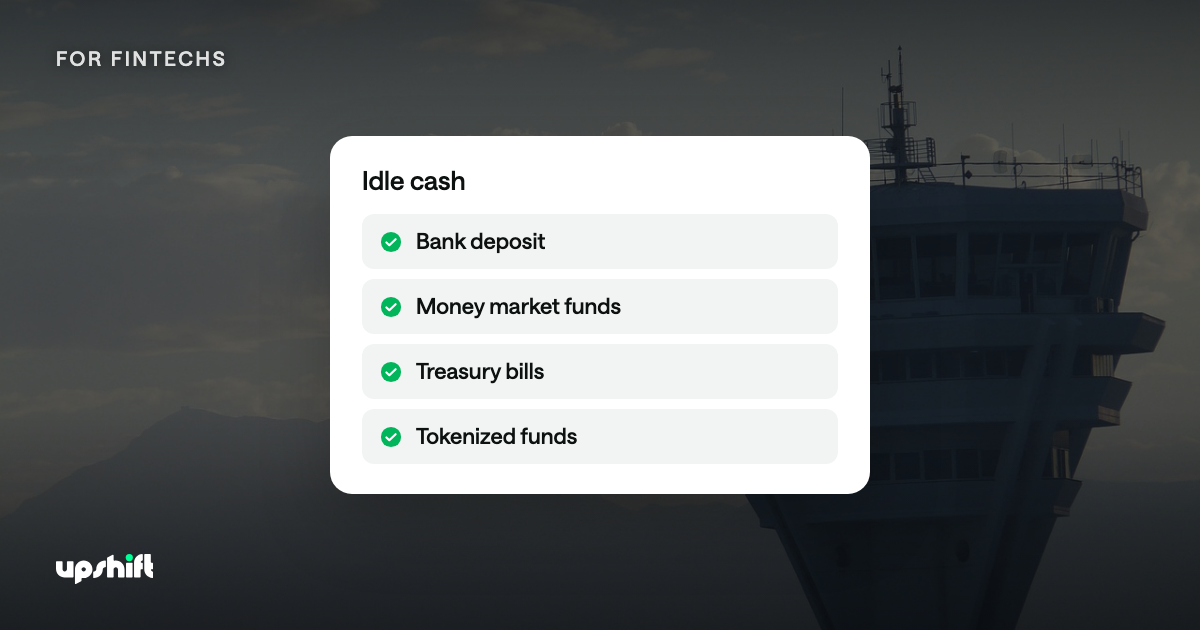
In the diagram, the software pulls in bank balances and builds a forecast, and cash the forecast doesn't need goes three ways. It can stay in a bank deposit, move into money market funds or T-bills, which paid roughly 3.1% to 4.0% net on startup treasury accounts in late September 2026, or move into tokenized funds and stablecoin vaults, which can pay out at weekends from a stablecoin buffer.
Where cash sits | Typical access | Weekend settlement | Example in this list |
Bank deposit | Same day | Depends on the bank's real-time rails | Ramp 2% business account |
Government money market fund | Same day if sold before the cut-off | No | Mercury (MRGXX), Rho (JPMorgan IJTXX), Kyriba (Morgan Money) |
Treasury bills | At maturity, or sold on business days | No | Rho 13-week T-bills, Meow |
Tokenized money market fund | Daily, onchain transfer | Transfers yes; redemptions follow the fund | Ripple Treasury (BlackRock BUIDL) |
Stablecoin vault | Depends on the vault; instant redemption on some for a fee | Yes | None of the 13 offers one built in |
Stablecoins themselves don't pay holders. The GENIUS Act, signed in July 2025, bars issuers from paying interest (Congressional Research Service). A company holding USDC earns only when it puts the balance somewhere else. How the GENIUS and CLARITY Acts reshape stablecoin yield covers the rules. Stablecoin treasury management covers the full setup, and tokenized money market funds vs stablecoin vaults compares the two onchain options.
How much does treasury management software cost?
Most vendors don't publish prices. Trovata's base package is $24,000 a year. Eco's 2026 guide estimates Kyriba's core platform at about $75,000 to $200,000 a year and GTreasury at about $70,000 to $180,000 for mid-market companies, with implementation on top. Startup treasury accounts charge differently, taking 0.15% to 0.60% a year of the invested balance. On $1 million that's $6,000 a year at Rho's or Mercury's top rate, which is already netted out of the rates they quote.
Stablecoin balances in a treasury stack
Upshift is onchain yield infrastructure that lets fintechs and asset managers offer yield inside their own products. Partners start with 24/7 tokenized money market funds and add higher-yield strategies, from lending to basis trades, on the same integration. A professional curator runs each stablecoin, BTC or ETH vault within risk limits set in advance, and depositors keep custody of their vault shares throughout.
For a fintech, the treasury system tracks the bank cash and a vault holds the stablecoin float, for example customer balances or settlement reserves that would otherwise sit in a wallet. Every vault processes redemptions daily, and some offer instant redemption for a fee, subject to liquidity. The contracts have been through 11 smart contract audits by 6 independent firms. How companies earn yield on treasury cash compares the structures, and what an onchain vault is explains the mechanics for treasury teams. If your stablecoins move through a BaaS program, BaaS providers compared covers the banking side.
Vault yields vary and aren't guaranteed. Vaults carry smart contract, strategy and liquidity risk, and there's no deposit insurance on them. Money market funds can fall below $1 a share in a stress event, and every fund and account above has its own cut-off times and limits.
Always make sure to do your own research and be aware of the above and any other risks before depositing.
Holding stablecoins between payments? Tell us how much sits idle and how fast you need it back, and we'll send a vault menu with redemption times.
Frequently asked questions
What is the best treasury management software?
For large multinationals, Kyriba and Ripple Treasury cover payments, cash, risk and stablecoins in one system, and SAP fits companies already on S/4HANA. Trovata, Embat and Agicap suit the mid-market, and Rho, Mercury, Meow and Ramp suit startups that mainly want idle cash invested.
What is the difference between a treasury management system and cash management software?
Cash management software focuses on bank visibility and forecasting. A treasury management system adds payments, debt, investments, FX hedging and bank account administration, usually for companies with many entities and banks.
Do startups need a treasury management system?
Usually not before they have several banks or entities. A business account with a treasury sweep, such as Rho or Mercury, covers investing idle cash from $50,000 or $250,000.
Which treasury software supports stablecoins?
As of October 2026, Kyriba supports USDC settlement through Circle and Ripple Treasury supports RLUSD payments plus tokenized money market funds. Meow moves USDC and USDT but pays no yield on them, and none of the other mid-market tools or startup accounts on this list mentioned stablecoins.
Is money in a startup treasury account FDIC insured?
No. Money market funds and T-bills in a startup treasury account are securities held at a broker. Mercury, for example, holds them at Apex Clearing with SIPC cover up to $500,000 against the broker failing, which doesn't cover a fall in the investments' value.
How long does a treasury system take to implement?
Mid-market tools usually connect banks in weeks. Enterprise systems such as Kyriba, SAP or Ripple Treasury often take several months, depending on the number of banks, entities and ERP connections.
Launch a vault with Upshift
Upshift builds custom, permissioned vaults for custodians, exchanges, neobanks and asset managers. Tell us what you are building and the team will follow up.
Create a vault with Upshift
Share your use case and we’ll get back to you shortly