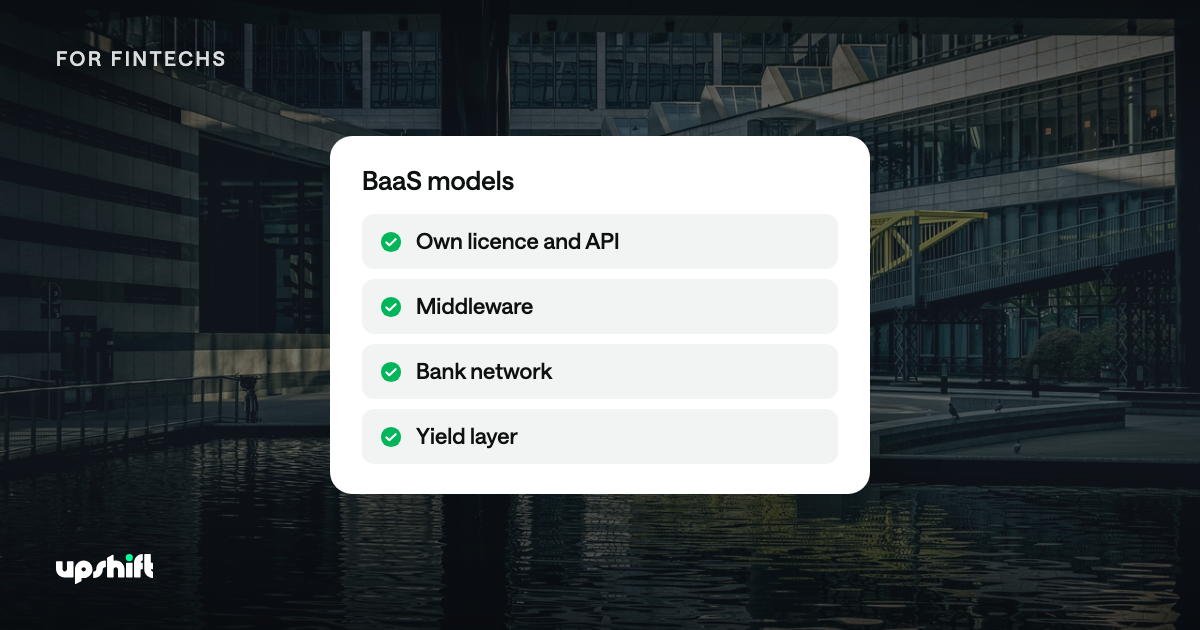
Banking as a service providers: 12 BaaS options compared

Banking as a service providers split into companies that hold the licence themselves and companies that connect your app to a partner bank, and that split tells you who keeps the ledger and who can pause your program.
On 1 July 2026, Grasshopper Bank and Increase launched instant payments in stablecoins. Banking as a service providers now sell dollar accounts and stablecoin rails side by side. The 12 main BaaS providers in 2026 fall into two groups. Column, Lead Bank, Cross River, Increase, ClearBank, Griffin, Solaris and Swan hold a licence and sell their own API. Unit, Treasury Prime, Synctera and Stripe Treasury connect your app to banks they don't own.
Every provider here was checked against its own website, a regulator or a funding announcement on 3 October 2026. We didn't test the products. Picks are grouped by model and region and aren't ranked, and none of them pays us anything to appear. If you're still sorting out the terms, embedded banking vs BaaS vs embedded finance explains the layers first.
What are the main BaaS providers in 2026?
Provider | Model | Region | Who holds the licence | Stablecoin support (Oct 2026) | Recent event |
Column | Bank with its own API | US | Column (national bank) | Send, receive and hold stablecoins as a payment rail | Led by Plaid co-founder William Hockey |
Lead Bank | Bank with its own API | US | Lead Bank | Bank for the Stripe and Visa stablecoin card platform | $70M Series B at $1.47B valuation, Sep 2025 |
Cross River | Bank with its own API | US | Cross River Bank | Not listed | FDIC consent order on fair lending, Mar 2023 |
Increase | API with its own bank plus partner banks | US | Increase Bank, Grasshopper, First Internet Bank, Core Bank | Stablecoin payments with Grasshopper | Stablecoin launch, 1 Jul 2026 |
Unit | Middleware | US | Partner banks (FDIC members) | Not listed | Pre-built banking and bill pay products, Jul 2025 |
Treasury Prime | Bank network | US | One of 20+ partner banks | Not listed | Moved to a bank-led model, Feb 2024 |
Synctera | Middleware | US | Partner banks in its network | Not listed | $15M Series A, Mar 2025 |
Stripe Treasury | Middleware inside Stripe | US, plus stablecoin accounts in 101 countries | Fifth Third Bank (USD); cards from Cross River and Lead Bank | USDC balances through Bridge | Stablecoin Financial Accounts, May 2025 |
ClearBank | Bank with its own API | UK and EU | ClearBank (UK), ClearBank Europe (NL) | EURC and USDC through Circle Mint | MiCA crypto-asset service provider status, 9 Apr 2026 |
Griffin | Bank with its own API | UK | Griffin Bank | Not listed | Full UK banking licence, Mar 2024 |
Solaris | Bank with its own API | Germany and EU | Solaris (German bank) | Not listed | SBI-led rescue, Jan 2025 |
Swan | E-money institution with its own API | EU (30 countries) | Swan (French e-money licence) | Not listed | €42M Series B extension, Jan 2025 |
"Not listed" means the provider's own site didn't mention a stablecoin product when we checked, which can change quickly.
Step 1: pick where the licence sits
The first decision is whether your app connects straight to the licensed company or to a layer in between. With a bank that sells its own API, one company keeps the ledger, holds the deposits and answers to the regulator. With middleware, the provider runs the API and its own ledger, and a partner bank holds the money in a pooled account. A bank network lets you choose among several banks through one integration.
Think of it like renting an office. You can sign the lease with the landlord, or go through a serviced-office company that leases the building and sublets desks. Both routes work. The serviced office is faster to move into, though you get a second company standing between you and the owner of the building, and if that company goes bust you're left negotiating with a landlord who has never heard of you and doesn't know which desk is yours.
The licence sits with the green box. The more boxes between your app and it, the more ledgers have to match.
In the diagram, a bank with its own API connects your app straight to the company holding the licence. Middleware adds one company between your app and the partner bank. A bank network adds a provider that lets you pick one of more than 20 banks. Each extra box is another ledger that has to match the bank's.
Model | Who keeps the customer ledger | Typical time to launch | What happens if the middle layer fails | Examples |
Bank with its own API | The bank | Slower: the bank runs its own compliance review | No middle layer | Column, Lead Bank, ClearBank, Griffin |
Middleware | The provider, reconciled to the bank | Faster: the provider has templates and an existing bank | The bank holds the money but may not know who owns which share | Unit, Synctera, Stripe Treasury |
Bank network | Shared between the bank and the network | Depends on which bank you pick | You keep the bank relationship and can move | Treasury Prime |
Step 2: shortlist US providers
US banking as a service providers fall into banks that sell their own API, middleware, and the networks that sit between the two.
Column: a national bank built for developers
Column is a nationally chartered bank led by William Hockey, a co-founder of Plaid, and it runs its own core banking software. Your app connects to the bank directly, with no middleware company in between. Its accounts page says you can "send, receive, and hold stablecoins just like any other payment rail", next to ACH, wires and real-time payments. Column suits larger fintechs and lenders with the engineering team to build on a bank's API.
Lead Bank: a Kansas City bank for fintech and stablecoin programs
Lead Bank raised a $70 million Series B at a $1.47 billion valuation in September 2025, led by ICONIQ and Greycroft, according to its announcement. It's the bank behind the Stripe and Visa stablecoin-linked card platform and settles USDC with Visa. Stripe also lists Lead as one of the two banks issuing Stripe Treasury cards. Lead suits payment companies and card programs that want a bank used to stablecoin flows.
Cross River: one of the longest-running fintech banks
Cross River is a New Jersey bank that has sponsored fintech lending, payments and card programs for more than a decade. It issues Stripe Treasury cards along with Lead. The FDIC put the bank under a consent order in March 2023 over fair-lending controls on its lending partnerships, which the bank said wasn't related to crypto. Cross River suits lenders and payment companies that want a bank with a long fintech record. Ask how the order affects new programs.
Increase: an API built on its own bank
Increase started as a banking API and later launched Increase Bank, and it also works with Grasshopper Bank, First Internet Bank of Indiana and Core Bank. Its founder says companies like Gusto, Ramp and Stripe use Increase's core technology to process more than $500 billion a year. Payment rails include ACH, wires, Real-Time Payments, FedNow and push-to-card. On 1 July 2026, Grasshopper and Increase launched instant payments via stablecoins, which lets companies on Increase move money abroad in near real time. Increase fits finance and payroll platforms that care about money movement and reconciliation more than branded consumer accounts.
Unit: middleware with ready-made products
Unit is a technology company and not a bank, and its banking services come from FDIC-member partner banks, according to its website. It offers deposit accounts and FBO wallets, ACH, wires and real-time payments, debit and credit cards, and lending products such as lines of credit and invoice factoring. Unit lists more than $100 billion in annual transaction volume and over 5 million accounts. In July 2025 it launched pre-built banking and bill pay products that a platform can embed with very little code. Unit fits vertical software companies (think construction, trucking or property management software) that want to add accounts fast, at least where the end customers are in the US and one of Unit's partner banks is comfortable with the industry the software serves.
Treasury Prime: a network of partner banks
Treasury Prime cut about half its staff in February 2024 and moved to a model led by the banks themselves. Its site describes a network of 20+ partner banks with more than $1.1 trillion in combined assets. Fintechs launch with one bank and add others as they grow. Treasury Prime suits fintechs that want a direct relationship with a bank and room to switch banks later.
Synctera: banking and card issuing in one platform
Synctera combines a ledger, card issuing, onboarding and compliance tools, and it matches each fintech with a bank from its network. It raised a $15 million Series A in March 2025 and has raised $94 million in total. It also sells Cable, a compliance testing tool used by banks and fintechs. Synctera fits startups launching a card program and an account together. Synctera picks the bank with you.
Stripe Treasury: accounts inside Stripe
Stripe Treasury, sold as Financial Accounts, gives platforms on Stripe Connect a balance, cards and payouts without a second vendor. On 3 October 2026, Stripe's Treasury page said USD funds eligible for FDIC pass-through insurance sit at Fifth Third Bank. Cross River and Lead Bank issue the prepaid cards. In May 2025 Stripe added stablecoin Financial Accounts in 101 countries, holding USDC through Bridge, the stablecoin company Stripe bought. Stripe pays no interest on balances. It offers a 1% credit toward Stripe fees on balances above $2,000 instead. It suits platforms that already process payments on Stripe.
Step 3: shortlist UK and EU providers
Most European BaaS providers hold their own licence and sell an API on top of it. A bank or e-money licence from one EU country can be passported across the rest. That leaves one ledger to check, held by the licensed firm.
ClearBank: a clearing bank with a stablecoin licence
ClearBank is a UK clearing bank that runs accounts and payments for fintechs, and its Dutch subsidiary ClearBank Europe serves EU clients. On 9 April 2026, the Dutch regulator confirmed ClearBank Europe as a crypto-asset service provider under MiCA, the EU crypto law. It was the first Dutch credit institution to finish that process, The Paypers reported. ClearBank Europe is using Circle Mint to give clients EURC and USDC. It suits payment firms that want euro and sterling accounts and stablecoins from one regulated bank.
Griffin: a UK bank built as a BaaS platform
Griffin left mobilisation, the restricted start-up phase for new UK banks, in March 2024 and raised $24 million at the same time, Finextra reported. It offers accounts, payments and white-label savings, and its blog says a fintech can earn part of the savings revenue as a distributor margin. Griffin fits UK fintechs and wealth apps that want a bank holding client money directly.
Solaris: a German bank under new ownership
Solaris is a Berlin bank that powers accounts and cards for brands across Europe. BaFin, the German regulator, fined the bank and appointed a special monitor over its anti-money-laundering controls. Japan's SBI then led a €100 million rescue in January 2025 and took a majority stake. Solaris suits European programs that need a full banking licence. Ask how the BaFin measures affect onboarding.
Swan: embedded accounts for European software platforms
Swan is a Paris company holding a French e-money licence, authorised by the ACPR in June 2020 and passported across 30 European countries. It gives software platforms white-label business accounts, cards and SEPA payments. Swan processes more than €1.5 billion a month for 150+ companies, including Pennylane and Agicap, EU-Startups reported when Swan added €42 million to its Series B in January 2025. Swan suits accounting, payroll and ERP software in Europe.
Step 4: check the ledger and the bank's record
The failure of Synapse in April 2024 showed what happens when a middleware ledger and a bank's balances stop matching. Customers lost access for months. The CFPB put the shortfall at between $60 million and $90 million. The Federal Reserve issued an enforcement action against Evolve, Synapse's main partner bank, on 14 June 2024. A month later the Fed, FDIC and OCC published a joint statement on bank-fintech deposit arrangements that set out what they expect banks to track. In the UK, new FCA safeguarding rules took effect on 7 May 2026 and require payment and e-money firms to reconcile client money every day.
Before you sign, get written answers to these questions:
- Who keeps the ledger of record, and how often is it reconciled against the bank's balance?
- How many partner banks can your program run on, and how long does a move take?
- Is the bank under a consent order or other enforcement action, and does it limit new programs?
- What does a customer receive, and how fast, if the provider fails?
Why BaaS providers failed in 2024 goes through the Synapse case in more detail.
Who earns the interest on customer balances?
In a BaaS program, the partner bank holds your customers' deposits and earns the interest on them, and your share is whatever the program agreement says. Stripe pays no interest on Treasury balances and gives a fee credit instead. Griffin shares part of its savings revenue with the fintechs that distribute its accounts. Most providers don't publish what share of the interest a fintech gets (it's negotiated). A company investing its own idle cash can compare treasury management software that sweeps it into money market funds and T-bills.
Balance | Where it sits | Who earns the return | What you can offer customers |
USD in a BaaS account | Pooled account at the partner bank | The bank, with a negotiated share to you | A savings rate the bank sets |
USDC in a Stripe Financial Account | Stripe and Bridge | No interest is paid; Stripe gives a fee credit | A 1% fee credit above $2,000 |
USDC in a stablecoin vault | A vault contract, with shares in the customer's wallet | The customer, from lending or tokenized Treasuries the vault holds | A variable onchain rate, after fees |
Stablecoin balances work differently. The GENIUS Act, signed in July 2025, bars stablecoin issuers from paying holders interest (Congressional Research Service). None of the BaaS providers we checked pays yield on stablecoins either. A fintech that wants customer USDC to earn puts it in a vault that lends it or holds tokenized Treasuries. How the GENIUS and CLARITY Acts reshape stablecoin yield covers the rules, and embedded yield covers how apps add it.
How do you add yield next to a BaaS provider?
Upshift is onchain yield infrastructure that lets fintechs and asset managers offer yield inside their own products. Partners start with 24/7 tokenized money market funds and add higher-yield strategies, from lending to basis trades, on the same integration. A professional curator runs each stablecoin, BTC or ETH vault within risk limits set in advance, and depositors keep custody of their vault shares throughout.
Your BaaS provider holds your customers' dollars, and an Upshift vault holds the stablecoin balances you choose to put to work. The contracts have been through 11 smart contract audits by 6 independent firms. Tria went live on the Upshift SDK two weeks after starting its integration, and Vault-as-a-Service covers vaults launched for your own app. Tokenized money market funds vs stablecoin vaults compares the most conservative options. Vault yields vary and aren't guaranteed, and vaults carry smart contract and strategy risk with no deposit insurance.
Always make sure to do your own research and be aware of the above and any other risks before depositing.
Adding yield to your customers' stablecoin balances? Tell us which balances you hold and where they sit today, and we'll send a vault menu and a launch timeline.
Frequently asked questions
What is a BaaS provider?
A BaaS provider is a company that lets a non-bank app offer accounts, cards and payments through an API. Some, like Column, are banks themselves. Others, like Unit, run the software and rely on partner banks for the licence and the deposits.
Are BaaS providers banks?
Some are. Column, Lead Bank, Cross River, ClearBank, Griffin and Solaris hold banking licences, and Swan holds an e-money licence. Unit, Synctera and Treasury Prime are technology companies working with FDIC-member banks.
Which BaaS providers support stablecoins?
As of October 2026, Column, Lead Bank, Increase with Grasshopper, ClearBank Europe and Stripe through Bridge offered stablecoin accounts or payments. None paid interest on stablecoin balances.
What is the best BaaS provider for a startup?
Middleware such as Unit or Synctera usually launches fastest, because the bank relationship and compliance templates exist. A startup trades that speed for a second ledger and a provider it depends on for any bank move.
What are the best BaaS providers in Europe?
ClearBank, Griffin, Solaris and Swan hold their own licences. ClearBank covers UK and EU banking plus EURC and USDC. Griffin is a UK bank, Solaris is a German bank, and Swan is a French e-money institution for software platforms.
How do BaaS providers make money?
From platform and per-account fees, a share of card interchange and a share of the interest the partner bank earns on deposits. The split with the fintech is set in the program agreement and rarely published.
Keep reading
- Embedded finance companies: the 2026 map. The providers behind payments, lending, cards and yield inside apps.
- How card programs earn yield on customer float. Settlement float, liquidity buffers and authorisations.
- Vault provider due diligence. The questions fintechs ask before they integrate a yield provider.
- What is PayFi. How payment balances and receivables earn onchain.
Launch a vault with Upshift
Upshift builds custom, permissioned vaults for custodians, exchanges, neobanks and asset managers. Tell us what you are building and the team will follow up.
Create a vault with Upshift
Share your use case and we’ll get back to you shortly