Embedded banking vs BaaS vs embedded finance

Banking-as-a-service is the layer that rents a licensed bank to an app, and embedded banking is the bank account the app then offers under its own name. Embedded finance covers that account plus every other financial feature an app adds the same way, from payments to yield.
Imagine you open a business account inside your Shopify admin on a Sunday night and pay a supplier from it on Monday morning. The account is embedded banking, because Shopify Balance puts a bank account inside Shopify's own product. Banking as a service (BaaS) is the layer underneath: Stripe Treasury connects Shopify to the licensed banks that hold the money. Embedded finance is the whole category, including payments, cards, lending and yield.
The layers carry different risks for you as the app. When a BaaS provider fails, your brand is still on the account, as customers of apps built on Synapse found in 2024.
Three terms for three layers of one stack
BaaS is sold to apps, while embedded banking is the product those apps sell to their own customers. Embedded finance is the wider market around both, and it includes products that never touch a bank.
Banking as a service | Embedded banking | Embedded finance | |
What it is | An API that connects an app to a licensed bank | A bank account, card or transfer shown inside a non-bank app | Any financial feature built into a non-financial product |
Who buys it | Fintechs and software platforms | The platform's own customers | Both, depending on the layer |
Who holds the licence | The partner bank | The partner bank, through the BaaS provider | Varies: a bank, a money transmitter, a lender or an onchain vault |
Example | Stripe Treasury, Unit, Column | Shopify Balance | Shopify Balance, Parafin loans in DoorDash, an Earn tab in a wallet |
US regulator in focus | Fed, FDIC and OCC, through the partner bank | The same, plus the CFPB on consumer accounts | Depends on the product |
Think of an airline codeshare. You buy a ticket from one airline, a second airline flies the plane, and a booking system you never see connects the two. In embedded banking your app sells the ticket, the licensed bank flies the plane, and the BaaS provider is the booking system.
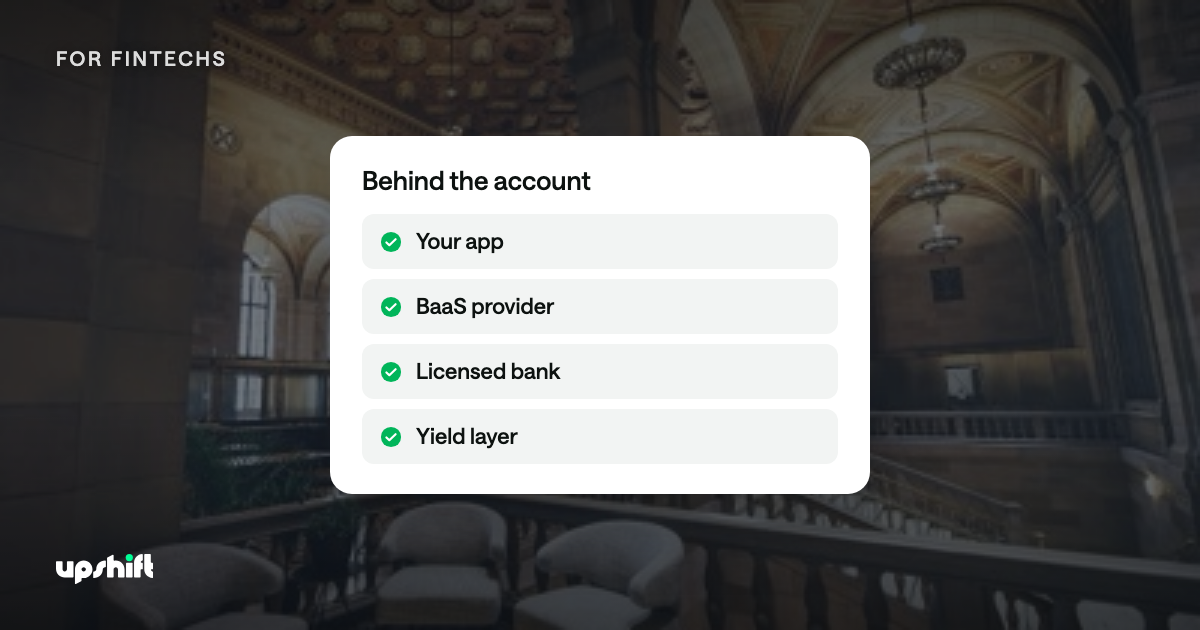
There are four layers. Your customer sees one brand, one balance and one card. Your app owns sign-up, the screens, support and the relationship. The BaaS provider runs the API, the ledger and the onboarding and KYC tools, and the licensed bank holds the deposits and answers to regulators. Layers two to four together give you embedded banking, while layer three on its own is BaaS.
How does banking as a service work?
A BaaS provider signs a program agreement with one or more licensed banks, then sells API access to apps that want to offer accounts and cards. Customer money usually sits in one pooled account at the bank, often called an FBO (for benefit of) account. The provider's ledger records which share of the pool belongs to each customer. Pooling is cheap. Opening a separate account on the bank's core system means a new customer record, disclosures, statements and monitoring for every user, while a new customer in a pool is just a ledger entry, and a payment between two users of the same app never leaves the pool. The bank stays legally responsible for the account, including the anti-money laundering checks, even when the app or the provider runs every onboarding screen and the bank never speaks to the customer at all. Unit, one of the larger US providers, crossed $100B in annual transaction volume in June 2026. Stripe Treasury runs the same model for platforms including Shopify, Instacart and Arc.
The jobs split roughly like this in most US programs:
- Partner bank: holds the deposits, issues cards and keeps the licence.
- BaaS provider: runs the API, the sub-ledger, card processing links and compliance tooling.
- Your app: designs the product, owns the customer and handles first-line support.
- Your customer: holds a claim on their share of the pooled account.
A few providers skip the middle layer. Column is a nationally chartered bank that sells its own developer API, which puts the ledger and the licence in one company. Banking as a service providers compared lists 12 providers by who holds the licence and who keeps the ledger.
What is embedded banking?
Embedded banking means the account, card or transfer your customer uses inside your product, with your brand on it. Shopify Balance gives merchants a business account and card in the Shopify admin, and payouts from their sales land in it. There's no separate bank login. Gig-economy apps do the same with debit accounts for drivers and couriers, where earnings land in an account the app opened for them.
Your revenue comes from two places. Card interchange, the fee a merchant pays on each card swipe, is split between the bank, the processor and you. Interest on deposits is the second source, and here the partner bank holds the money, earns the spread and pays you a negotiated share of it. You set neither the rate your customers see nor the rate the bank earns. Both move with the Fed.
Embedded finance covers far more than bank accounts
Embedded finance is every financial feature a non-financial company builds into its product through a specialist, and embedded banking is one slice of it. Bain estimated that $2.6T of US transactions ran through embedded finance in 2021 and forecast $7T by 2026. It put platform and provider revenue at $22B in 2021, rising to $51B. Payments makes up most of that volume, mainly card and online checkout run by companies like Stripe and Adyen for the platforms that sell through them.
The other layers rarely need a bank partner at all. Parafin funds cash advances inside DoorDash and Amazon seller dashboards. Stablecoin providers like zerohash and Bridge move USDC for brokerages and payroll apps. The newest layer is yield: an Earn tab where customer balances sit in an onchain vault that earns a variable rate. Embedded finance companies: the 2026 map lists the main providers in each layer, with figures.
Why did BaaS providers fail in 2024?
Synapse, a BaaS middleware provider, filed for chapter 11 bankruptcy on 22 April 2024. Its partner banks then found they held less for consumers than Synapse's records showed, a shortfall of between $60M and $90M according to the CFPB. Customers of apps such as Yotta and Juno lost access to their savings for months while the trustee tried to rebuild the ledger. The apps took the blame. Their logo was on the account. The CFPB's stipulated judgment against Synapse was entered on 12 September 2025. Pass-through FDIC insurance was little help. It covers a bank failure, and none of the banks had failed, while the records showing who owned what were the very thing in dispute.
Regulators had been moving on partner banks before that. The Federal Reserve issued an enforcement action against Evolve Bank & Trust on 14 June 2024. Evolve was one of Synapse's banks, and the order covered its fintech risk management and anti-money laundering controls. Blue Ridge, Cross River, Sutton, Lineage, Piermont and Thread Bank were all hit with consent orders between 2023 and 2024, according to Banking Dive's running list. Metropolitan Commercial Bank and Five Star Bank chose to leave BaaS altogether. The FDIC proposed a rule in September 2024 that would make banks keep their own records of who owns each dollar in a pooled account.
Questions to put to a BaaS provider after 2024:
- Who keeps the ledger of record, the bank or the provider?
- How often is the ledger reconciled against the bank's balance, and who signs off on the result?
- How many partner banks are there, and can your program move from one to another?
- What happens to customer money if the provider fails tomorrow?
- Is the partner bank under a consent order, and does it limit new programs?
Where the interest on customer balances goes
In a BaaS program, the partner bank holds your customers' deposits, earns the interest and decides what share of it you get. When your customers hold USDC in your app, the balance sits in a wallet. Nothing earns until you choose where it goes.
The GENIUS Act, signed on 18 July 2025, bars stablecoin issuers from paying holders interest or yield just for holding the coin. Apps that want those balances to earn now use vaults that lend or hold tokenized Treasuries, and the return comes from those assets. How the GENIUS and CLARITY Acts reshape stablecoin yield covers the rules in more detail.
Deposit through a BaaS program | USDC in an onchain vault | |
Where the money sits | A pooled account at the partner bank | A vault contract, with shares in the customer's wallet |
Who keeps the record | The bank and the provider's ledger | The blockchain, readable by anyone |
What the interest comes from | The bank's lending and securities | Lending, tokenized Treasuries or other strategies the vault holds |
Who sets the customer rate | The bank, with a share agreed with you | The vault's returns after fees, which float with the market |
Insurance | Pass-through FDIC cover if bank records are complete | No deposit insurance |
Main risks | Ledger mismatch, partner bank enforcement | Smart contract risk, strategy risk, withdrawal timing |
A vault's record is public, which means anyone can check what each holder owns at any time. That doesn't remove risk. Every vault carries smart contract and strategy risk, and the rate moves with the market. Tokenized money market funds vs stablecoin vaults compares the most conservative options, and vault provider due diligence lists the questions fintechs ask before they integrate.
Always make sure to do your own research and be aware of the above and any other risks before depositing.
How Upshift fits as the yield layer
Upshift is onchain yield infrastructure that lets fintechs and asset managers offer yield inside their own products. Partners start with 24/7 tokenized money market funds and add higher-yield strategies, from lending to basis trades, on the same integration. A professional curator runs each stablecoin, BTC or ETH vault within risk limits set in advance, and depositors keep custody of their vault shares throughout.
Upshift sits next to your BaaS provider in the stack. Neither replaces the other. The bank account covers your customers' dollars, and an Upshift vault covers the stablecoin balances. Tria went live on the Upshift SDK two weeks after starting its integration. The guide for neobanks and fintechs in our docs walks through the integration, and Vault-as-a-Service covers vaults launched under your own name.
Adding yield to your app's stablecoin balances? Tell us which balances your customers hold and we'll send a vault menu and a launch timeline.
Frequently asked questions
Is embedded banking the same as BaaS?
They're two ends of one deal. A BaaS provider sells bank access to an app, and the app turns it into embedded banking for its own customers. Unit sells BaaS, and a gig app that gives drivers a debit account through Unit is doing embedded banking.
Who holds the banking licence in a BaaS program?
The partner bank. The BaaS provider and the app are usually unlicensed for deposits, which is why US regulators enforce against the banks. Column is an exception, as a chartered bank that sells its API directly.
What is an FBO account?
A "for benefit of" account is a pooled bank account that holds many customers' money under one name. The bank or the BaaS provider keeps a separate ledger of each customer's share, and at Synapse that ledger stopped matching the bank's balances.
Is BaaS the same as open banking?
Open banking moves account data between institutions with the customer's permission, as Plaid does when it links a bank account to an app. BaaS moves the account itself into the app.
Can an embedded banking app offer yield on stablecoins?
Yes, through a vault. The GENIUS Act stops stablecoin issuers from paying holders yield. Apps instead put balances in vaults that earn from lending or tokenized Treasuries. Each app takes its own legal advice for the markets it serves.
Keep reading
- How consumer apps are distributing onchain yield: the apps that added vaults in 2026 and the five distribution routes.
- Tokenized money market funds: stablecoin yield without DeFi: the conservative starting point for a yield product.
- How companies earn yield on idle treasury cash: six options compared, from T-bill ladders to vaults.
- Why every financial product will run on vaults: the case for vaults as the yield layer.
Launch a vault with Upshift
Upshift builds custom, permissioned vaults for custodians, exchanges, neobanks and asset managers. Tell us what you are building and the team will follow up.
Create a vault with Upshift
Share your use case and we’ll get back to you shortly