Instant exit from T-bill yield: T+1 funds vs vault buffers

Tokenized T-bill funds pay out on business days, and a few add a USDC route that runs 24/7 up to a set capacity. A stablecoin vault pays instant exits from its liquidity buffer, and anything larger waits for its withdrawal period.
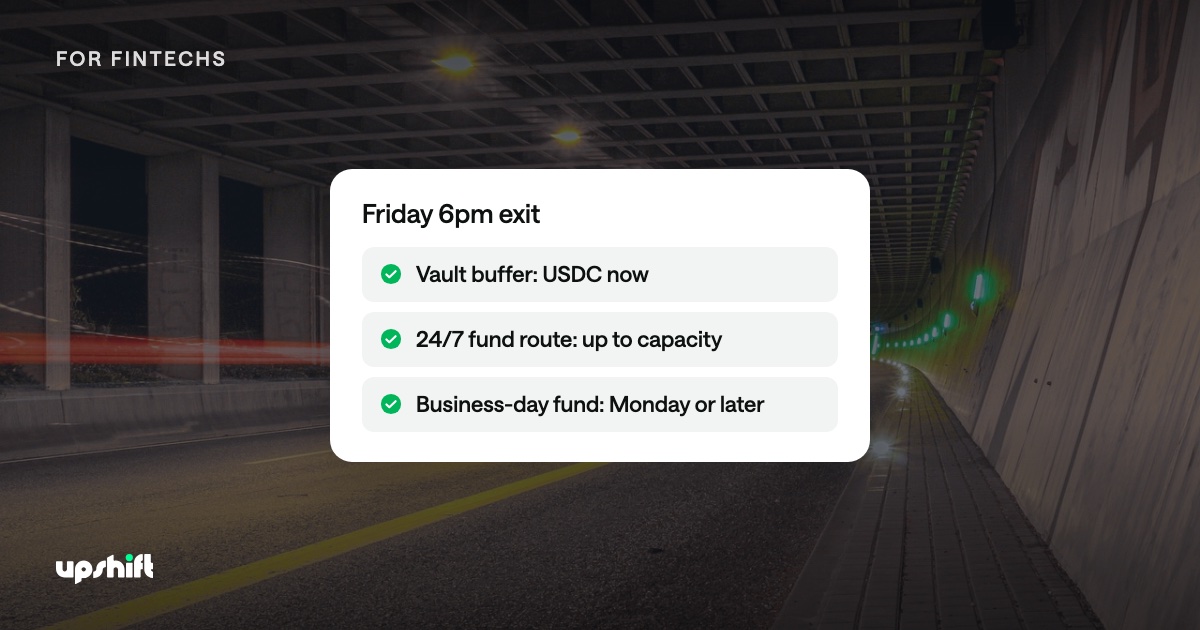
Say you want $1 million back from a T-bill position at 6pm Eastern on a Friday to fund weekend payouts. A tokenized fund that redeems in dollars on business days pays on Monday, and a T+1 fund pays on Tuesday. A fund with a 24/7 USDC route can pay that evening, and so can an Upshift vault's liquidity buffer. Either instant exit stops at the size of the route or buffer.
That gap matters most to payment companies, payroll platforms and card programs that send money on Saturdays. The Clearing House's RTP network settles payments up to $10 million, 24/7/365, which means payouts keep leaving on Saturday and Sunday while the wires that refill the account behind them stop on Friday evening. A finance lead who wants T-bill yield on that float also needs the money accessible at all times.
What happens to a Friday 6pm request under each model?
A Friday 6pm request (US Eastern) lands after most fund cutoffs and before a weekend with no Fedwire. The table follows the same $1 million through each route, using each issuer's published terms as checked on 17 October 2026.
Route | Example | When the money arrives | Limit or cost |
Upshift vault, instant route | A Cash vault holding tokenized money market funds next to a USDC buffer | Friday evening, in one transaction | Up to the buffer's size, for a fee set per vault (0 to about 0.2%) |
Fund with a 24/7 USDC route | Ondo OUSG | Friday evening, instant mint and redemption 24/7/365 | $5,000 minimum, 0% fee, qualified purchasers only |
Fund with a 24/7 USDC route | Circle USYC | Friday evening, in one block, below the instant-redemption capacity | Above that capacity, T+0 or T+1; capacity not published; 0.03% redemption fee above $1 million of daily volume; $100,000 minimum; non-US investors only |
Fund with a 24/7 USDC route | BlackRock BUIDL through Circle's USDC contract | Friday evening, near-instant (Circle, April 2024) | Fee and capacity not published |
Fund, same-day redemption | Superstate USTB, USD route | Monday, since Friday's 1pm ET USD redemption cutoff has passed | Its USDC route is immediate, through a capped liquidity facility |
Fund, business-day redemption | BlackRock BUIDL, standard route | Monday at the earliest, in USD by wire | $250,000 minimum redemption |
Fund, next-business-day redemption | Spiko Smart Cash (D+1) | Tuesday | Dealt on Monday, paid the next business day |
Upshift vault, standard route | Same vault, amount above the buffer | Monday evening at the earliest, at the first daily run after the 72 hours end | 72 hours on most vaults (range 1 to 30 days); no instant fee |
Instant routes on both sides pay on Friday evening, but each one stops at a capacity. USYC's instant route has a capacity, and an Upshift vault's instant route stops at its USDC buffer. Business-day routes pay from Monday whatever the size. The standard vault route pays at the first daily processing run after its withdrawal period. On a 72-hour vault, that's Monday evening at the earliest.
How do tokenized T-bill funds redeem?
Tokenized T-bill funds keep their shares onchain, while the transfer agent redeems them on the fund's dealing calendar. You send a request before the daily cutoff and the fund prices it at that day's NAV. The cash settles the same day (T+0) or the next business day (T+1). Weekends and US bank holidays aren't dealing days, and a Monday holiday adds a day. A Friday evening request therefore joins Monday's dealing, and a T+1 fund pays it on Tuesday.
- Superstate's USTB redeems the same day, with a 1pm ET cutoff for USD redemptions and liquidity each market day (fund page, checked 20 Oct 2026).
- BlackRock's BUIDL redeems in USD every business day, with a $250,000 minimum redemption (rwa.xyz, October 2026).
- Spiko's docs list same-day withdrawals for its T-Bills fund and next-business-day (D+1) withdrawals for its Smart Cash fund, with instant SEPA withdrawals up to €500,000 a day on euro share classes (Spiko docs, 17 Oct 2026).
- Franklin Templeton's BENJI (FOBXX) processes purchases and redemptions during normal business hours on business days.
Each fund also limits who can hold it. BUIDL and OUSG are for qualified purchasers, and USYC is for eligible non-US investors. BUIDL vs USYC vs BENJI lists eligibility, minimums and fees fund by fund.
Funds that pay out in USDC around the clock
Several issuers have added a 24/7 stablecoin route on top of the business-day calendar. A liquidity facility or a pool of USDC pays for it. Ondo says OUSG mints and redeems instantly 24/7/365, weekends and bank holidays included, from $5,000 with no fee. Circle says USYC redeems into USDC in one block up to its instant-redemption capacity, with larger amounts settling T+0 or T+1.
In April 2024 Circle launched a smart contract for BUIDL holders to swap shares for USDC near-instantly, 24/7. Superstate's USTB redeems immediately in USDC through a liquidity facility with an affiliated provider. Superstate says that facility has a cap, and its interest can reduce fund returns. Live capacity isn't on the fund pages. In practice, a large Saturday redemption can still meet the same limit a vault buffer has, just on the issuer's side.
US-registered funds are adding 24/7 access too. In February 2026 the SEC approved 24/7 trading of WisdomTree's tokenized money market fund at a fixed $1, through a broker-dealer with onchain settlement.
How does an Upshift vault exit work?
Upshift is onchain yield infrastructure that lets fintechs and asset managers offer yield inside their own products. Partners start with 24/7 tokenized money market funds and add higher-yield strategies, from lending to basis trades, on the same integration. A professional curator runs each stablecoin, BTC or ETH vault within risk limits set in advance, and depositors keep custody of their vault shares throughout.
An Upshift vault gives you two ways out, and both are written into the vault contract. The standard route is a withdrawal request. You ask to redeem your vault shares, and the request waits out the vault's withdrawal period, which is 72 hours on most vaults and anywhere from 1 to 30 days on the others, depending on what the vault holds and how it's set up.
Upshift processes claims every day. Your payout is priced at the vault's NAV share price when the request settles and you claim. A pending request can't be cancelled. The instant route skips the wait. You redeem against the vault's liquidity buffer, a sleeve of USDC held back from the strategy, for a fee set per vault, from zero to about 0.2%.
Standard route | Instant route | |
How long it takes | The vault's withdrawal period, 72 hours on most vaults (1 to 30 days by vault), then the next daily processing run | One transaction |
Price you get | NAV share price at settlement and claim | NAV share price at the time of the instant redemption, less the fee |
Fee | None for the withdrawal itself | Set per vault: 0 to about 0.2% |
How much | Any amount | Up to the size of the liquidity buffer |
Can you cancel? | No, once submitted | Settles at once |
Upshift's fees and fund flows docs describe the buffer as a configurable percentage held back in the vault. Instant redemptions come out of it, and the curator doesn't have to unwind a strategy to pay them. Upshift also works with short-term lenders that top the buffer back up when withdrawals run high. The buffer stays large enough for instant exits, and less of the vault has to sit in idle USDC.
No vault can always pay out instantly. A request larger than the buffer, or one that arrives after others have drawn it down, goes through the standard route instead.
Instant exit for fund positions through Upshift Clear
Upshift Clear is for when you hold a tokenized fund yourself and want USDC before the issuer's redemption settles. Upshift Clear prices your fund tokens with a Chainlink oracle, takes a spread fee and pays you USDC from a pool funded by liquidity providers in the same transaction, without waiting for the issuer's calendar.
The tokens then go through the issuer's normal redemption, and the dollars that come back refill the pool. The first Clear vault launched for Superstate's USCC, and the Upshift Clear launch post walks through it. Payouts stop at the USDC the pool holds.
Sizing the instant buffer against weekend payouts
The buffer earns little, and its size sets how much you can take out on a Saturday. Take a payments company that sends $1.2 million on a typical Saturday and $1 million on Sunday (illustrative figures). With a 30% margin for a spike, it needs about $2.9 million it can reach before Monday. That's the buffer target.
In a vault set up for one company, the buffer can be agreed against that number when the vault is deployed, and revisited as payout volumes grow or a holiday weekend comes up. Short-term lenders can top the buffer up during a spike, which keeps the target smaller than the worst weekend. The rest of the balance sits in tokenized funds earning the T-bill rate. In a vault shared with other depositors, the buffer serves everyone, and your Saturday draw competes with theirs.
A common setup splits the balance in two. Money that moves this week stays in USDC or a buffer. Cash for the coming months sits in the fund or vault on the standard route. How PSPs fund weekend payouts covers Fedwire hours and the Friday prefund. T-bill rate on stablecoin balances works through the rate left after fees.
When each model fits
Each route trades a slice of yield, or a minimum, for speed.
- A business-day fund fits cash you won't need before Monday. It pays the full fund rate and needs no buffer, and the fund's eligibility rules and minimums apply.
- A fund with a 24/7 USDC route fits a company that qualifies for the fund and draws less than the route's capacity. Weekend exits come from the issuer's facility, priced by the issuer.
- A stablecoin vault with a buffer fits a platform that pays out at weekends or holds money for many customers. You get instant exits up to the buffer, at a fee set per vault that can be zero, share accounting per depositor and the option to add Core or Enhanced vaults later on the same integration.
- Upshift Clear fits a holder of a supported tokenized fund who needs USDC before the issuer's redemption settles.
Whether a vault's depositors must meet a fund's eligibility rules is a question for counsel (general information, not legal advice). Tokenized money market funds vs stablecoin vaults compares holding the fund directly with holding it in a vault. The stablecoin yield without DeFi explainer sets out a Cash band built only from tokenized funds.
Risks and limits on instant exit
Every instant route draws on a pool of money that someone has to fund. A vault buffer, USYC's capacity, Superstate's facility and the Upshift Clear pool all have a size, and a draw past that size waits for the slower route, whether that's the fund's next dealing day or the vault's withdrawal period. Vault yields float with the market and aren't guaranteed.
A vault adds smart contract and oracle risk on top of the fund's own. The buffer also trims the rate you receive. Upshift's contracts have been through 11 smart contract audits by 6 independent firms. A vault provider due diligence checklist lists the redemption questions to ask before you deposit. Always make sure to do your own research and be aware of the above and any other risks before depositing.
Need T-bill yield you can reach at weekends? Send us your weekend payout volumes and the amount you'd hold. We'll come back with a buffer size, a vault setup and its exit terms.
Frequently asked questions
Can I redeem a tokenized money market fund on a weekend?
Only through a stablecoin route, where one exists. OUSG redeems in USDC 24/7/365 from $5,000, and USYC pays in one block up to its instant capacity. Standard USD redemptions wait for the next business day.
What does T+1 mean for a tokenized fund?
The cash settles one business day after the fund deals your request. A request after Friday's cutoff is dealt on Monday and paid on Tuesday, and a Monday bank holiday adds another day.
Is an Upshift vault withdrawal instant?
Up to the vault's liquidity buffer, yes. The fee is set per vault, from zero to about 0.2%. Larger amounts go through the withdrawal period, 72 hours on most vaults, and Upshift processes claims daily.
Can I cancel a pending vault withdrawal?
No. A submitted standard request stays in place until it settles, at the vault's NAV share price at settlement and claim.
Which tokenized treasury funds offer instant redemption?
Ondo's OUSG redeems in USDC 24/7 from $5,000, and Circle's USYC pays instantly up to its capacity. Superstate's USTB pays immediately in USDC through a capped facility. BlackRock's BUIDL has Circle's USDC contract, announced in April 2024. Each fund limits who can hold it.
Keep reading
- Stablecoin redemption times. Exit times for 10 yield options, from Aave to sUSDe, and how each behaves under stress.
- Tokenized treasuries. The largest funds, their sizes and their USDC exits.
- FBO accounts and stablecoin yield. Who earns on customer dollars in a bank account, and where stablecoin balances differ.
- Upshift yield options. The Cash, Core and Enhanced vault bands.
Launch a vault with Upshift
Upshift builds custom, permissioned vaults for custodians, exchanges, neobanks and asset managers. Tell us what you are building and the team will follow up.
Create a vault with Upshift
Share your use case and we’ll get back to you shortly