Institutional crypto custody providers compared (2026)

Institutional crypto custody now runs through federally chartered trust banks as well as New York trust companies and overseas licences. Anchorage, BitGo and Fidelity Digital Assets hold OCC charters, while Coinbase, Gemini and Fireblocks Trust hold New York trust charters.
Imagine a registered adviser holding $20 million of bitcoin and USDC for clients, with its annual audit three weeks away. Its custody runs through chartered banks and trust companies. On 12 December 2025 the OCC conditionally approved five more national trust banks. They include conversions for BitGo, Fidelity Digital Assets and Paxos.
In the US, the main custody providers are Anchorage Digital, BitGo, Fidelity Digital Assets, Coinbase Custody, Gemini, Fireblocks Trust Company and BNY, with Zodia Custody, Komainu, Copper and Ceffu holding licences elsewhere. Fireblocks and Fordefi sell wallet technology that a firm runs for itself. Fireblocks also owns a chartered trust company.
Institutional crypto custody providers compared
Custodian | Legal status | Qualified custodian (US) | Segregation | Staking and yield | Chains and assets |
Anchorage Digital Bank | National bank chartered by the OCC (Anchorage) | Yes, describes itself as an "SEC-qualified custodian" (Anchorage) | "Bankruptcy-remote, segregated custody" (Anchorage) | Staking and voting from custody (Anchorage) | Published supported-assets list, no count given (Anchorage) |
BitGo Bank & Trust | National trust bank chartered and regulated by the OCC (BitGo) | Yes, sold as qualified custody with $250M of insurance (BitGo) | Cold storage that is segregated and structured to be bankruptcy-remote (BitGo) | Staking, restaking and DeFi listed as products (BitGo) | Coins, tokens and staking assets listed by protocol (BitGo) |
Fidelity Digital Assets | National trust bank charter granted by the OCC in 2025 (Fidelity) | The custody page doesn't use the term (Fidelity) | Offline, cold-vaulted, multi-site storage (Fidelity) | Not on the custody page (Fidelity) | Not listed on the custody page (Fidelity) |
Coinbase Custody Trust Company | New York limited purpose trust company (iShares Bitcoin Trust 10-K) | Yes, represents that it qualifies under Rule 206(4)-2(d)(6) (iShares Bitcoin Trust 10-K) | Trust's bitcoin held in segregated cold storage accounts (iShares Bitcoin Trust 10-K) | Not covered in the filing (iShares Bitcoin Trust 10-K) | Bitcoin for the trust; no wider list in the filing (iShares Bitcoin Trust 10-K) |
Gemini Trust Company | Licensed by New York State to custody digital assets (Gemini) | Yes, "fiduciary and qualified custodian under New York Banking Law" (Gemini) | Unique, independently verifiable onchain addresses per client (Gemini) | Not on the custody page (Gemini) | BTC, ETH "and a growing range" (Gemini) |
Fireblocks Trust Company | Limited-purpose trust company chartered by NYDFS (Fireblocks) | Yes, sold as qualified custody (Fireblocks) | Asset segregation on a bankruptcy-remote basis (Fireblocks) | Staking and collateral services listed (Fireblocks) | Not listed on the trust company page (Fireblocks) |
BNY | Global custody bank (BNY) | A bank meets the rule's definition (Rule 206(4)-2) | Asset segregation and "bankruptcy stay protection" (BNY) | Not on the digital assets page (BNY) | Not listed on the digital assets page (BNY) |
Zodia Custody | MiCA authorisation for Zodia Custody Europe from Luxembourg's CSSF, Dec 2025 (Blockhead) | Outside the US rule; ADGM unit holds an FSRA permission (Zodia) | Collateral stays in the client's own segregated wallet (Zodia) | ETH staking and validator tools (Zodia) | Over 80% of crypto market cap, including BTC, ETH, XRP, USDT and USDC (Zodia) |
Komainu | Headquartered in Jersey, with a Dubai VARA licence (Komainu) | Outside the US rule (Komainu) | "Secure, segregated, and verifiable on the blockchain" (Komainu) | Staking listed as a service (Komainu) | Supported assets in its documentation (Komainu) |
Copper | Withdrew its UK FCA application, Dec 2024; approvals in Switzerland, Hong Kong and Abu Dhabi (The Block) | Outside the US rule (The Block) | Not stated on the homepage (Copper) | Staking listed as a product (Copper) | Not listed on the homepage (Copper) |
Ceffu | Dubai VARA licence VL/25/10/001 for custody (Ceffu) | Outside the US rule (Ceffu) | Not stated on the about page (Ceffu) | Staking and rewards (Ceffu) | Supported-assets list on its site (Ceffu) |
How we chose
Each provider here holds client crypto for institutions under a licence or charter it names in public. Every fact in the table comes from the provider's own site, a regulator or a public filing, checked on 14 October 2026. The criteria were:
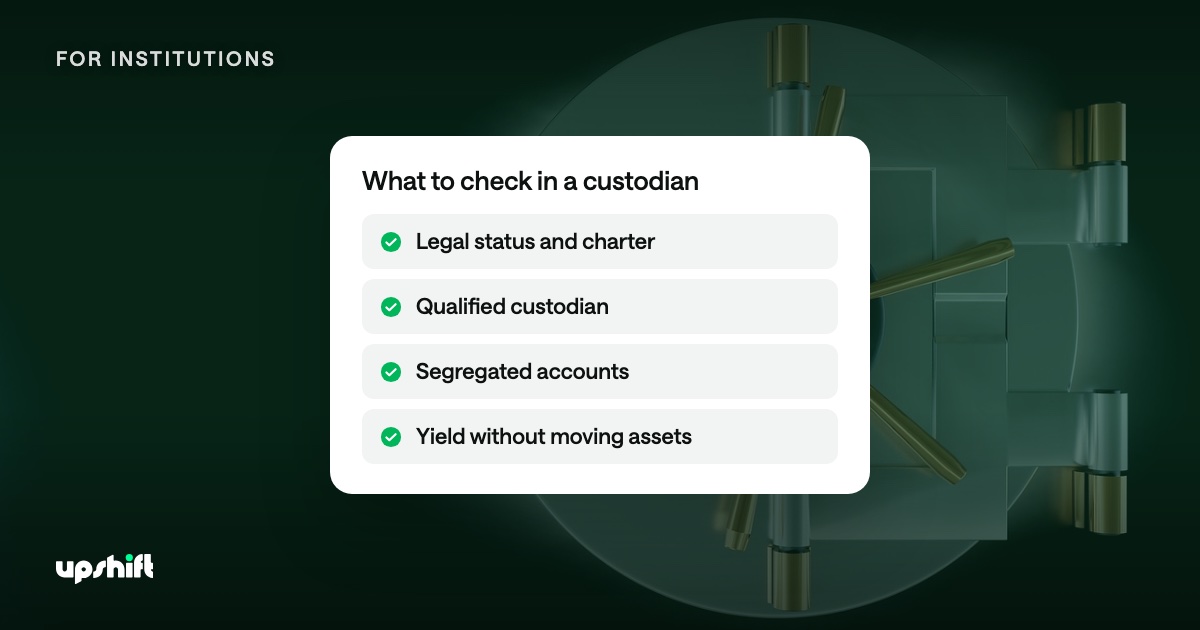
- Legal status: the charter or licence, and the regulator that granted it.
- Qualified custodian status: whether the firm says it meets the SEC's definition for advisers.
- Segregation: whether client assets sit apart from the custodian's own balance sheet and from other clients.
- Staking and yield offered from inside custody.
- Chains and assets, where the provider publishes them.
Check qualified custodian status first
Under the SEC's custody rule, Rule 206(4)-2, a registered investment adviser has to keep client assets with a qualified custodian. The rule lists banks, broker-dealers, futures commission merchants and certain foreign financial institutions. Trust companies count when they're supervised as banks.
BlackRock's iShares Bitcoin Trust 10-K says Coinbase Custody keeps the trust's bitcoin in accounts "segregated from the assets held by the Bitcoin Custodian as principal and the assets of its other customers". Bitcoin waiting to trade sits elsewhere. It's an omnibus claim on Coinbase Inc.'s pooled wallets and venue accounts. A treasury can look for the same split in its own custody agreement: a segregated vault balance and a pooled trading balance.
Insurance differs. BitGo states $250M of cover for assets in qualified custody, Gemini $125M as of 1 March 2024 ($25M hot, $100M offline), and Coinbase Global carries a crime policy of up to $320M across its subsidiaries, per the same 10-K.
Sort federal banks from New York trust companies
Banks and trust banks with a federal charter:
- Anchorage Digital, best for staking and governance votes run from a federally chartered bank.
- BitGo Bank & Trust, best for insured cold storage across a wide asset list.
- Fidelity Digital Assets, best for hedge funds and trading firms that want off-exchange settlement next to custody.
- BNY, best for institutions that want crypto held by the bank that holds the rest of their assets.
New York trust companies:
- Coinbase Custody, best for funds that want the custodian named in BlackRock's iShares Bitcoin Trust filings.
- Gemini, best for clients who want their own addresses they can check onchain.
- Fireblocks Trust Company, best for firms on Fireblocks wallets that need qualified custody for part of their holdings.
Custodians licensed outside the US
- Zodia Custody, best for EU and Gulf institutions, with MiCA and ADGM permissions.
- Komainu, best for posting crypto as collateral while it stays in custody. Nomura, CoinShares and Ledger founded it.
- Copper, best for off-exchange settlement through ClearLoop, which routed $3bn of settlements a month per its homepage.
- Ceffu, best for Binance traders, through its MirrorX off-exchange settlement.
Fireblocks and Fordefi sell MPC wallet software. MPC splits each signing key into shares that never come together in one place. A firm running either one keeps control of its own wallets. Paxos bought Fordefi in November 2025. Fordefi says nearly 300 institutions use it. Fireblocks put its qualified custody product in a separate entity, Fireblocks Trust Company, which holds a limited-purpose trust charter from New York's Department of Financial Services (NYDFS).
Track the 2025 and 2026 rule changes
- OCC charters, 12 December 2025. The OCC conditionally approved de novo national trust banks for First National Digital Currency Bank and Ripple National Trust Bank. It also approved conversions from state trust companies for BitGo, Fidelity Digital Assets and Paxos. Each approval comes with conditions the firm has to meet first.
- Standard Chartered and Zodia, 18 May 2026. Standard Chartered plans to acquire Zodia's custody business and fold it into the bank's own digital asset operations. Zodia's software platform stays independent. Other Zodia shareholders accepted the bank's non-binding offer. No closing date has been published.
- SEC custody proposal, 1 October 2026. The SEC proposed rule changes for crypto custody. State trust companies authorised by their state banking regulator could act as qualified custodians. Advisers could hold a crypto asset themselves when no qualified custodian will take it. The rule would be renumbered 223-1. Comments close 60 days after Federal Register publication, and the proposal is still open.
Legal status here is general information, not legal advice.
Earn stablecoin yield while assets stay in custody
Upshift runs stablecoin vaults: smart contracts that take deposits and issue a share token. A curator, typically an asset manager or hedge fund, runs the strategy inside limits set for each vault. A deposit from a custody account mints that share token. The custodian holds it for the client like any other asset. Kraken Institutional clients allocate into Upshift vaults this way.
The receipt token goes back to each client's segregated account. Vaults come in three risk bands (Cash, Core and Enhanced) and can be limited to a single allow-listed depositor. Most vaults use a 72-hour withdrawal period. An instant exit is available up to the vault's USDC buffer, for a fee. Our guide to onchain yield in qualified custody walks through the custody agreement step by step.
Fordefi's Earn product lists Upshift vaults; assessed on the same criteria.
Add stablecoin yield to your product, from 24/7 tokenized money market funds to DeFi. Tell us where your stablecoins are held and how fast you need them back, and we'll show you which vaults your custodian can hold.
See how Upshift works for treasuries and asset managers.
Frequently asked questions
Who are the biggest crypto custodians?
Coinbase Custody holds the bitcoin for BlackRock's iShares Bitcoin Trust, and BNY offers digital asset custody alongside its traditional custody business. Anchorage, BitGo and Fidelity Digital Assets hold federal charters from the OCC. Outside the US, Zodia Custody, Komainu, Copper and Ceffu serve institutions under European, Jersey, Swiss and Dubai rules.
Can I lose my crypto with a custodian?
Yes, through theft, a lost key or the custodian's failure. Recovery depends on segregation. Coinbase Custody holds the iShares trust's bitcoin in segregated accounts. Bitcoin waiting to trade is an omnibus claim on pooled wallets. Insurance is capped, at $250M for BitGo and $125M for Gemini.
Which banks offer crypto custody services?
BNY holds crypto for institutional clients, and Anchorage Digital Bank is an OCC-chartered national bank. BitGo, Fidelity Digital Assets and Paxos got conditional OCC approval to become national trust banks in December 2025. Standard Chartered plans to take Zodia's custody business in-house.
What does institutional custody mean?
A regulated firm holds the private keys for a fund, company or adviser, under a charter or licence that sets capital and audit rules. For a US registered adviser the firm usually has to be a qualified custodian under Rule 206(4)-2, such as a bank or a supervised trust company.
Which providers offer custodial wallets?
Every custodian in the table holds the keys for its clients. Fireblocks and Fordefi sell MPC wallet software that firms run for themselves. Fireblocks Trust Company offers custody where it holds the keys.
What is institutional custody of XRP?
Zodia Custody lists XRP among its supported assets. Ripple National Trust Bank got conditional OCC approval for a national trust bank charter on 12 December 2025.
Keep reading
- Qualified custodians for onchain yield. The custody agreement, the receipt token and the policy engine.
- How companies earn yield on treasury cash. Accounting and policy for corporate holders.
- MiCA licence. What EU custody and service providers need.
- Crypto treasury management. Tools and controls for a company holding crypto.
Launch a vault with Upshift
Upshift builds custom, permissioned vaults for custodians, exchanges, neobanks and asset managers. Tell us what you are building and the team will follow up.
Create a vault with Upshift
Share your use case and we’ll get back to you shortly