Crypto treasury management: 15 solutions compared

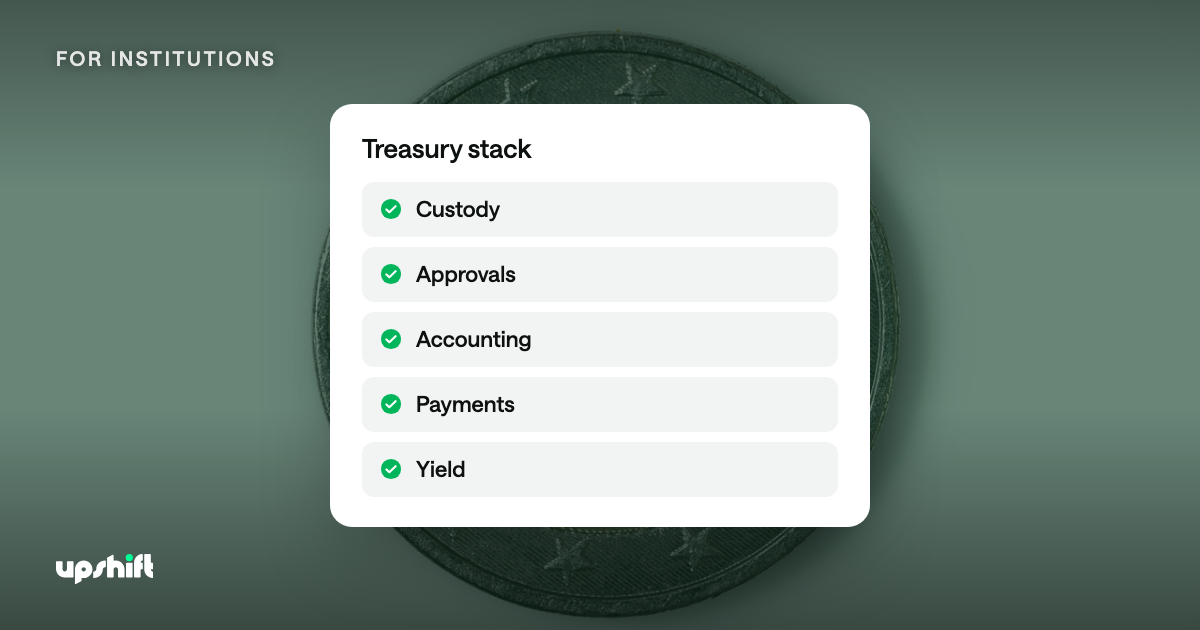
A company holding stablecoins or bitcoin needs five things from its crypto treasury stack: somewhere safe to keep the keys, rules on who can move funds, books an auditor will accept, a way to pay people and a place for idle balances to earn. Few providers sell all five, and most finance teams end up combining two to four of them.
197 public companies held 1.276 million BTC on 4 October 2026, according to BitcoinTreasuries.net, and many more private companies now hold USDC or USDT for payments and payroll. Crypto treasury management is the set of tools they use to hold, approve, record, pay out and earn on those balances. The main crypto treasury management solutions in 2026 are Fireblocks, BitGo, Anchorage Digital, Coinbase Prime, Fordefi and Utila for custody and approvals; Cryptio, Bitwave and TRES Finance for accounting; Request Finance and Meow for payments and business accounts; and Upshift, Morpho, Ondo and Superstate for yield on idle balances.
Crypto treasury management solutions compared
Provider | Layer | What it does for a treasury | Yield on idle balances | Scale, from its own site (Oct 2026) |
Fireblocks | Custody, approvals, accounting (TRES) | MPC wallets with a policy engine for transfers, payments, DeFi and staking | Fireblocks Earn: a Sentora-curated vault on Morpho, and Aave | 2,500 enterprises |
BitGo | Custody | Qualified custody, wallets, staking and trading | Staking | OCC-chartered trust bank |
Anchorage Digital | Custody | Bank custody, trading, settlement and stablecoin issuance | Staking and stablecoin rewards | Federally chartered bank |
Coinbase Prime | Custody and trading | Custody through Coinbase Custody Trust Company, trading and financing | USDC rewards up to 3.40% with no lockup; up to 5.75% lending to Coinbase (PrimePlus), with higher rates for longer commitments | Not published on the page |
Fordefi | Wallets and approvals | MPC wallet with granular policies and DeFi access | Fordefi Earn, including Upshift vaults | Owned by Paxos since Nov 2025 |
Utila | Wallets and approvals | MPC wallets, policy engine, stablecoin pay-ins and payouts | Not listed | 350+ companies; $30B+ monthly volume |
Cryptio | Accounting | Subledger, reconciliation and ERP exports across 150+ blockchains and venues | Not applicable | 400+ institutions; SOC 1 and SOC 2 Type II |
Bitwave | Accounting and payments | Crypto accounting, payments and compliance with NetSuite, QuickBooks, Sage Intacct and Xero | Not applicable | Not published |
TRES Finance | Accounting | Reconciliation, reporting and audit from 220+ networks, exchanges and banks | Not applicable | Bought by Fireblocks, Jan 2026 |
Request Finance | Payments | Business account with USDC and USDT wallets, invoicing, approvals and batch payouts | Not listed | 1,500+ finance teams; from $50 a month |
Meow | Business account | Business banking, cards, global payments and USDC | Commercial paper account, 3.73% to 3.97% on dollars | Not published |
Upshift | Yield | Stablecoin, BTC and ETH vaults, from tokenized money market funds to DeFi and institutional lending, plus custom permissioned vaults for a single treasury | Variable, by vault and risk band; redemptions processed daily, instant for a fee on most vaults | $550M+ peak deposits; 50+ vaults; 30+ chains |
Morpho | Yield | Lending markets and curated vaults | Variable lending rates; withdrawals instant while there's unlent liquidity | $16.9B total deposits |
Ondo (OUSG) | Yield | Tokenized short-term US Treasuries fund | 3.57% 30-day APY; instant 24/7 redemptions in USDC from $5,000 | $321M OUSG TVL |
Superstate (USTB) | Yield | Tokenized short-duration US government securities fund | 3.61% 30-day yield; same-day redemptions, immediate in USDC | $744M AUM |
Rates and fund sizes are as each provider showed them on 3 or 4 October 2026, and they move with short-term US rates. OUSG and USTB are open only to accredited investors and qualified purchasers. "Not listed" means the provider's site didn't mention the feature on 4 October 2026.
The five layers of a crypto treasury stack
A crypto treasury runs on five layers. Most providers sell one or two of them.
In the diagram, custody sits at the top because every other layer needs somewhere to hold the keys. The approval rules usually live inside the custody platform. In Fireblocks, Fordefi and Utila, a finance team sets who can start a transfer and who approves it. It also sets limits per transaction and the addresses money may go to. Accounting tools read from every wallet, exchange and bank account the company uses. Payments tools send invoices and payouts, and the yield layer takes whatever the cash forecast says can sit for days or months.
A general treasury management system such as Kyriba or Ripple Treasury covers bank cash, forecasting and payments, and both now handle some stablecoin flows (USDC settlement at Kyriba, RLUSD payments at Ripple Treasury). Our comparison of 13 treasury management systems covers that software. The tools here are crypto-native: they hold keys, read blockchains and connect to onchain funds and vaults. For the policy side (tiers, approved issuers, booking and approvals), stablecoin treasury management for finance teams sets out a full treasury policy.
Custody, wallets and approval policies
Fireblocks: MPC wallets, policies and an Earn product
Fireblocks says 2,500 enterprises use its platform for wallets, payments, treasury management and tokenization. Its policy engine sets limits, multi-party approvals and role-based permissions across transfers, stablecoin payments, DeFi trading and staking. In April 2026 it launched Fireblocks Earn, which puts idle stablecoins into a Sentora-curated vault on Morpho or into Aave. Fireblocks bought TRES Finance on 7 January 2026, which brings accounting into the same group, though TRES still runs as a standalone product.
BitGo: chartered custody and staking
BitGo received full OCC approval in December 2025 to operate as BitGo Bank & Trust, a national trust bank. It offers custody, wallets, staking, trading and stablecoin services. BitGo is a listed company. Companies whose auditors or boards want a federally chartered custodian tend to start here or at Anchorage.
Anchorage Digital: a crypto bank
Anchorage Digital Bank describes itself as the first federally chartered crypto bank. It offers qualified custody, trading, settlement, staking and stablecoin rewards, and it issues regulated stablecoins for others, including Tether's USAT. It fits treasuries that want bank custody plus staking on the same account.
Coinbase Prime: custody, trading and USDC rewards
Coinbase Prime holds client assets at Coinbase Custody Trust Company, a New York limited purpose trust company and qualified custodian. Institutions holding USDC on Prime earn rewards of up to 3.40%. PrimePlus pays up to 5.75% for lending the USDC, with Coinbase as the counterparty and higher rates for longer commitments. Treasuries that also trade BTC or ETH can keep custody, execution and stablecoin rewards in one place.
Fordefi: MPC wallet and DeFi access
Fordefi is an MPC wallet with granular transaction policies, built for teams that use DeFi apps directly. Paxos bought Fordefi in November 2025. Since 8 September 2026 its Earn feature has listed Upshift vaults (Sentora RWA, Sentora BTC and earnAUSD) for clients to deposit into from their own wallets.
Utila: wallets and stablecoin payments
Utila sells MPC wallets with a policy engine, address whitelists and quorum approvals, plus stablecoin pay-ins and batch payouts for fintechs, payment companies and banks. Its site lists more than 350 companies and $30 billion or more in monthly volume. Wallet as a service providers compared covers embedded wallets for customers, and MPC vs multisig explains the two signing models.
Accounting and reporting tools
Crypto accounting tools pull every transaction from wallets, exchanges and custodians, price it, tag it and push journal entries into the ERP. In the US, the FASB proposed guidance on 18 August 2026 on when certain stablecoins can count as cash equivalents, with comments open until 19 November 2026. Your auditor still makes the call on your own balances.
Cryptio: an accounting subledger for institutions
Cryptio pulls data from more than 150 blockchains, exchanges, custodians and DeFi protocols, reconciles balances and exports to ERPs and banking systems. It lists more than 400 digital asset institutions as clients, including Circle, Paxos, Securitize and Anchorage Digital. Its SOC 1 and SOC 2 Type II reports are audited by PwC.
Bitwave: accounting, payments and compliance
Bitwave combines crypto accounting, payments, reporting and compliance for enterprise finance teams. It connects to NetSuite, QuickBooks, Sage Intacct and Xero, and says it's AICPA SOC compliant. Its site doesn't publish prices.
TRES Finance: reconciliation and audit, now part of Fireblocks
TRES Finance aggregates data from more than 220 Web3 networks, exchanges and banking sources for accounting, reconciliation, reporting and audit. Its clients include Alchemy, Starkware and OP Labs. It has been part of Fireblocks since January 2026.
Payments and business accounts
Request Finance: a business account for currencies and stablecoins
Request Finance gives a business one account for 25+ currencies and stablecoins, with virtual IBANs, SWIFT, and USDC and USDT wallets. Finance teams create invoices, set approval policies and pay hundreds of people in one batch, on bank or stablecoin rails. It reports more than 1,500 finance teams and $1 billion processed, with plans from $50 a month and free stablecoin payouts.
Meow: business banking with USDC
Meow offers business banking, cards, global payments and USDC in one platform. Its Commercial Paper Account, run by Meow Advisory, showed net yields of 3.73% to 3.97% on 3 October 2026, with a $100,000 minimum checking balance. That yield is on dollars in the account, and Meow's site doesn't list a yield product for its USDC balances.
Yield on idle stablecoins and digital assets
Idle stablecoins can earn in four ways, and each one comes with a different counterparty. A custodian can pay rewards on the balance (Coinbase Prime). A tokenized money market fund pays the T-bill rate to approved holders (Ondo, Superstate). A lending protocol pays what borrowers pay (Morpho). And a curated vault can mix several of these sources inside one strategy, under risk limits set in advance (Upshift). Some balances can't move at all: payment float due on Friday belongs in the operating tier, whatever the rate elsewhere.
Route | Example | Who pays the yield | Who can use it | Redemption time |
Custodian rewards or lending | Coinbase Prime, PrimePlus | Coinbase | Prime clients | Rewards: no lockup. PrimePlus: fixed commitments, with higher rates for longer terms |
Tokenized money market fund | Ondo OUSG, Superstate USTB | US Treasury bills held by the fund | Accredited investors and qualified purchasers | OUSG: instant 24/7 in USDC from $5,000, daily in USD. USTB: same day, immediate in USDC within daily limits, 1pm ET cutoff for USD |
Lending vault | Morpho vaults | Onchain borrowers | Set by each vault and front end | Instant while the vault has idle or unlent cash; when fully lent, depositors can exit in kind |
Curated vault | Upshift vaults | The strategy: funds, lending, basis trades or credit | Open, allow-listed, or a single treasury's own vault | Requests processed daily, with a lag set per vault; most vaults offer instant redemption for a fee when liquidity allows |
Redemption terms are from each provider's own page or docs on 4 October 2026: Coinbase, Ondo, Superstate, Morpho and Upshift.
Upshift: stablecoin vaults from tokenized money market funds to DeFi
Upshift is onchain yield infrastructure for fintechs, asset managers and treasuries holding stablecoins. A company can start in a conservative vault holding 24/7 tokenized money market funds and add higher-yield strategies, from lending to basis trades, on the same integration. A professional curator, typically a hedge fund or asset manager, runs each stablecoin, BTC or ETH vault within risk limits set in advance. Sentora, for example, runs the Sentora USD, BTC and ETH vaults. Vaults sit in three risk bands: Conservative, Core and Enhanced. The yield options page showed indicative bands of 3-4%, 5-7% and 8% or more before vault fees in September 2026. Curators on the Upshift prime stack also get a policy engine that limits activity by chain, protocol, token and contract function. They can trade across onchain protocols and centralized venues, and borrow from an institutional lender network. That mix is how one Upshift vault can hold both CeFi lending and DeFi positions.
Upshift has held more than $550 million in deposits at peak, across 50+ vaults on more than 30 chains for 66,000+ users. A treasury can also get a custom, permissioned vault: a whitelisted vault where it's the sole depositor and only its own wallets can deposit. When that vault's curator runs on an Upshift prime account, the company's own policy limits, such as approved chains, protocols and tokens, are set onchain in the policy engine. Whitelisted vault providers compared covers the options, and Kraken Institutional clients reach permissioned Upshift vaults from inside qualified custody. Each vault's owner is a multisig, and the contracts have been through 11 smart contract audits by 6 independent firms. Upshift raised a $10 million Series A led by Dragonfly in March 2025.
Morpho: lending markets and curated vaults
Morpho runs lending markets and vaults where curators allocate one deposit asset across approved markets within onchain risk limits. Rates float with borrower demand. Its site showed $16.9 billion in total deposits on 3 October 2026 and lists Fireblocks, Coinbase and Robinhood among the companies building on it. What is Morpho covers the mechanics.
Ondo: OUSG, a tokenized Treasuries fund
OUSG holds tokenized money market funds including BlackRock's BUIDL, Franklin's BENJI and Fidelity's FYOXX. It showed a 3.57% 30-day APY and $321 million in TVL. Instant mints and redemptions run 24/7 in USDC from $5,000, with no fee on instant redemptions.
Superstate: USTB, a tokenized government securities fund
Superstate's USTB, the Invesco Short Duration US Government Securities Fund, holds short-duration Treasury bills. It showed $744.3 million in assets and a 3.61% 30-day yield, with same-day subscriptions and redemptions that settle immediately in USDC. Tokenized money market funds vs stablecoin vaults compares holding a fund directly with holding it through a vault.
How to diversify a corporate treasury with crypto
Diversifying with crypto works best when each balance is sorted by when it'll be spent, before anyone picks an asset. A common treasury policy uses three tiers, plus a fourth line for BTC or ETH held as a strategic asset.
Tier | Covers | Where it sits | Earns | Exit |
Operating cash | The next few days of payments and payroll | Bank account plus USDC or USDT in a custody wallet | Little or nothing | Immediate |
Reserve | The next few weeks to months | Tokenized money market fund or a conservative vault holding one | Close to the T-bill rate | Same day or daily |
Yield sleeve | Cash not needed for months | Curated stablecoin vaults in the Core or Enhanced band | Variable, above T-bills | Each vault's published terms |
Strategic crypto (optional) | A board-approved BTC or ETH allocation | Qualified custody, or a BTC or ETH vault | Price exposure, plus any vault yield | Market dependent |
Size the operating tier from the cash forecast and keep it idle. Put the reserve in assets with same-day exits. Cap the yield sleeve at a share of total cash the board approves. Spread it across more than one vault and curator, since a single strategy can pause withdrawals. A BTC or ETH allocation sits outside the cash tiers altogether, because its value moves with the market. Give it its own board limit, separate from the cash tiers' limits. How to earn yield on bitcoin covers BTC vaults, and how companies earn yield on treasury cash compares six structures for the reserve tier.
Vault yields vary and aren't guaranteed. Vaults carry smart contract, strategy and liquidity risk, with no deposit insurance, and stablecoins can trade below their peg. Before allocating, run each provider through the vault provider due diligence checklist.
Always make sure to do your own research and be aware of the above and any other risks before depositing.
Holding idle stablecoins in your treasury? Tell us how much sits idle and how fast you need it back, and we'll send a vault menu with risk bands and redemption times.
Frequently asked questions
What are the top crypto treasury management tools?
By layer: Fireblocks, BitGo, Anchorage Digital, Coinbase Prime, Fordefi and Utila for custody and approvals; Cryptio, Bitwave and TRES Finance for accounting; Request Finance and Meow for payments; Upshift, Morpho, Ondo and Superstate for yield.
What is the best crypto treasury solution?
Fireblocks sells custody, policies, payments, TRES accounting and an Earn product within one group. Companies that want a chartered custodian start with BitGo, Anchorage or Coinbase Prime and add an accounting tool such as Cryptio or Bitwave.
How do you diversify a corporate treasury with crypto?
Split cash into operating, reserve and yield tiers by when it's needed, then add any BTC or ETH as a separate board-approved line. Spread the yield tier across at least two vaults or funds with different exit terms.
Who are the stablecoin yield infrastructure providers?
Upshift, Morpho and other vault providers supply the strategies. Fireblocks, Fordefi and Privy list vaults inside their wallets as Earn products, and tokenized fund issuers such as Ondo and Superstate supply the T-bill exposure many vaults hold.
Who offers trusted stablecoin yield platforms?
Treasuries usually check four things: audits, custody of the shares, who runs the strategy and how withdrawals work. Upshift publishes 11 audits by 6 firms, Superstate's USTB is an Invesco fund, and Coinbase Prime holds USDC at a New York trust company.
Our treasury team needs to generate returns on idle stablecoin reserves. Where should we start?
Start with the reserve tier in a tokenized money market fund or a conservative vault holding one, since both exit the same day or daily. Move longer-dated cash into Core-band vaults once your policy sets limits per venue.
Which stablecoin yield providers offer both CeFi and DeFi yield with institutional risk management?
Upshift vaults can combine CeFi lending to institutional borrowers with DeFi strategies, with a policy engine enforcing onchain limits for curators on the Upshift prime stack. Coinbase Prime offers CeFi rewards only, and Morpho offers onchain lending.
Keep reading
- What is an onchain vault. How vault shares, NAV and redemptions work for treasury teams.
- Stablecoin yield infrastructure compared. Upshift, Morpho, Midas and Veda side by side.
- Onchain yield in qualified custody. Earning on assets without moving them out of a custodian.
- Bitcoin treasury companies. Who holds BTC on the balance sheet, and how much.
Launch a vault with Upshift
Upshift builds custom, permissioned vaults for custodians, exchanges, neobanks and asset managers. Tell us what you are building and the team will follow up.
Create a vault with Upshift
Share your use case and we’ll get back to you shortly