Wallet as a service providers: 12 embedded wallets compared

Most wallet as a service providers now belong to a payments company, an exchange or a custodian, and the owner shapes who holds the keys, which chains you get and whether wallet balances can earn.
Five wallet as a service providers changed owners between June 2025 and July 2026: Stripe bought Privy, Consensys bought Web3Auth, Fireblocks bought Dynamic, Paxos bought Fordefi and Kraken's parent Payward bought Magic's wallet business. The 12 main providers in 2026 are Privy, Dynamic, Coinbase Developer Platform, Turnkey, Circle Wallets, Magic, MetaMask Embedded Wallets, Para and Crossmint for apps, plus Fireblocks, BitGo and Fordefi for institutions.
We checked each provider against its own site, documentation or an acquisition announcement on 3 October 2026. We didn't build on them, and the list isn't ranked. Upshift doesn't sell wallets.
Which wallet as a service providers are there in 2026?
Provider | Owner | Who holds the key | Scale claimed (date) | Yield on balances | Published price |
Privy | Stripe (Jun 2025) | Hardware-isolated keys, user signs through login | 160M+ accounts (site, Oct 2026) | Earn API: tokenized money market funds, Aave, Morpho, Kamino, Veda | Usage-based |
Dynamic | Fireblocks (Oct 2025) | Embedded wallets on Fireblocks infrastructure | 50M+ onchain accounts (Oct 2025) | Through Fireblocks Earn | On request |
Coinbase CDP Embedded Wallets | Coinbase | Keys isolated in trusted execution environments | Not stated | USDC rewards up to 3.85% paid to US developers | 5,000 wallet operations a month free, then pay as you go |
Turnkey | Independent | Keys in secure enclaves | Not stated on the Earn launch | Earn: Aave and Morpho vaults on 4 EVM chains | Usage-based |
Circle Wallets | Circle | User-controlled, developer-controlled or modular | Not stated | None | 1,000 wallets free, then $0.05 per active wallet |
Magic | Payward / Kraken (Jul 2026) | Non-custodial embedded wallets | 60M+ wallets, $10B stablecoin volume (Jul 2026) | Not listed | On request |
MetaMask Embedded Wallets | Consensys (Jun 2025) | Key split with MPC and secret sharing | Not stated | Not listed | Usage-based |
Para | Independent | 2-of-2 MPC: user device plus Para | 15M+ wallets (site) | Not listed | Usage-based |
Crossmint | Independent | Wallets for users, companies and agents | 50+ chains | Not listed | On request |
Fireblocks | Independent | MPC, shares split between client and Fireblocks | 2,500+ institutions (Oct 2025) | Earn: Aave and a Sentora-curated Morpho vault | On request |
BitGo | Independent | Custodial, through BitGo Bank & Trust | Not stated | Staking | On request |
Fordefi | Paxos (Nov 2025) | MPC, institutional | 200+ institutions (Nov 2025) | Earn: yield vaults inside the Fordefi app (Sep 2026) | On request |
"Not listed" means the provider's site or docs didn't mention the feature when we checked. Scale figures are the providers' own claims and count wallets created, not active users.
Who holds the keys in an embedded wallet?
An embedded wallet is a crypto wallet built into your app. A customer signs up with an email or passkey and never sees a seed phrase. Wallet as a service providers run the key management behind it, and they do it in three ways. The model sets whether the wallet counts as custodial, and that changes the licences you may need.
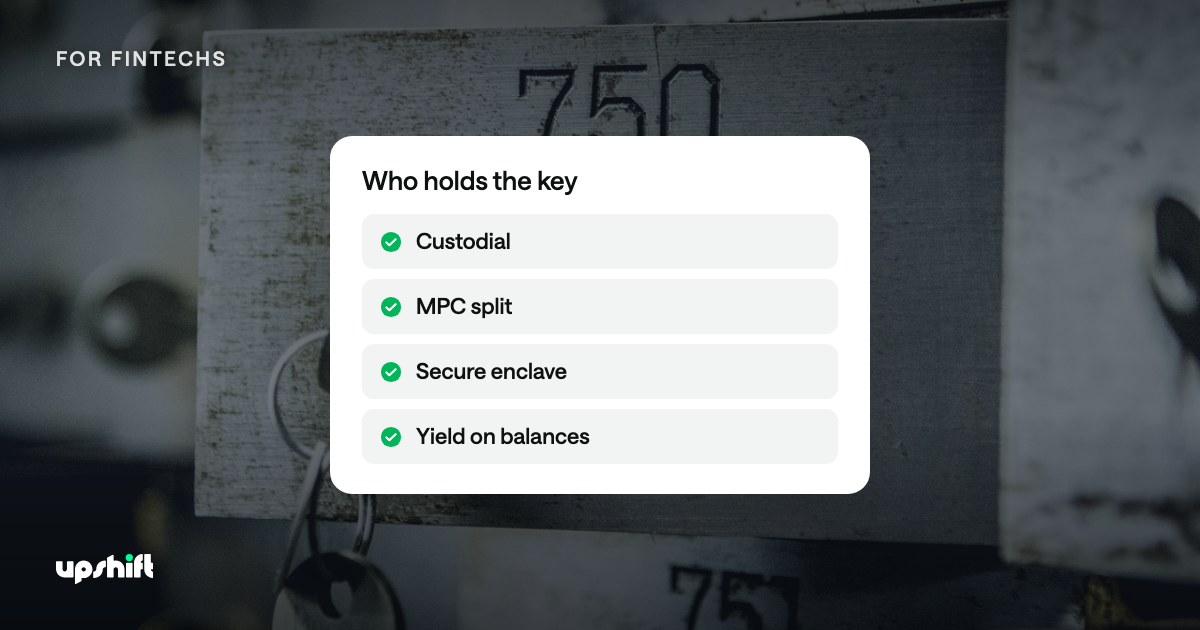
Think of a safe deposit box. In a custodial setup the bank holds the only key. With MPC, the box needs two keys turned at once, one held by you and one by the bank. With a secure enclave, the key sits inside a sealed machine at the bank that only opens when you show your ID.
The model sets who can move the money: the provider alone, the provider and the user together, or the user through a login.
In the diagram, a custodial wallet leaves the whole key with the provider or the app, as with BitGo or Circle's developer-controlled wallets. An MPC wallet splits the key into shares, one on the user's device and one with the provider (Para and MetaMask Embedded Wallets work this way). A secure enclave wallet keeps the key inside sealed provider hardware that signs only when the user logs in, which is how Privy, Turnkey and Coinbase describe theirs.
Model | Who can move funds | If the provider shuts down | Examples |
Custodial | The provider or the app | Depends on the custody agreement and any trust charter | BitGo, Circle developer-controlled wallets |
MPC split | User and provider together | Users need the provider's export or recovery process | Para, MetaMask Embedded Wallets, Fireblocks |
Secure enclave | The user, through a login | Users export their key through the provider's tools | Privy, Turnkey, Coinbase CDP |
An MPC wallet isn't automatically non-custodial. If the provider holds every share, it controls the money. Ask each provider who holds which share and how a user exports the key. MPC vs multisig explains the signing models in more detail. Enclave and MPC wallets still depend on the provider being online and on the login method. Check the export process, and whether users sign in with passkeys or email codes.
Which embedded wallets suit consumer and fintech apps?
Privy: best for apps on Stripe
Stripe announced its purchase of Privy in June 2025, when Privy had more than 75 million accounts. Its site now claims more than 160 million accounts and names Ramp, Deel, Hyperliquid and Klarna as customers. Privy's Earn API lets an app deposit wallet balances into tokenized money market funds, Aave, Morpho, Kamino or Veda vaults. The app can take up to 50% of the yield on Morpho as a fee. On Aave the cap is 100%. Privy suits consumer apps and fintechs that already use Stripe and want wallets and yield from one vendor.
Dynamic: best for exchanges and trading apps
Fireblocks bought Dynamic in October 2025, when Dynamic powered more than 50 million onchain accounts for customers including Kraken, zerohash, Magic Eden, Lighter and Ondo Finance. Dynamic handles the user-facing wallet and login, and Fireblocks provides the key infrastructure underneath. It suits trading apps that want consumer wallets now and institutional custody from the same group later.
Coinbase CDP Embedded Wallets: best for apps building on Base
Coinbase made its CDP Embedded Wallets generally available on 16 October 2025. Keys sit in trusted execution environments, the wallets run on EVM chains and Solana, and the first 5,000 wallet operations each month are free. US developers earn up to 3.85% in USDC rewards on balances across their CDP wallets, paid by Coinbase rather than earned in a vault. It suits apps on Base that want onramps and swaps built in.
Turnkey: best for teams that want low-level control
Turnkey runs keys inside secure enclaves and sells lower-level building blocks than most providers here. It raised a $30 million Series B led by Bain Capital Crypto in June 2025. In September 2026 it launched Swaps and Earn. Earn connects wallets to ERC-4626 vaults on Morpho and Aave across Ethereum, Base, Arbitrum and Polygon, lists only vaults with at least $100,000 in deposits, and takes the app's fee out of the yield. Turnkey suits engineering-heavy teams.
Circle Wallets: best for USDC-first apps
Circle offers user-controlled, developer-controlled and modular wallets on 10 chains, including Ethereum, Base, Solana and Monad. Its pricing is per active wallet: the first 1,000 a month are free, then $0.05 each, with a $0.01 rebate for wallets holding at least 10 USDC. Grab is a named customer. Circle Wallets has no yield feature. It suits payment apps built around USDC.
Magic: now part of Kraken's B2B business
Payward, Kraken's parent, agreed to buy Magic's wallet business in July 2026. Magic had powered more than 60 million wallets and $10 billion in stablecoin volume for more than 200,000 developers. Customers moved to Payward Services from 1 August 2026, and the rest of Magic became Newton Labs. Magic suits apps that want a wallet backed by an exchange group.
MetaMask Embedded Wallets: best for consumer brands
Consensys, the company behind MetaMask, bought Web3Auth in June 2025 and renamed the product MetaMask Embedded Wallets. It splits keys using MPC and secret sharing, and Web3Auth's users have included McDonald's and NBCUniversal. It fits consumer brands running loyalty or collectibles programmes.
Para: best for crypto apps that want MPC with a simple login
Para renamed itself from Capsule in February 2025. It splits each key 2-of-2 between the user's device and Para, and its site claims more than 15 million wallets. It fits crypto apps that want MPC wallets with a consumer login.
Crossmint: best for EU fintechs
Crossmint offers wallets on more than 50 chains and holds two EU licences: a MiCA crypto-asset service provider authorisation from Spain's CNMV and a payment institution licence from the Bank of Spain, both in force by 3 July 2026. That covers holding stablecoins and moving them as payments under one regulated provider. Crossmint suits European fintechs that don't want to license the wallet themselves.
Which wallet providers suit institutions?
Fireblocks: best for exchanges, banks and payment companies
Fireblocks uses MPC to split keys between the client and Fireblocks, and it served more than 2,500 financial institutions when it bought Dynamic. On 15 April 2026 it launched Earn in early access, with a Sentora-curated vault on Morpho and Aave's stablecoin lending markets. Fireblocks said it processed $6 trillion in stablecoin transfers in 2025. It suits large institutions moving stablecoins at volume.
BitGo: best for regulated custody
The OCC gave BitGo full approval in December 2025 to convert its South Dakota trust company into BitGo Bank & Trust, a national trust bank. Its wallet-as-a-service product bundles custodial wallets, staking and onboarding for fintechs and banks. It fits companies whose compliance teams want a federally chartered custodian holding the keys.
Fordefi: best for institutions active in DeFi
Paxos, the stablecoin issuer behind USDG and PYUSD, bought Fordefi in November 2025 for more than $100 million, according to reports at the time. Fordefi's MPC wallet was used by more than 200 institutions, mostly for trading and DeFi. On 8 September 2026 it added Earn, which lets clients find, deposit into, track and withdraw from yield vaults without leaving the Fordefi app. Upshift vaults were available in Fordefi Earn from launch day, including Sentora's RWA and BTC vaults and the earnAUSD vault on Monad. It suits funds and trading desks that interact with onchain protocols every day.
Can users earn yield on embedded wallet balances?
Yes, and five of the 12 providers now build it in. Privy, Turnkey, Fireblocks and Fordefi let an app send wallet balances into vaults or lending markets and take a fee from the yield. Coinbase pays developers USDC rewards on balances instead. In each case the yield comes from a vault, a lending market or a fund, because the GENIUS Act, signed in July 2025, bars stablecoin issuers from paying holders interest.
Provider | Where the money goes | Who gets the return | Launched |
Privy Earn | Tokenized money market funds, Aave, Morpho, Kamino, Veda | User, with the app taking a fee | Live (Oct 2026) |
Turnkey Earn | Morpho and Aave ERC-4626 vaults | User, with the app fee taken from yield | Sep 2026 |
Fireblocks Earn | Sentora-curated Morpho vault, Aave | The Fireblocks client | Apr 2026, early access |
Fordefi Earn | Yield vaults, from staking to Upshift vaults such as earnAUSD | The Fordefi client | Sep 2026 |
Coinbase CDP | Coinbase USDC rewards | The developer | Oct 2025 |
Rules on who can pay rewards are still moving. In March 2026 the OCC proposed a presumption against yield paid to stablecoin holders through affiliates or third parties, including exchanges and wallets. The CLARITY Act draft passed by the Senate Banking Committee would also have barred rewards that are "economically equivalent to deposit interest", though the bill stalled when a Senate cloture vote failed 49 to 50 on 15 September 2026. Yield earned by a user who deposits into a vault is a separate structure from an issuer or platform paying rewards. How the GENIUS and CLARITY Acts reshape stablecoin yield covers where the line sits.
What does wallet as a service cost?
Developer-focused providers price by usage. Circle charges $0.05 per active wallet after the first 1,000 a month, on its all-included plan for up to 5,000 wallets. Coinbase gives 5,000 wallet operations a month free, then charges per operation. Privy, Turnkey, Para and MetaMask price by monthly active users on their own pricing pages, and the plans change often. Institutional providers, Fireblocks, BitGo and Fordefi among them, price on request, usually as an annual contract.
How do you add a yield vault to an embedded wallet?
Upshift is onchain yield infrastructure that lets fintechs and asset managers offer yield inside their own products. Partners start with 24/7 tokenized money market funds and add higher-yield strategies, from lending to basis trades, on the same integration. A professional curator runs each stablecoin, BTC or ETH vault within risk limits set in advance, and depositors keep custody of their vault shares throughout.
Institutional teams on Fordefi can deposit into Upshift vaults through Fordefi Earn, live since 8 September 2026. For a wallet app, the vault share sits in the customer's embedded wallet next to their USDC, whichever provider runs the keys. Upshift's single-asset vaults implement the ERC-4626 interface, and exits run through a daily request and claim or an instant redemption for a fee, subject to liquidity. Tria went live on the Upshift SDK two weeks after starting its integration. The contracts have been through 11 smart contract audits by 6 independent firms. How neobanks and fintechs offer stablecoin yield and how exchanges build an Earn product cover the product design.
Vault yields vary and aren't guaranteed. Vaults carry smart contract, strategy and liquidity risk, with no deposit insurance, and a wallet provider's key model doesn't change the risk of the vault the money goes into.
Always make sure to do your own research and be aware of the above and any other risks before depositing.
Adding Earn to your app's wallets? Tell us which wallet provider and chains you use, and we'll send a vault menu that fits them.
Frequently asked questions
What is wallet as a service?
Wallet as a service is a set of APIs and SDKs that lets an app create crypto wallets for its users without building key management itself. The provider handles key storage, signing, recovery and chain support.
Is an embedded wallet custodial?
Whoever can sign controls the money. A wallet where the provider or app holds the whole key is custodial. MPC and enclave wallets where only the user can authorise a transaction are usually treated as non-custodial, though the legal answer varies by country.
Which wallet as a service provider is best for fintechs?
Privy suits fintechs on Stripe, Crossmint suits EU fintechs that need licensed stablecoin payments, and BitGo suits teams whose compliance function wants a chartered custodian. Fireblocks fits larger payment companies.
Do I need a licence to offer embedded wallets?
Often not for a non-custodial wallet, though custodial wallets and stablecoin transfers can need a money transmitter licence in the US or MiCA authorisation in the EU. Crossmint and BitGo hold licences that partners can operate under.
Can embedded wallets earn yield on USDC?
Yes, through Privy Earn, Turnkey Earn, Fireblocks Earn, Fordefi Earn or a vault integrated directly. Coinbase also pays US developers USDC rewards on CDP wallet balances.
What happens to an embedded wallet if the provider shuts down?
Non-custodial providers offer key export, which lets users move to another wallet. Magic's customers moved to Payward Services in August 2026 without a manual migration.
Keep reading
- Banking as a service providers compared. The bank side of an embedded finance stack.
- Embedded yield. The routes apps use to add Earn to customer balances.
- What is Morpho. The lending protocol behind several wallet Earn products.
- USDC yield. Where a return on USDC comes from and what each route pays.
Launch a vault with Upshift
Upshift builds custom, permissioned vaults for custodians, exchanges, neobanks and asset managers. Tell us what you are building and the team will follow up.
Create a vault with Upshift
Share your use case and we’ll get back to you shortly