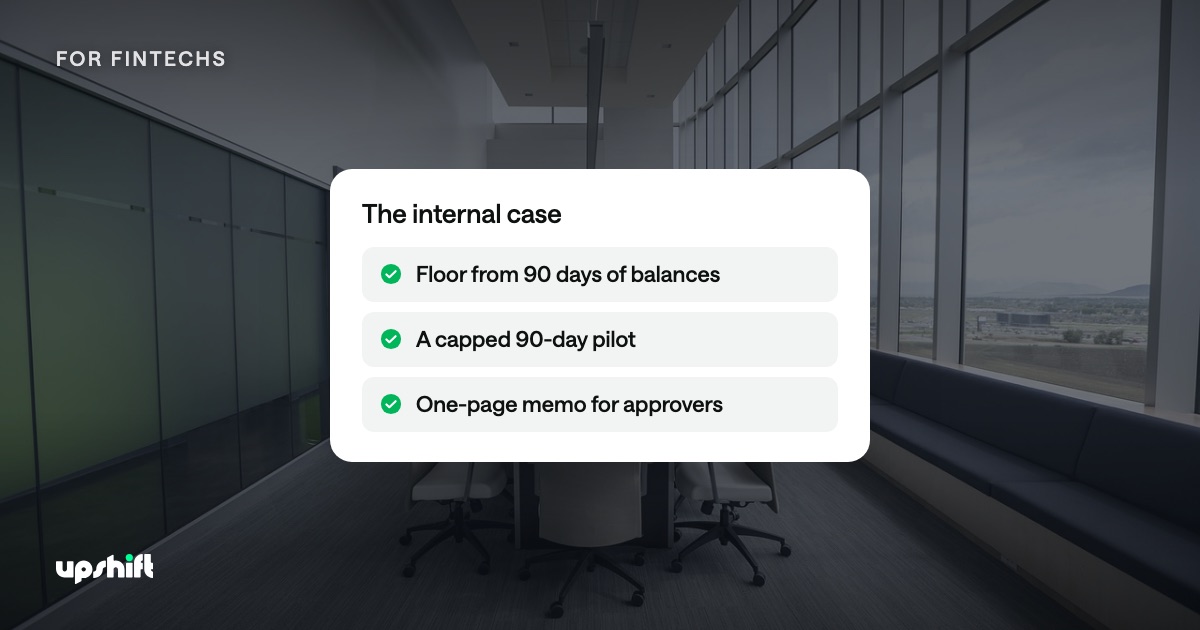
The internal case for yield on idle stablecoin balances

Finance teams that get yield on idle stablecoin balances approved usually start from the part of the balance that never moves. Most ask for a capped pilot with a tested exit before anything bigger.
Take a payments company whose USDC balance swung between $22 million and $41 million over the last 90 days. The $22 million floor never moved. At the 13-week Treasury bill rate of 4.13% on 2 November 2026, it would have earned about $908,600 a year. Most internal cases for yield on idle stablecoin balances start from a floor like that one. Approval then runs through several people, each with a different question.
The same $22 million in an interest checking account at the FDIC's national average of 0.07% earns about $15,400. USDC held in a wallet earns nothing at all. A gap that size usually gets a CFO's attention. The harder questions come later, about how the money comes back and who checks it.
Who has to say yes, and what each one asks
Six groups usually weigh in before a payments company or neobank moves part of a buffer. Each starts from a different first question.
Who | What they ask | What to bring |
CFO and finance | How much does it earn, after fees, and how do we book it? | The floor, a rate per band, the net figure, and your auditor's view on the vault shares |
Treasury and operations | Can we get the money back before a payout? | The exit terms per vault, matched against the payout calendar |
Compliance | Whose money is it, who's the counterparty, and is it allowed? | A list of which balances are your own, the contracting entity, and counsel's view per market |
DD and internal audit | What controls stop the money going somewhere it shouldn't? | Audit reports, the vault's roles and owner multisig, and how NAV is checked |
Engineering | What do we have to build and run? | The integration path and a test plan with small amounts on mainnet |
CEO and board | What's the worst case, and how big is the bet? | A pilot size, a review date, and the risks in one list |
Most teams circulate a one-page memo that answers all six.
How much of the balance can earn?
Treasury teams usually size the earning slice from 90 days of daily balances. The lowest point in that window becomes the floor, since that money stayed put through every payout run. In the example, the payments company's balance never fell below $22 million, swung up to $35 million in a normal week and reached $41 million at month-end.
Slice | In the example | How long it sits | Where it can go |
Floor | $22M | The whole 90 days | Cash band vault, with part in Core once the pilot ends |
Weekly swing | $22M to $35M | Hours to a few days | A tokenized money market fund with instant redemption, or plain USDC |
Month-end peak | $35M to $41M | A day or two | Stays liquid |
Upshift groups its vaults into three bands. Cash holds tokenized Treasury and money market funds at 3-4% indicative, Core holds blue-chip lending and AAA credit at 5-7%, and Enhanced runs custom strategies at 8% and up, all before vault fees as of 3 November 2026 on the yield options page. If the payments company put $15 million of its floor in a Cash vault at 3.5% and $7 million in a Core vault at 6%, the split would earn about $945,000 a year before fees.
The weekly swing still earns something if it sits in a fund that redeems at any hour. Ondo's OUSG showed a 3.74% APY on 3 November 2026 and redeems to USDC instantly. What payment companies can do with idle stablecoin balances prices every option on a $20 million buffer.
Finance: the revenue line and how to book it
Finance wants a number it can defend. A typical model takes the floor, a rate inside the band range and the vault's fees, and puts the net figure next to what the money earns today. Most show a range instead of a point estimate, because every rate in the model floats with US short rates.
For a neobank or platform that offers Earn to customers, the revenue line is a fee share on customer balances. The Upshift integration guide lists three ways a partner earns: an origin fee on each deposit, a fee wrapper share class, or a share of vault fees. That's a new line in the P&L, and it grows with customer balances.
Finance teams tend to ask the auditor early how it will classify the vault shares. The vault publishes a share price to mark to, and the institutional API returns NAV history, positions and the fee schedule for each vault. Auditors usually ask for that data before the first quarter-end, and treasury teams often set up the export before the first deposit.
What will compliance want to see?
Compliance starts with whose money it is. A company's own surplus USDC is its to invest. Money held for customers usually isn't, and in the UK only the payment institution may hold an interest in safeguarded funds under regulation 23 of the Payment Services Regulations 2017.
- Which balances. Compliance teams sort each balance by owner: the company's own buffer, prefunded accounts in its name, and customer funds. Pilots usually include only the first two, unless counsel says otherwise.
- Who the counterparty is. Compliance asks each provider which legal entity signs the contract and which law governs it.
- Who holds the shares. Shares can sit in your own wallet or with a custodian. Kraken Institutional clients, for example, get the receipt token back in a segregated custody account.
- Who else is in the vault. A single-depositor vault limits deposits and withdrawals to your wallet, enforced onchain.
- Where the yield comes from. The GENIUS Act bars US payment stablecoin issuers from paying holders interest. Vault yield comes from the assets the vault holds, such as T-bills or loans.
UK firms also run daily reconciliation of safeguarded funds under the FCA's PS25/12 rules from 7 May 2026. This section is general information, and counsel confirms what applies in each market. Where stablecoin yield comes from covers each source of yield, which is often the first thing compliance asks about.
DD and internal audit: the controls to document
DD and internal audit want controls they can check, ideally onchain. For an Upshift vault, that file holds:
- 11 smart contract audits by 6 independent firms, with the reports.
- The vault's roles, read from the contract: a multisig owner, the operator, and a separate multisig for code upgrades, set out on the risk controls page.
- How the price is checked. Every Upshift vault is priced and settled by Upshift, which validates the curator's net asset value before it reaches depositors.
- Where the money can go: the strategy perimeter and the protocols the curator is allowed to use.
Upshift also shares a data room and DDQ answers on request. The vault provider due diligence checklist lists the questions to send any provider, Upshift included.
Treasury and engineering: exits and integration
Treasury's question is how fast the money comes back. Most Upshift vaults use a 72-hour withdrawal period, with a range of 1 to 30 days across vaults and no fee on a standard withdrawal. An instant exit is available up to each vault's USDC buffer, for a fee set per vault from zero to about 0.2%.
Two details belong in the treasury runbook. A pending withdrawal request can't be cancelled. The payout is priced at the vault's share price when the claim settles, and Upshift processes claimable withdrawals daily.
Engineering work is small when the company invests its own balance. A treasury team can deposit from its own wallet, through a branded vault page, or through a custodian's Earn product. A customer-facing Earn feature takes more build, though Tria went live two weeks after starting on the Upshift SDK, according to the Tria case study.
How do you start without moving the whole buffer?
Most first approvals cover a pilot. A typical pilot takes a slice of the floor, has an end date and includes an exit drill in its first few weeks.
Pilot term | In the example |
Amount | $3M, about 14% of the $22M floor |
Band | Cash: tokenized Treasury and money market funds, 3-4% indicative |
Vault setup | Single-depositor vault, the company only |
Length | 90 days, then a review |
Exit drill | A queued withdrawal in week 2, timed end to end, plus a $50,000 instant exit (at 0.2%, $100) |
Expected earnings | About $25,900 over 90 days at 3.5%, against about $520 at 0.07% |
Review | Realised yield against the T-bill rate, exit times against the stated terms, and any reconciliation issues |
The pilot's earnings are small on purpose. Its job is to put real exit times and a real reconciliation in front of the board.
A one-page memo outline
Most approvals run on one page, in this order.
- The balance: 90-day floor, swing and peak, with the source.
- The proposal: pilot size, band, vault setup and length.
- The numbers: net earnings at the low and high end of the band, against the current account rate.
- Controls and exits: audits, roles, NAV checks, withdrawal terms, and which balances are excluded.
- Risks and the review date, with who decides what happens after 90 days.
Where Upshift fits
Upshift is onchain yield infrastructure that lets fintechs and asset managers offer yield inside their own products. Partners start with 24/7 tokenized money market funds and add higher-yield strategies, from lending to basis trades, on the same integration. A professional curator runs each stablecoin, BTC or ETH vault within risk limits set in advance, and depositors keep custody of their vault shares throughout.
Ethena Pay users moved more than $3.5 million into Earn+ on its first day, 28 October 2026, according to the Ethena Pay case study. Uphold customers move RLUSD into Uphold Earn in the Uphold app, where Sentora lends it in Morpho markets.
What can go wrong
- A stablecoin can trade below $1 for a period.
- Smart contract risk: Upshift vault contracts have had 11 smart contract audits by 6 independent firms.
- A large withdrawal waits for the queue once the instant buffer is used up.
- Rates fall when the Fed cuts, and the band ranges move with them.
Vault yields float with the market and aren't guaranteed. Always make sure to do your own research and be aware of the above and any other risks before depositing.
Building the case for your idle balances? Send us your 90-day balance range and payout calendar, and we'll send back a pilot size, the band numbers and the exit terms to put in your memo.
Frequently asked questions
How much of a stablecoin buffer can earn yield?
Most teams start from the lowest balance over the last 90 days. That floor stayed put through every payout run, and no near-term payout depends on it. Swings above it suit funds with instant redemption.
What does a CFO need to approve stablecoin yield?
A net revenue figure at the low and high end of the band range, the exit terms, and the auditor's view on how to book the vault shares. A capped pilot with a review date makes the first approval smaller.
Can customer funds go into the pilot?
Usually not. Funds held under safeguarding or FBO rules follow their own rules, and FBO account interest goes to the bank and the program agreement. A pilot normally uses the company's own buffer.
How long does a pilot take to set up?
For a company investing its own balance, mostly the time compliance and DD need. The deposit itself can come from a company wallet or a custodian, with no product build.
What happens if we need the money back early?
You request a withdrawal and receive it after the vault's withdrawal period, 72 hours on most vaults. An instant exit up to the vault's USDC buffer costs a fee set per vault, from zero to about 0.2%.
Keep reading
- Vault provider due diligence: the questions DD sends a provider.
- Segregated vs co-mingled vault accounts: when your company should be the only depositor.
- Stablecoin vault redemption times: exit terms across providers.
- Tokenized money market funds vs stablecoin vaults: holding a fund directly or through a vault.
Launch a vault with Upshift
Upshift builds custom, permissioned vaults for custodians, exchanges, neobanks and asset managers. Tell us what you are building and the team will follow up.
Create a vault with Upshift
Share your use case and we’ll get back to you shortly