Where does stablecoin yield come from? Five sources

Stablecoin yield is money someone pays to use your dollars, and every payer brings its own risk. Upshift vaults start with the T-bill rate and add other sources on the same integration.
On 15 October 2026, 3-month US Treasury bills paid 4.10%, according to the Federal Reserve's daily series. That rate is the yardstick for nearly every stablecoin yield you'll see. Stablecoin yield comes from five payers: the US government, borrowers on lending markets, futures traders, companies borrowing private credit, and traders or protocols that pay liquidity providers. Each pays for something different, and none of it is risk-free.
A stablecoin on its own earns you nothing. Under the GENIUS Act, signed on 18 July 2025, a US payment stablecoin issuer can't pay holders interest for holding the coin. Any return on your balance comes from putting the dollars to work with someone who pays to use them.
Where does stablecoin yield come from?
Stablecoin yield always traces back to a person or institution that pays to use your money. A stablecoin behaves like a dollar bill in a drawer. It holds its value and earns nothing until you lend it out, buy something with it that pays interest, or rent it to traders who need it for a few hours or a few months.
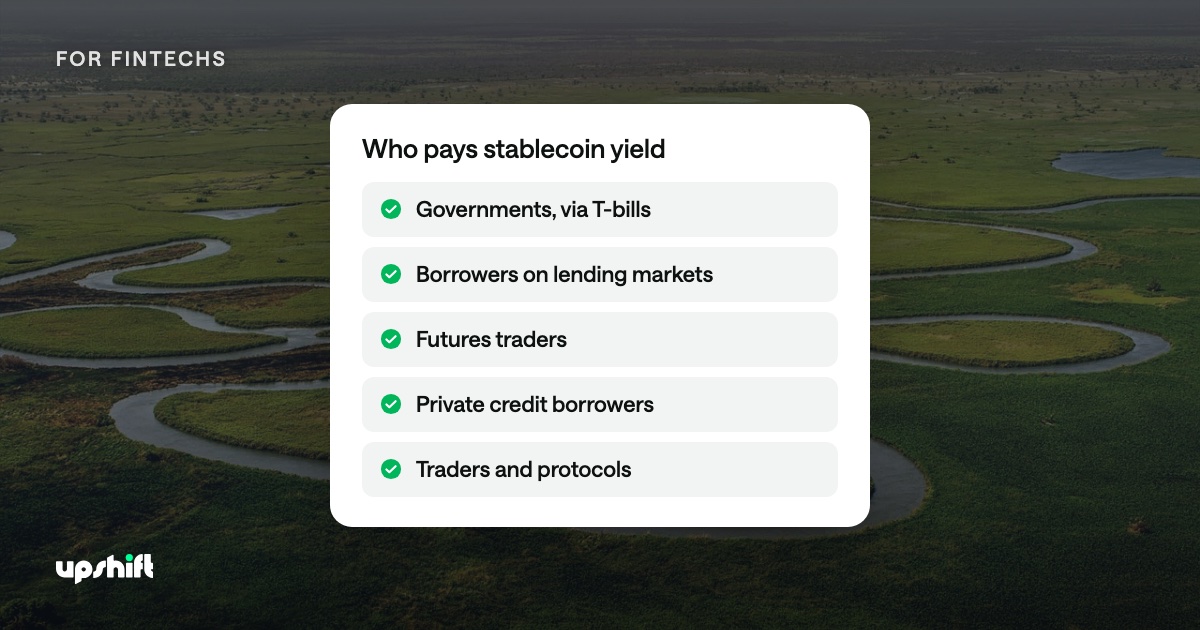
You deposit USDC into a vault and receive vault shares. A curator, typically a hedge fund or asset manager, places the USDC with one or more of five payers:
- The US government, which pays interest on the T-bills held by tokenized money market funds.
- Borrowers on lending markets such as Aave and Morpho, who lock up collateral valued above the loan.
- Futures traders, who pay a funding rate to whoever holds the hedged side of the trade.
- Companies borrowing private credit, which pay interest on loans that often run for a fixed term.
- Traders and protocols, which pay swap fees and reward tokens to liquidity providers.
The payments flow back into the vault and lift the value of each share, which means the yield reaches you through a rising share price and no separate interest payment ever lands in your wallet. When you redeem, you get USDC back at the share price on the day the withdrawal settles. The vault accounting docs show the share math step by step.
Stablecoin yield sources side by side
Source | Who pays you | Rate seen (date) | What can go wrong | How a vault holds it | Upshift band |
T-bills and tokenized money market funds | The US government | 3-month T-bill 4.10% (15 Oct 2026); tokenized Treasury funds 3.58% 7-day APY (17 Oct 2026) | Rate falls when the Fed cuts; fund issuer terms and redemption hours | Fund tokens plus a USDC buffer | Cash |
Overcollateralized lending | Borrowers who post collateral | Aave USDC on Ethereum 3.76% (17 Oct 2026); large Morpho USDC vaults on Base 3.2% to 4.8% | Bad debt if collateral falls faster than liquidations; withdrawals wait when most of a pool is lent out | Supply positions in lending markets | Core |
Basis and funding rates | Futures traders on the long side | Ethena sUSDe 4.75% (14 Oct 2026); 10.3% average since launch | Funding turns negative; exchange or custodian failure | Hedged spot and short futures, or a token such as sUSDe | Enhanced |
Private credit | Companies that borrow | Maple USDC pool 5.24% (17 Oct 2026) | Borrower default; term loans that can't be called early | Tokenized loans or credit fund shares | Core or Enhanced, by borrower quality |
Liquidity provision and incentives | Traders (swap fees) and protocols (reward tokens) | Median swap-fee APY 0.12% on stablecoin pools above $10M (17 Oct 2026) | Incentives end; a stablecoin in the pool loses its peg | LP tokens, with rewards claimed and sold | On top of a band |
Rates come from FRED, rwa.xyz, Ethena, Morpho and DefiLlama on the dates shown. They move daily. Upshift's yield options page lists indicative ranges for each band, before vault fees: 3-4% for Cash, 5-7% for Core and 8% or more for Enhanced. No yield is guaranteed.
T-bills and tokenized money market funds
A tokenized money market fund pays you the interest the US government pays on short-dated Treasury bills, minus the fund's fee. A T-bill works like a short IOU from the government. TreasuryDirect sells bills for 4 to 52 weeks at a discount, and pays the full face value at maturity. The gap between the two is your interest.
A money market fund pools those bills, and a tokenized version issues its shares as tokens you can hold in a wallet. On 17 October 2026, rwa.xyz counted $14.69B in tokenized Treasury funds paying an average 7-day APY of 3.58%. That's below the 4.10% bill rate, mostly because of fund fees and the mix of bill maturities each fund holds.
Three things can go wrong with a T-bill fund:
- The rate moves. When the Federal Reserve cuts rates, the yield on new bills drops within weeks, and the fund's yield follows.
- Issuer terms. Many funds only accept holders the issuer has approved, set minimums, and redeem on business days.
- Smart contract and wrapper risk, which a paper T-bill doesn't carry.
A vault holds the fund tokens on your behalf, next to a USDC buffer that pays out withdrawals. This is the Cash band. Our post on stablecoin yield without DeFi shows how fintechs pay this rate to customers. Our comparison of tokenized money market funds vs stablecoin vaults covers holding a fund directly or through a vault.
Overcollateralized lending on Aave and Morpho
On lending markets, borrowers pay you interest to borrow your USDC, and they lock up collateral valued above the loan. A pawnshop runs the same deal: someone hands over a $150 watch to borrow $100, and if they don't repay, the shop sells the watch. On Aave or Morpho the collateral is usually ETH, BTC or a tokenized asset. A smart contract sells it if its value falls too close to the loan.
The rate floats. Aave's interest rate strategy sets the rate from the pool's usage ratio, with a gentle slope up to a target level and a steep one above it. On 17 October 2026, DefiLlama data showed Aave's main USDC pool on Ethereum paying lenders 3.76%, with a 30-day average of 4.34%. The largest Morpho USDC vaults on Base paid between 3.2% and 4.8%, according to Morpho. Lending paid slightly less than T-bills that week, and the order flips when borrowing demand rises.
Two things break. If collateral falls faster than liquidations can sell it, the pool is left with bad debt that lenders share. And if most of the pool is lent out, you wait to withdraw until borrowers repay or new deposits arrive. A vault holds supply positions in one or more markets and spreads deposits across them. Upshift puts blue-chip lending in the Core band, and our explainer on DeFi lending covers utilization and exits in more detail.
Basis trades and funding rates
In a basis trade, futures traders betting on rising prices pay a fee to whoever holds the opposite side. That fee is the funding rate. A delta-neutral strategy buys a crypto asset and sells the same amount in perpetual futures at the same time. The price exposure cancels out. What's left is the funding payment, plus any staking yield on the asset you hold.
An analogy that holds up reasonably well is a warehouse that owns grain and has already sold it forward. The owner doesn't care whether grain prices rise or fall, because the two positions offset each other. The owner earns the premium that buyers pay to get exposure now and settle later. In crypto, that premium tends to grow when traders are optimistic and shrink or turn negative when they're not.
Ethena's funding risk page puts average BTC and ETH funding at 7.8% to 9% a year over three years, 2022 included. Ethena's sUSDe, which passes this income to stakers, paid 4.75% on 14 October 2026 and has averaged 10.3% since launch, according to ethena.fi. The 14 October rate was less than half the average since launch. You're paid for lending price exposure to other traders, and their demand rises and falls with the market.
The main risks:
- Funding turns negative and the strategy pays instead of earning. Ethena's reserve fund is meant to absorb that, though its share of new revenue is currently set at 0%.
- An exchange or custodian holding the futures position fails or freezes withdrawals.
- The hedge breaks during a sharp price move, or a token like USDe trades away from $1 on one venue.
- Capacity: the trade only pays while there are enough traders on the other side.
A vault can hold a basis position two ways. It can hold a token such as sUSDe, or a curator can run the hedged position directly across onchain protocols and exchanges. Upshift puts market-neutral strategies in the Enhanced band. Our posts on funding rate arbitrage and Ethena USDe cover the mechanics and the history.
Private credit and tokenized loans
Private credit pays you the interest a company pays on a loan. You stand where a bank would on a business loan. The borrower might be a trading firm, a fintech lender or a fund. The loan often runs for a fixed term of several months, and lenders usually earn more than the T-bill rate in return for carrying the borrower's credit risk until it's repaid.
On 17 October 2026, rwa.xyz counted $8.16B in tokenized credit held by investors onchain. Maple's main USDC pool, one public benchmark, paid 5.24% the same day according to DefiLlama. The things that go wrong are the familiar ones from traditional lending. A borrower defaults, and recovery depends on the collateral and the legal agreement behind the loan. A term loan can't be called early, and the money stays locked until the borrower repays.
A vault holds tokenized loans or credit fund shares. Some vaults lend to vetted institutional borrowers against collateral, with margin calls handled offchain. The band depends on the borrower's credit quality. Upshift's Core band includes tokenized credit such as AAA-rated CLOs, and loans to lower-rated or unrated borrowers sit in Enhanced. Our explainer on RWA tokenization covers how these assets get onchain.
Liquidity provision and incentives
Liquidity providers deposit two stablecoins into a trading pool, and traders who swap between them pay a small fee on each trade. Picture a currency exchange booth at an airport that earns a sliver on every swap. Between two dollars, it's tiny. On 17 October 2026, the 46 stablecoin-to-stablecoin pools on DefiLlama holding more than $10M had a median fee yield of 0.12%.
Most of the headline yield on these pools comes from incentives, meaning tokens a protocol or issuer hands out to attract deposits. Of those 46 pools, 15 paid rewards that day. A Curve USDC-RLUSD pool, for example, showed 4.36%, almost all of it from rewards. Incentives are a marketing budget with an end date.
A reward paid in a protocol's own token is only as good as the price you can sell it for. If one stablecoin in the pool loses its peg, traders swap into the good one and you're left holding more of the bad one. Our post on stablecoin depegs shows how that plays out.
A vault holds LP tokens, claims the rewards and usually sells them for USDC. Incentives sit on top of a band and don't form one.
Is stablecoin yield ever free of risk?
Stablecoin yield is never risk-free, and the T-bill rate is as close as it gets. Finance textbooks use the T-bill rate as the benchmark for a riskless return, because the US government is the borrower. Put the bill inside a fund and the fund onchain, and you add a fund manager, a smart contract and redemption hours. Each one adds a little risk.
A higher rate always pays you for something specific. Lending adds collateral and liquidity risk, basis adds funding and exchange risk, credit adds default risk, and incentives add the risk that the rewards stop. When a provider quotes 8% on stablecoins, ask which of the five payers sits on the other side. Then ask what happens to your money if that payer stops.
Always make sure to do your own research and be aware of the above and any other risks before depositing.
How does a vault hold each source?
A stablecoin vault holds the positions for you and gives you one share token that rises in value as the positions pay. Upshift is onchain yield infrastructure that lets fintechs and asset managers offer yield inside their own products. Partners start with 24/7 tokenized money market funds and add higher-yield strategies, from lending to basis trades, on the same integration. A professional curator runs each stablecoin, BTC or ETH vault within risk limits set in advance, and depositors keep custody of their vault shares throughout.
Upshift groups vaults into three bands, ordered by risk:
- Cash: tokenized T-bill and money market funds, 3-4% indicative.
- Core: blue-chip lending and tokenized credit, 5-7% indicative.
- Enhanced: market-neutral strategies such as basis and funding, 8% or more indicative.
Platforms can start with Cash and add Core or Enhanced once the first product has a track record, without a second integration. Most Upshift stablecoin vaults use a 72-hour withdrawal period, and the full range runs from 1 to 30 days. Instant exits run up to the size of the vault's USDC buffer, for a fee set per vault, from zero to about 0.2%. The how it works docs follow a deposit from start to finish, and our guide to stablecoin redemption times compares exit speeds across providers.
Add stablecoin yield to your product, from 24/7 tokenized MMFs to DeFi. Tell us the balance you hold and how fast it needs to come back, and we'll show you which band each part of it fits.
Frequently asked questions
How do stablecoins generate yield?
Yield comes from lending the stablecoin, buying an interest-paying asset with it, or providing it to traders. Under the GENIUS Act, a US payment stablecoin issuer can't pay holders interest for holding the coin.
What is the safest source of stablecoin yield?
Tokenized funds holding short-dated US Treasury bills carry the least credit risk, because the US government is the borrower. They still carry fund, smart contract and redemption-timing risk, and their yield falls when the Fed cuts rates.
Why do some stablecoin yields reach 10% or more?
Rates above roughly 6% usually come from funding rates in a strong market, borrowed money layered on a position, riskier borrowers or token incentives. Ethena's sUSDe averaged 10.3% since launch but paid 4.75% on 14 October 2026.
Can stablecoin yield go negative?
The funding rate in a basis trade can turn negative, and a lending pool with bad debt can lose principal. A T-bill fund's yield can fall close to zero if the Fed cuts rates to zero, as it did in 2020.
How fast can I get my money out of a stablecoin vault?
It varies by vault. Most Upshift stablecoin vaults settle withdrawals in 72 hours. You can exit instantly up to the size of the vault's USDC buffer, for a fee set per vault that can be zero.
Is stablecoin yield the same as bank interest?
They work differently. A bank sets the interest on a deposit, and deposit insurance may cover the balance. Stablecoin yield comes from the market positions behind it, floats daily and carries no deposit insurance.
Keep reading
- Stablecoin yield for businesses. How a business earns on its own balance or offers yield to customers.
- T-bill rate on stablecoin balances. How fintechs pay the Cash band rate to customers.
- Tiered stablecoin yield. How neobanks price each band.
- Stablecoin vault risk controls. The limits each vault enforces, compared.
Launch a vault with Upshift
Upshift builds custom, permissioned vaults for custodians, exchanges, neobanks and asset managers. Tell us what you are building and the team will follow up.
Create a vault with Upshift
Share your use case and we’ll get back to you shortly