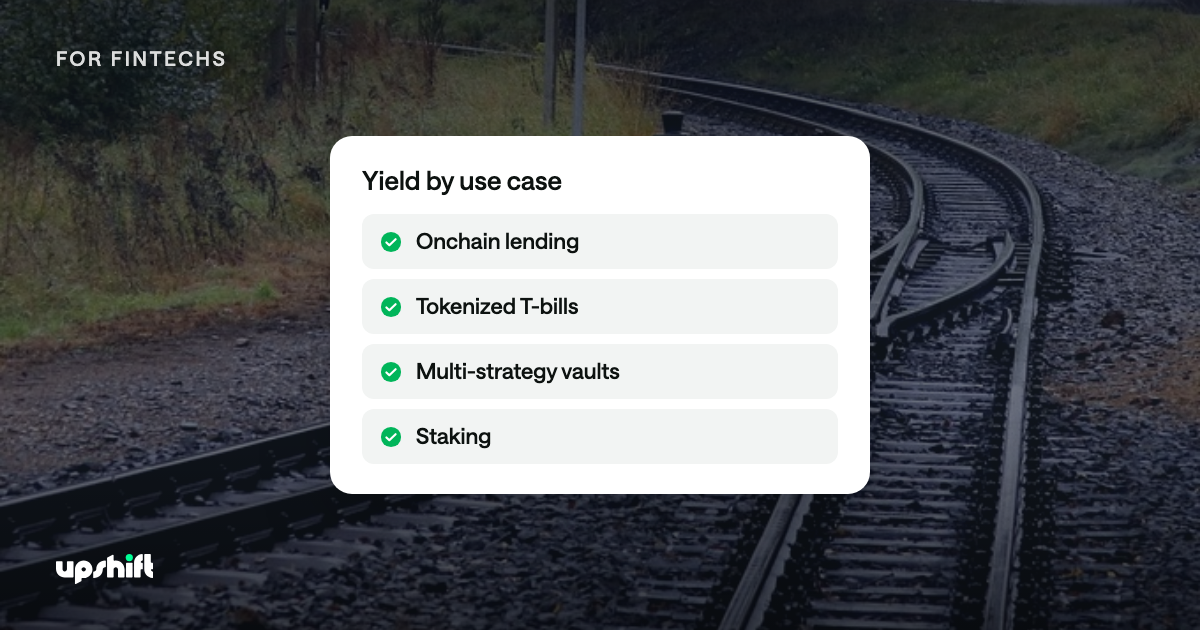
Morpho alternatives: 10 yield options by use case

Morpho is an onchain lending network with curated lending vaults. Teams that need yield from tokenized funds or several strategies at once use a different tool for that part.
On 24 September 2026, Morpho's Paul Frambot wrote that Morpho's core purpose is to build onchain credit markets connecting lenders and borrowers, and that Morpho Vaults exist to spread deposits across those markets under a fixed set of rules. Teams look for Morpho alternatives when their product needs yield from somewhere other than overcollateralized lending, such as tokenized Treasury bills, staking or a mix of DeFi and centralised strategies.
The main Morpho alternatives in October 2026, grouped by use case, are Aave and Spark for lending-only yield; BlackRock's BUIDL, Ondo's OUSG and Superstate's USTB for tokenized T-bills; Upshift for multi-strategy curated vaults across DeFi and CeFi under your own brand; Midas and Upshift for fund-style tokens; and Kiln for staking. Several of them work alongside Morpho. Upshift curators can allocate into Morpho markets, and Kiln's DeFi product routes stablecoins into lending vaults on Morpho and other protocols.
Which Morpho alternatives fit which use case?
Provider | Use case | Where the yield comes from | Who decides the allocation | Who can hold it | Size on its own site (4 Oct 2026) |
Morpho (for reference) | Curated onchain lending, variable and fixed rate | Interest from overcollateralized borrowers | A curator sets caps; an allocator moves funds between Morpho markets | Open, with optional gates per vault | $16.93B total deposits, $5.57B outstanding loans |
Upshift | Multi-strategy curated vaults across DeFi and CeFi, under your brand | Set per vault: tokenized money market funds, lending, fixed-rate and basis positions, institutional credit | A professional curator per vault, inside limits written into the contract | Open, whitelisted or sole-depositor, set per vault | $550M+ peak deposits, 50+ vaults, 30+ chains |
Aave | Lending-only yield | Interest from overcollateralized borrowers | Pool rates follow supply and demand; governance sets risk parameters | Open | $33.8B net deposits, 2.5M+ users |
Spark | Lending and savings around Sky's USDS | Borrower interest plus Spark's allocations to other markets | Spark's allocation framework | Open | $4.92B Savings TVL, $4.65B SparkLend TVL |
BlackRock BUIDL | Tokenized money market fund | Short-term US government securities | BlackRock as fund manager | Qualified purchasers, through Securitize | $2.25B, 106 holders (rwa.xyz) |
Ondo OUSG | Tokenized Treasury fund | Short-term US Treasuries, mainly through BUIDL | Ondo | Qualified purchasers, $5,000 minimum | $321M TVL (3 Oct 2026) |
Superstate USTB | Tokenized Treasury fund | Short-duration Treasury bills | Invesco as fund adviser | Accredited investors and qualified purchasers | $744.1M assets under management |
Midas | Fund-style tokens | An external manager's strategy | The strategy manager | Non-US investors, under a prospectus | $735.6M TVL |
Kiln | Staking yield | Proof-of-stake network rewards | Kiln runs the validators | Through custodians, exchanges and wallets | $18B+ assets delegated at peak |
Sizes measure different things: Morpho and Aave show deposits, and Kiln shows assets delegated at its all-time high. BUIDL's figure comes from rwa.xyz, and Midas's from its homepage on 4 October 2026.
What is Morpho built for?
Morpho runs two kinds of lending market. Its variable rate markets, known as Morpho Blue, each pair one collateral asset with one loan asset, an oracle, an interest rate model and a liquidation loan-to-value ratio, and those parameters never change after deployment. Anyone can create a market. Morpho Midnight, live since 21 July 2026, adds fixed-rate markets where lenders and borrowers trade units that mature on a set date.
On 22 September 2026, Coinbase launched fixed-rate, bitcoin-backed USDC loans on Midnight. They sit next to its variable-rate Morpho loans, which Morpho says have passed $1.4 billion in active loans against roughly $3 billion of collateral.
Morpho Vault V2 is the layer most fintechs touch. A curator sets absolute and relative caps on risk factors such as a collateral asset or an oracle, an allocator moves deposits between approved markets, and a sentinel can cut exposure or cancel a pending change. Most curator actions are timelocked. Depositors can exit in kind into the underlying market position if a vault runs short of idle cash. Optional gate contracts can limit who deposits (a KYC list, for example).
Morpho's homepage showed $16.93 billion in total deposits and $5.57 billion in outstanding loans on 4 October 2026, and its Vault V2 factory is deployed on 49 mainnets. Kraken, Ledger, Fireblocks, Coinbase, Robinhood, Deel, Crypto.com and Circle are among the companies it lists as building on it. Every Morpho vault earns what borrowers pay on collateralized loans, and what is Morpho walks through the markets in more detail.
What are the alternatives for lending-only yield?
Aave and Spark also pay depositors the interest borrowers pay, and both run pooled markets in place of Morpho's isolated pairs. DeFi lending explains how lenders earn and how they get their money out on each.
Morpho vs Aave
The two differ mainly in market design. Morpho isolates each collateral and loan pair in its own market and lets curators build vaults on top. Aave runs shared pools where many collateral assets back loans from the same reserves, with risk parameters voted by Aave governance. An Aave depositor carries the risk of that pool's whole collateral list. A Morpho vault depositor carries the risk of the markets the vault's curator has enabled, up to its caps. Both pay variable rates, and Morpho adds fixed-rate lending through Midnight.
Aave showed $33.8 billion in net deposits and 2.5 million+ users on its homepage on 4 October 2026. It names Whop, Kraken and MetaMask among the apps offering Aave-powered yield to their users.
Spark: lending and savings around USDS
Spark runs SparkLend, Spark Savings and the Spark Liquidity Layer, which deploys capital across savings, lending, institutional credit and approved markets. Its homepage showed $4.92 billion in Savings TVL, $4.65 billion in SparkLend and $2.04 billion in the Liquidity Layer on 4 October 2026. Spark sells to institutions, stablecoin issuers and fintechs, and USDS from the Sky ecosystem is the stablecoin at the centre of its borrowing market.
Which platforms run multi-strategy curated vaults across DeFi and CeFi?
Upshift is onchain yield infrastructure for fintechs and asset managers with stablecoin balances. Depending on its mandate, one Upshift vault can hold 24/7 tokenized money market funds, lend on Morpho or Aave, run fixed-rate or basis positions, or lend to institutional borrowers. Morpho is often one of the venues inside that mandate. A professional curator such as Sentora runs each vault inside limits written into the contract, and vaults sit in Conservative, Core and Enhanced bands. Partners usually start with a tokenized money market fund vault and add strategies later on the same integration.
For curators on Upshift prime accounts, the Upshift prime stack adds a policy engine that limits each curator by chain, protocol, token and function. It also adds credit and reach into centralised venues through an institutional lender network that has originated more than $800 million in loans. Each vault's owner is a Gnosis Safe multisig. Contract upgrades need 4 of 6 signers split between the asset issuer, Upshift and the curator. The contracts have been through 11 smart contract audits by 6 independent firms.
Partners launch vaults under their own name through the Upshift SDK (the npm package @augustdigital/sdk, one client for EVM chains, Solana and Stellar), the API or the Upshift app. They set the vault name, the fee and who can deposit, which can be a whitelist or a single depositor. Upshift has reached more than $550 million in peak deposits across 50+ vaults on 30+ chains for 66,000+ users. Current deposits include about $30 million on Stellar and $9 million on Solana (Upshift API, 4 October 2026). Tria, Fordefi Earn and app.monad.xyz run Upshift vaults.
Every Upshift vault processes redemptions daily, each with its own lag, and most offer instant redemption for a fee, subject to liquidity.
Where do tokenized funds and T-bills fit?
A tokenized money market fund pays roughly the short-term US Treasury rate to approved holders, with no borrowers or liquidations involved. BUIDL, OUSG and USTB are among the largest on rwa.xyz.
- BlackRock's BUIDL, issued through Securitize, held $2.25 billion across 106 holders on rwa.xyz on 4 October 2026 and showed a 3.69% 7-day APY. It's open to qualified purchasers and redeems daily, with a minimum redemption of 250,000 USDC.
- Ondo's OUSG holds BUIDL as its primary asset and showed a 3.57% APY. Mints and redemptions run instantly in USDC, 24/7, from $5,000 with no fee.
- Superstate's USTB, the Invesco Short Duration US Government Securities Fund, held $744.1 million with a 3.61% 30-day yield, and accredited investors and qualified purchasers can subscribe or redeem in USD or USDC each market day.
- A stablecoin vault can hold one of these funds for its depositors, next to a USDC buffer that pays out withdrawals when the fund itself is closed.
Fund yields move with short-term US rates and aren't guaranteed. Tokenized money market funds vs stablecoin vaults compares holding a fund directly with holding it through a vault, and tokenized treasuries lists the six largest funds. BUIDL vs USYC vs BENJI compares weekend redemptions fund by fund.
Who offers fund-style tokens and staking?
Midas issues mTokens, ERC-20 tokens that track a strategy run by an external manager, under a prospectus that excludes US persons. Its docs describe the tokens as financial instruments, separate from stablecoins, and strategy assets can sit at exchanges, custodians or brokers. Managers named on its site include Apollo and Wellington Management. Its homepage showed $735.6 million in TVL on 4 October 2026.
An Upshift vault share works as a fund-style token too. An asset manager runs the strategy as the vault's curator, and the share token tracks the net asset value Upshift validates. On the Upshift prime stack the strategy can reach exchanges and institutional lenders next to onchain positions, and Securitize Fund Services adds independent performance reporting for Upshift vaults. Asset managers on Upshift covers the setup.
For staking yield, Kiln is the best option on this list. Kiln runs validators on proof-of-stake chains for custodians, exchanges and wallets, and it offers dedicated or pooled ETH staking with or without a liquid staking token. Its site showed $18 billion+ in assets delegated at its all-time high and $800 million+ in yield generated since 2018. Staking rewards come from the network itself and are paid in the staked asset, which puts them outside stablecoin lending. Ethereum staking yield compares ETH rates by provider.
How do teams use Morpho alongside other tools?
Plenty of products run Morpho next to one of the alternatives above. Fireblocks Earn, launched in April 2026, puts idle stablecoins into a Sentora-curated vault on Morpho or into Aave. Kiln DeFi routes wallet deposits into curated lending vaults on Morpho, Aave, Euler and Spark. August Digital, Upshift's parent company, curates Morpho Vault V2s on Ethereum and Monad. Upshift vaults use Morpho as one venue in a wider strategy. A curator can spread lending across several Morpho markets and move the allocation as rates change, or shift it to Aave or a tokenized money market fund in the same vault. A mandate can also borrow against collateral on Morpho to fund a higher-yielding position, a carry trade. The earnAUSD Looping Vault on Monad loops this way: it posts earnAUSD as collateral on Morpho and Curvance, borrows stablecoins and deposits them again, and each loop adds more borrowing and more liquidation risk. Coinbase runs both its variable-rate and fixed-rate loans on Morpho and keeps the user experience in its own app.
Who does what in an onchain vault explains the curator, allocator and owner roles each of these setups relies on.
How do you add Upshift vaults to your product?
Most partners start with one Conservative stablecoin vault holding tokenized money market funds, then add Core or Enhanced vaults on the same integration as customers ask for more. You choose the vault name, the fee and who can deposit, and a curator runs the strategy inside limits written into the contract. How to launch a vault covers the steps from mandate to live vault, and vault provider due diligence lists the questions to send any provider, Morpho included.
Vault yields vary and aren't guaranteed. Vaults carry smart contract, strategy and counterparty risk, and there's no deposit insurance.
Always make sure to do your own research and be aware of the above and any other risks before depositing.
Need stablecoin yield beyond onchain lending? Tell us which balances you hold and who your depositors are, and we'll send a vault menu and a launch timeline.
Frequently asked questions
What are the alternatives to Morpho for a curated vault?
Curated vaults also run on Upshift, and Midas and Upshift both offer fund-style tokens that track a manager's strategy. Upshift enforces its depositor whitelist in the vault contract, on deposits and on every redemption route, which lets a partner restrict a vault to wallets it approves.
What are the alternatives to Aave for institutional yield?
Institutions that want lending exposure also use Morpho and Spark, and BUIDL, OUSG and USTB pay the short-term Treasury rate to qualified or accredited investors. Upshift adds sole-depositor vaults for a single institution, and whitelisted vault providers compares the permissioned options.
Which vault providers support both CeFi and DeFi strategies?
Upshift curators on a prime account can run CeFi lending and exchange strategies next to DeFi positions in one vault. Midas strategy assets can sit at exchanges, custodians or brokers. Morpho and Aave lend through onchain markets.
What are the best vault infrastructure alternatives for institutions?
Upshift and Morpho both support permissioned deposits. Upshift uses a Gnosis Safe multisig as each vault's owner and a 4-of-6 multisig for upgrades. Morpho Vault V2 uses gate contracts and timelocked curator changes.
What are the alternatives to building your own vault contracts?
A team can deploy from an audited factory such as Morpho Vault V2, or have a provider such as Upshift deploy and configure vaults alongside it. Tria went live with Upshift vaults two weeks after starting its SDK integration, according to the Tria case study.
Which yield infrastructure providers support the most chains?
Morpho's Vault V2 factory is deployed on 49 mainnets, and Upshift runs vaults on 30+ chains including Solana and Stellar. A chain listed in a provider's docs can still have little or no money deposited on it.
Keep reading
- Stablecoin yield infrastructure compared. Chains, vault counts, strategies and curators side by side.
- How neobanks and fintechs offer stablecoin yield. Product patterns when the depositor is a consumer.
- How onchain yield vaults are secured. Multisigs, timelocks, policy engines and audits, control by control.
- How to tier vault strategies by risk. Offering Conservative, Core and Enhanced vaults in one product.
Launch a vault with Upshift
Upshift builds custom, permissioned vaults for custodians, exchanges, neobanks and asset managers. Tell us what you are building and the team will follow up.
Create a vault with Upshift
Share your use case and we’ll get back to you shortly