Vault infrastructure providers: 11 compared for 2026

Eleven platforms let a fintech, exchange or treasury team launch a stablecoin vault without writing smart contracts, and they split on two things above all: where a vault can put the money, and who holds the keys to change the contracts.
Imagine you run product at a neobank holding $40 million of customer USDC, and the board wants an Earn tab live by the end of next quarter with no in-house Solidity team. The stablecoin vault infrastructure providers you can launch on in 2026 are Upshift, Morpho, Lagoon, Mellow, Midas, Enzyme Onyx, Gauntlet Aera, Veda, Concrete, Kiln and IPOR Fusion.
Each supplies audited vault contracts, an SDK or API and a model for who runs the strategy. Morpho runs an open curator market on immutable contracts, Veda and Kiln power Earn tabs at Kraken, Ledger Live and Trust Wallet, and Upshift covers 24/7 tokenized money market funds, onchain lending and centralized venues on one integration.
Rows cite each provider's own website, docs or GitHub as of 4 October 2026. For a narrower three-way look at custody and exits, see how Upshift, Mellow and Lagoon compare.
Vault infrastructure providers compared
Provider | What it offers | Contract standard | Chains (own docs) | Centralized venues | Who runs the strategy | SDK or API |
Upshift | Tokenized funds, lending and CeFi strategies behind one integration | ERC-4626 single-asset and multi-asset vaults, plus Solana and Stellar programs | 30+, including Solana and Stellar | Yes, through the Upshift prime stack | Professional curators such as Sentora, within onchain policy limits | TypeScript SDK (EVM, Solana, Stellar), REST API, CLI, MCP server |
Morpho Vault V2 | Lending vaults on immutable contracts, with an open curator market | ERC-4626 | Vault factory on 49 mainnets | None documented | Permissionless curators, such as Steakhouse, Gauntlet and Galaxy | Morpho SDK, GraphQL API |
Lagoon | Self-deployed vaults, with the manager's own custody | ERC-7540 | 13 mainnets in docs | Through the curator's own wallet | Any curator, permissionlessly | GraphQL API, TypeScript SDKs |
Mellow | Curator vaults with limits checked by onchain verifiers | Core Vaults, exposing ERC-4626 and ERC-7540 interfaces | 10 | Through off-exchange settlement (Copper ClearLoop, Ceffu) | Designated curators, checked by onchain verifiers | REST API, CLI |
Midas | ERC-20 mTokens for external managers, sold to non-US investors | ERC-20 mTokens with deposit and redemption contracts | 16 in its registry | Yes, assets can sit at exchanges, custodians or brokers | External managers, with Midas as issuer | No public integrator SDK found |
Enzyme Onyx | Issuance and administration tools for tokenized funds | ERC-20 shares with ERC-7540-like queues | 4 with contracts | Through the manager's wallet | The fund manager | Onyx API and SDK |
Gauntlet Aera | Vaults where Gauntlet acts as guardian and risk manager | Custom multi-depositor vault | 10+ EVM networks | None documented | A guardian, usually Gauntlet | Gauntlet App and API |
Veda | Modular BoringVault contracts, managed through a console | BoringVault (custom ERC-20 with modules) | 16 supported, including Solana | None documented | The partner, a third-party curator or Veda Curation Services | Veda API and Console |
Concrete | Custody-linked and pre-deposit campaign vaults | ERC-4626, with async and pre-deposit variants | 6 in its SDK | No direct exchange integration documented; multisig strategies and custodied AssetCX tokens | Concrete's allocator, or the partner's own strategy | Earn V2 SDK, subgraph |
Kiln DeFi | Staking and lending vaults behind a widget and API | ERC-4626 and ERC-7540 | 6 with contracts | None at contract level | Kiln, with curated strategies from asset managers | Kiln Connect API, JS SDK, widget |
IPOR Fusion | Rules-based strategies with role-based limits | ERC-4626 | 10 | None documented | An "Atomist" sets limits and an "Alpha" executes | Python SDK, API, MCP server |
Chain counts use each provider's own definition, which varies: Morpho counts factory deployments, Veda counts chains its API supports, and Concrete's figure is its SDK list. Headline sizes aren't comparable either, since Morpho shows protocol-wide deposits and Veda shows transaction volume.
What a stablecoin vault platform supplies
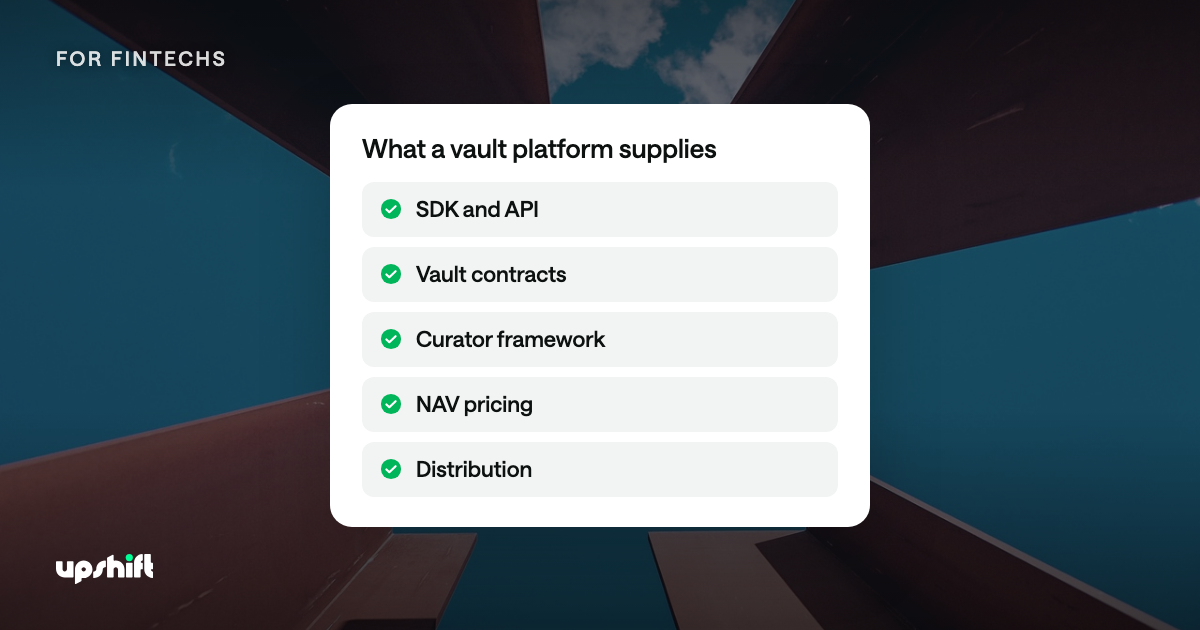
A vault platform can supply up to five pieces a fintech would otherwise build: the SDK or API its app calls, the vault contract that issues shares and enforces the rules, a framework that lets a curator run the strategy inside limits set in advance, a pricing engine that values every holding so anyone can check the share price (the vault's NAV), and distribution to depositors and partner channels. Upshift supplies all five, including NAV verification and distribution through partner apps and more than 66,000 depositors.
A curator is the professional team picking the investments, usually a hedge fund or asset manager. The partner keeps its own app, brand and customer relationship.
The vault provider supplies the SDK, the vault contract and the curator framework. The curator places the money in one or more of the three venues in the bottom row.
In the diagram, money moves from your app through the SDK into the vault contract, and the curator places it in one or more of three venues: tokenized money market funds, onchain lending and liquidity markets, or centralized venues such as exchanges and OTC desks. Every platform in the table reaches onchain markets, and fewer reach the other two.
Contract standards and vault templates
ERC-4626 is Ethereum's standard interface for yield vaults: deposit an asset, receive shares, redeem shares for the asset plus or minus performance. Upshift, Morpho, Concrete, Kiln and IPOR Fusion build on it.
ERC-7540 adds request-based deposits and redemptions for strategies that can't pay out instantly, and Lagoon is built on it, while Kiln supports both. Veda's BoringVault and Gauntlet's Aera use their own designs with separate modules for deposits, accounting and strategy calls. Our ERC-4626 explainer covers how shares are priced.
The standard matters mostly for integration. An ERC-4626 share token plugs into wallets, lending markets and custodians that already read the interface. A custom contract can add logic inside one vault (Veda's Merkle-verified manager, for example), though every integrator has to learn it once. Upshift's multi-asset vaults take several deposit coins, such as USDC and USDT, and redeem everything in one reference asset.
When teams ask for vault contract templates for yield products, they usually mean a pre-audited contract plus a set of roles and parameters they can fill in. Lagoon and Morpho let anyone deploy from a factory.
Upshift, Mellow, Concrete, Kiln and Enzyme deploy alongside the partner and configure the fees, whitelist, redemption schedule and curator roles. Gauntlet asks teams to contact it before running a guardian. How to launch a vault covers the steps from mandate to a live vault, and who holds which keys.
Chains and multi-chain deployment
Each provider lists its chains in its own docs:
- Upshift runs vaults on more than 30 chains, including Solana and Stellar, which need separate contract languages and their own audits. Halborn audited the Stellar vault in April 2026 and OtterSec the Solana vault in September 2025.
- Morpho lists its Vault V2 factory on 49 mainnets.
- Midas's registry shows 16 networks.
- Lagoon lists 13 mainnets in its docs.
- Mellow lists 10.
- IPOR Fusion lists 10.
- Veda's chain support page lists 16 chains, Solana among them.
- Gauntlet Aera works on EVM chains, and its docs say cross-chain to non-EVM chains isn't supported yet. Gauntlet's gtUSDa vault takes deposits on Ethereum, Base, Arbitrum and OP.
- Kiln, Concrete and Enzyme Onyx list between 4 and 6.
Few vault platforms run on Solana or Stellar, and fewer hold real deposits there: Upshift's vaults held about $30 million on Stellar and about $9 million on Solana on 4 October 2026, by its own API.
A chain listed in docs and a chain with a live vault aren't always the same thing. Lagoon's own API showed vaults on 5 chains on 4 October 2026 against 13 in its docs.
Tokenized funds and centralized venues
A strategy that holds tokenized T-bills, runs a basis trade or lends to an institution through an exchange needs more than an onchain lending market. Four platforms reach centralized venues from the vault itself: Upshift, Mellow, Midas and Concrete. Lagoon and Enzyme reach them through the manager's own wallet, and Morpho, Veda, Aera, Kiln and IPOR Fusion document onchain venues only.
- Upshift runs CeFi and onchain strategies in one vault through the Upshift prime stack: a policy engine that limits activity by chain, protocol, token and contract function, an institutional lender network, and execution across onchain protocols and centralized venues from one smart contract account, for curators on Upshift prime accounts.
- Mellow uses Copper ClearLoop and Ceffu for off-exchange settlement on venues including Binance, Bybit, Deribit, OKX and Kraken.
- Concrete routes funds to a Safe or Fordefi wallet with values reported back onchain, or mints AssetCX tokens 1:1 against balances held at a qualified custodian.
- Midas monitors exchange, custodian and broker positions held by its strategy managers.
On Upshift, a partner can start with a Conservative vault holding 24/7 tokenized money market funds, then add Core and Enhanced vaults that lend onchain or run basis trades, all on the same SDK and contracts. We see this pattern most with neobanks and payment companies, which want the first vault to look like a cash product and keep the option of higher-yield strategies later. Tokenized money market funds vs stablecoin vaults sets out the trade-offs.
Who runs the strategy and what limits them
Every platform separates the team that picks investments from the contract that holds deposits, and each puts the limit in a different place:
- Upshift's policy engine blocks any call outside the protocols, contracts, functions and tokens approved for that vault, and Upshift validates the curator's net asset value before it reaches depositors.
- On Morpho, any curator can deploy, and the Vault V2 design timelocks curator changes for 0 to 3 weeks, with a sentinel role that can cancel a pending change.
- Mellow checks every curator action against onchain verifiers.
- IPOR Fusion splits the job between an "Atomist" who sets the allowed assets and risk bounds and an "Alpha" who trades inside them.
- Lagoon moves assets to the curator's own Safe, MPC or single-key wallet at settlement, and the limits are whatever that custody setup enforces.
- Veda's manager only executes calls on a Merkle-tree allowlist.
- Aera uses the same allowlist idea for its guardians.
The Block reported in July 2026 that curated vaults held about $8.75 billion across 811 products run by 110 firms, citing vaults.fyi. Curators work across several platforms at once.
SDKs and APIs for vault integrations
Each platform ships its own integration tools:
- Upshift's TypeScript SDK is one client for EVM, Solana and Stellar that reads vault data and builds deposit, withdrawal and claim transactions, and Upshift also ships a REST API, a CLI and a read-only MCP server for AI agents. Tria went live with Upshift vaults in its app two weeks after it started integrating the SDK.
- Morpho offers a viem-based SDK and a GraphQL API.
- Concrete's Earn V2 SDK targets React and Wagmi apps.
- Kiln adds a no-code white-label widget on top of its Connect API, which lets a wallet launch Earn without building a front end.
- Lagoon works through a keyless GraphQL API and TypeScript SDKs.
- IPOR Fusion works through a Python SDK.
- Veda works through its API and Console.
- Midas lists no public integrator SDK.
- Aera's guardian SDKs are available on request.
Audits and who controls upgrades
Provider | Audits listed by the provider | Upgrade control |
Upshift | 11 by 6 firms: Halborn, Hacken (5), OtterSec, ChainSecurity, Sigma Prime, Zellic (2) | Code upgrades need the ProxyAdmin multisig, typically 4 of 6 signers from the asset issuer, Upshift and the curator; parameter changes go through a Safe owner with a delay set per vault |
Morpho Vault V2 | 11 on Vault V2 from 6 firms, including Spearbit, Certora, ChainSecurity and Zellic | Immutable contracts; curator changes timelocked 0 to 3 weeks |
Lagoon | 12 reports: Nethermind, Trail of Bits, Bretzel | Opt-in upgrades to whitelisted versions after a 24-hour to 30-day delay; can be made immutable |
Mellow | 13 on Core Vaults: Nethermind, Sherlock, MixBytes | Upgradeable proxies with a timelock controller per vault |
Midas | 15 from 4 auditors, including Sherlock, Hacken and Halborn | 48-hour timelock on every upgrade |
Enzyme Onyx | 3 ChainSecurity reports on Onyx | Upgradeable proxies controlled by a global owner |
Gauntlet Aera | 3 (Spearbit, OpenZeppelin) plus a Cantina competition | Immutable vaults; owner can swap modules behind a timelock |
Veda | 14 reports, mostly 0xMacro, plus Spearbit | Modules can be upgraded and restricted independently |
Concrete | 31 reports, mostly Halborn, plus Cantina, Zellic, Code4rena | Upgradeable; each vault owner accepts upgrades |
Kiln DeFi | Quantstamp and Spearbit on v1, plus Trail of Bits on its async vault | Beacon proxy run by a multisig of Kiln and third parties |
IPOR Fusion | BlockSec and Protofire on live contracts | Per-role timelocks set by the owner; strategy adapters immutable |
Audit counts aren't a quality score on their own. Concrete counts every Halborn report separately, and Veda's 14 cover many modules. Upshift's code upgrades aren't timelocked, which lets a fix ship fast and puts the check in the 4-of-6 multisig split across three parties; Midas and Lagoon run delays instead. Our vault provider due diligence list has the questions to ask each one.
Provider notes
Upshift: best for one integration from tokenized funds to DeFi
Upshift is onchain yield infrastructure for fintechs and asset managers with stablecoin balances. It has held more than $550 million in deposits at peak and runs 50+ vaults on more than 30 chains for over 66,000 users, with vaults in three risk bands: Conservative, Core and Enhanced. Partners offer the vaults under their own name through the SDK, API or app, with a fee share. Institutional teams on Fordefi have been able to deposit from Fordefi Earn since 8 September 2026, and Kraken Institutional clients reach permissioned Upshift vaults from qualified custody. Upshift raised a $10 million Series A led by Dragonfly in March 2025. Its parent company is August Digital.
Morpho: lending vaults on immutable contracts
Morpho's site showed $16.9 billion in total deposits across the protocol on 4 October 2026. Its vaults allocate into Morpho lending markets, and partners it names include Coinbase, Crypto.com, Kraken, Ledger and Bitget. What is Morpho covers the markets underneath.
Lagoon: permissionless vault deployment
Lagoon lets any curator deploy a vault with no approval or upfront fee, and it reported $159 million+ in assets across 86+ vaults on its homepage on 4 October 2026. Listing on Lagoon's own app is approved separately.
Mellow: curator vaults checked by onchain verifiers
Mellow's own API summed to $342.4 million across its vaults on 4 October 2026, with partners including Lido, Ethena, Flow Traders and Keyrock. Strategies sit in isolated subvaults, one per strategy.
Midas: ERC-20 mTokens with external managers
Midas issues mTokens under a prospectus and excludes US persons, and its docs describe the tokens as financial instruments, separate from stablecoins. Strategy managers named on its site include Apollo, Fasanara and Wellington Management, and its homepage showed $735.6 million in TVL on 4 October 2026.
Enzyme Onyx: tokenized fund issuance and administration
Onyx is Enzyme's stack for issuing and administering tokenized funds, rolled out on request, with compliance policies through Chainlink's policy engine. CV5 Capital, a Cayman fund platform, adopted it in November 2025.
Gauntlet Aera: vaults with Gauntlet as guardian
Gauntlet reported $100 million+ in Aera vaults on its product page on 4 October 2026. KAST and Exa run Earn products on it.
Veda: modular BoringVault contracts
Veda powers Kraken DeFi Earn, ether.fi and Lido Earn, and its homepage reported $32 billion+ in total volume and 320,000+ users on 4 October 2026. Funds stay onchain, with the manager limited to whitelisted protocol calls.
Concrete: custody-linked and pre-deposit vaults
Concrete reported $1.34 billion in assets on platform on 4 October 2026 and names BitGo as a custody partner. Its enterprise vaults have hosted pre-deposit campaigns for Stable and USDai.
Kiln DeFi: best for staking yield
Kiln runs Earn for Ledger Live, Trust Wallet, Bitpanda and Safe, and reports $2 billion+ in total deposits. Its async vault is built on Lagoon's v0.6 contracts.
IPOR Fusion: rules-based mandates with role timelocks
Tesseract, a MiCA-authorised crypto-asset service provider, chose Fusion in March 2026 for dedicated client vaults, with BitGo custody access added in June.
Vault yields vary and aren't guaranteed. Vaults carry smart contract, strategy, counterparty and liquidity risk, with no deposit insurance, and stablecoins can trade below their peg.
Always make sure to do your own research and be aware of the above and any other risks before depositing.
Comparing vault platforms for an Earn launch? Tell us your coins, chains and how fast customers need their money back, and we'll map which Upshift vaults fit, from tokenized money market funds up.
Frequently asked questions
What are the top vault contract platforms for DeFi?
The eleven platforms partners launch on are Upshift, Morpho, Lagoon, Mellow, Midas, Enzyme Onyx, Gauntlet Aera, Veda, Concrete, Kiln and IPOR Fusion. On their own sites in October 2026, Morpho showed $16.9B in protocol-wide deposits, Kiln $2B+, Concrete $1.34B on platform and Upshift $550M+ at peak, and each counts deposits differently.
What are the best vault contract platforms for stablecoin yield?
For stablecoins specifically, the split is between platforms that also hold tokenized T-bill funds and those focused on lending. Upshift and Midas both run tokenized fund strategies, while Morpho, Kiln and IPOR Fusion route mainly to lending markets such as Aave and Morpho.
Which vault contract platforms have built-in risk management?
All eleven set limits in code. Upshift's policy engine restricts calls by chain, protocol, token and function; Mellow uses onchain verifiers with over 60 permission types; Veda and Aera use Merkle-tree allowlists; and Morpho adds caps that curators can cut at once while increases wait out a timelock.
Which vault contract providers are built for institutions?
Providers with permissioned vaults and named institutional clients include Upshift (Kraken Institutional, Fordefi Earn), Enzyme Onyx (CV5 Capital), IPOR Fusion (Tesseract, BitGo custody) and Concrete (BitGo). Midas restricts some strategies to professional investors.
Which vault contract solutions support multi-chain deployment?
Morpho lists its vault factory on 49 EVM mainnets. Upshift, Midas and Veda list Solana as well as EVM chains, and Upshift is the only one of the eleven with Stellar vaults in its docs.
What are the best SDK integrations for vault contracts?
Upshift's SDK installs as @augustdigital/sdk from npm and covers EVM, Solana and Stellar in one client. Kiln offers a no-code widget on top of its Connect API, and Morpho's SDK runs on viem.
Keep reading
- Upshift vs Morpho, Midas and Veda. Strategies, curators and chains across four platforms.
- Whitelisted and sole-depositor vaults. Which providers gate deposits, redemptions and transfers.
- How exchanges build an Earn product. From vault menu to launch.
- Who does what in an onchain vault. Owner, operator, curator and depositor roles.
Launch a vault with Upshift
Upshift builds custom, permissioned vaults for custodians, exchanges, neobanks and asset managers. Tell us what you are building and the team will follow up.
Create a vault with Upshift
Share your use case and we’ll get back to you shortly