Stripe stablecoin payments explained: Bridge, Tempo, OUSD

A business on Stripe can take USDC at checkout and keep OUSD or USDC in a financial account that Bridge custodies, where the US balance earns Stripe fee credits.
Stripe gives US businesses fee credits at 1% a year once their combined USD and USDC balance in a Stripe financial account tops $2,000. Since 30 September 2026 the same account can hold OUSD instead of USDC.
Stripe built the stablecoin stack behind it between closing its Bridge deal in February 2025 and the OUSD launch. Bridge handles custody and issuance, Privy provides wallets, Tempo is the payments blockchain, and Stripe's checkout, accounts and cards sit on top.
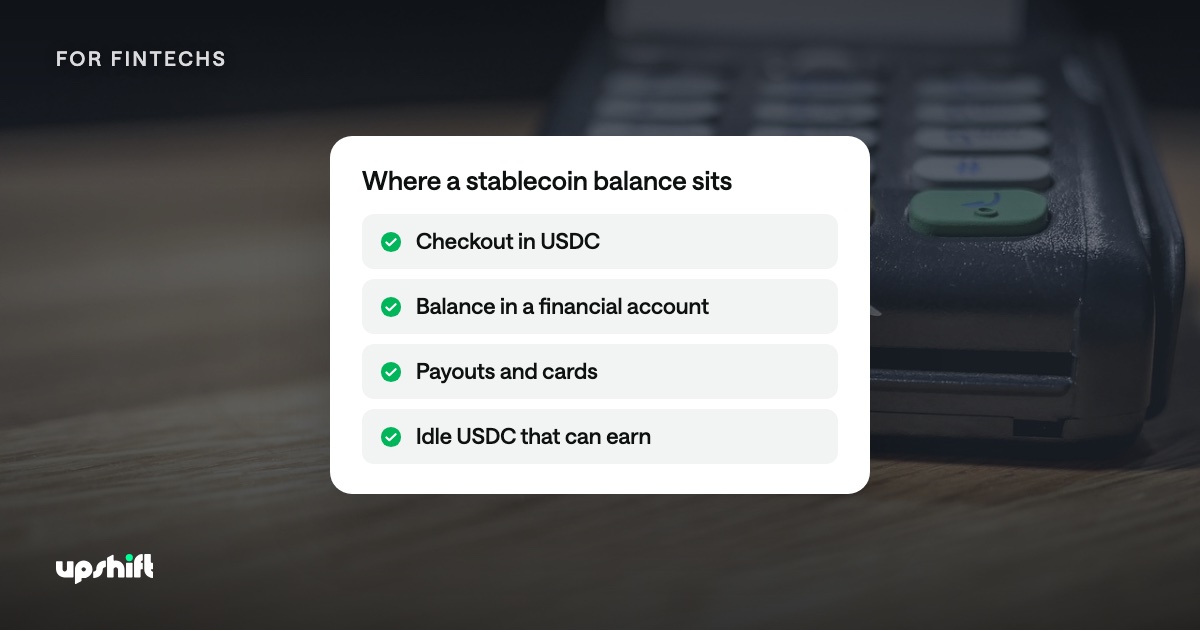
Customers can pay in USDC at checkout, and Stripe settles those sales in local currency. A separate financial account holds the business's OUSD or USDC, and Bridge keeps the coins in custody.
The Stripe stablecoin stack in one table
Piece | What it does | Where the money sits | Who holds it | What it earns (14 Oct 2026) |
Stablecoin payments | Customers pay in USDC, USDP or USDG from their own wallet, up to $10,000 per transaction | Stripe payments balance, in local currency | Stripe | Fee credits apply to the financial account, not the payments balance |
Stablecoin balance | Holds OUSD or USDC (one at a time) next to USD, EUR or GBP balances | The financial account | Bridge custodies the coins | US: fee credits at 1% a year once USD plus USDC tops $2,000 |
OUSD | Dollar stablecoin for Open Standard, live on Base, Ethereum, Solana and Tempo | A Stripe stablecoin balance or any wallet | Issued by Bridge Building Inc. | Rewards for Open Standard members on balances held at Bridge; rate not published |
Open Issuance | Lets a company launch its own stablecoin through Bridge | Holders' wallets; reserves in cash and Treasuries | Bridge issues; reserves are allocated through BlackRock, Fidelity Investments and Superstate | The issuing company can earn rewards from reserves |
Tempo | Payments blockchain incubated by Stripe and Paradigm | A network that carries transfers | Validators include Stripe, Visa and Zodia Custody | Not applicable |
Privy | Embedded wallets that apps build into their products | Wallets inside the app | Privy wallet infrastructure, inside the app | Outside the Stripe fee credit program |
Stablecoin cards | Cards that draw from the stablecoin balance, in public preview in the US | The stablecoin balance until the card is used | Bridge custodies the balance | US: 2% cashback on eligible spend, in private preview |
As of 14 October 2026, Stripe's US pricing page lists stablecoin payments at 1.5% of the transaction amount, which covers conversion to fiat, wallet and AML screening, fraud prevention and gas sponsorship.
A payment moves from checkout to a stablecoin balance
Checkout sales land in local currency, and a stablecoin balance is funded by converting fiat or by a wallet transfer.
A customer who picks crypto at checkout goes to crypto.stripe.com, connects a wallet and sends USDC on Tempo, Ethereum, Solana, Polygon or Base. Stripe's docs say the sale settles in the merchant's Stripe balance in local currency. Stablecoin payments carry no disputes or chargebacks, and refunds go back in stablecoins to the customer's wallet. US businesses can accept today, while the EU, Hong Kong, Mexico and Switzerland are in private preview.
Holding stablecoins is a separate step. The business moves money from its payments balance or an outside bank account into a fiat balance, then converts it into a stablecoin balance. A crypto wallet can also send USDC straight in. External bank money can't land in the stablecoin balance directly; it has to pass through a Stripe fiat balance first.
Bridge holds the coins while its trust bank waits for final approval
Stripe completed its acquisition of Bridge on 4 February 2025, and Stripe's announcement didn't give a price. Bridge now handles custody and issuance across the stack. Stripe's financial account docs say that "Bridge custodies USDC and OUSD". On 17 February 2026 Bridge said the OCC had conditionally approved it to organize Bridge National Trust Bank, and Banking Dive found the approval dated 12 February in the OCC's database.
Once it has final approval, the charter would cover digital-asset custody, stablecoin issuance and orchestration, and reserve management. As of Bridge's OUSD launch post on 30 September 2026, the trust bank was "in organization" and not yet operational, and it doesn't issue OUSD. Until that changes, Bridge Building Inc. is the issuer.
Each coin has its own issuer, and Tempo carries the transfers
A Stripe stablecoin balance holds one coin at a time, and the coin sets who backs it. Circle issues USDC. Bridge issues OUSD for Open Standard, a company founded by Coinbase, Mastercard, Shopify, Stripe and Visa, and charges no fees to mint or redeem it.
Bridge's Open Issuance platform, launched on 26 September 2025, lets a company issue its own coin with reserves split between cash and Treasuries, managed through BlackRock, Fidelity Investments and Superstate. Phantom's CASH was its first use case, and Bridge said coins from MetaMask, Dakota, Slash, Lava and Takenos would move onto it. Stripe's May 2025 launch of stablecoin accounts promised USDB, Bridge's own coin, "soon", though Stripe's docs list only OUSD and USDC today.
Tempo, the blockchain Stripe incubated with Paradigm, opened a testnet on 9 December 2025 and went to mainnet on 18 March 2026. Stripe, Visa and Zodia Custody joined as validators on 14 April 2026. USDC on Tempo moves as USDC.e inside Stripe's accounts. Privy announced that Stripe was acquiring it on 11 June 2025, when Privy powered more than 75 million accounts across 1,000+ developer teams, and said it would keep running as an independent product.
The balance earns fee credits or OUSD rewards
US businesses whose financial account ends the day with more than $2,000 across USD and USDC earn fee credits at 1% a year on that combined balance, calculated daily and issued monthly. Stripe applies the credits to eligible Stripe fees as they're billed, rather than paying them out as cash.
The USDC part is US only: Australian accounts get the same 1% on AUD balances above 2,000 AUD. OUSD holders can earn rewards by joining Open Standard as partners, though neither Stripe nor Bridge has published a rate. Under the GENIUS Act, signed on 18 July 2025, a payment stablecoin issuer can't pay holders interest just for holding the coin.
Money leaves to a wallet, a bank or a card
A stablecoin balance can leave as USDC to any supported wallet, or as fiat to a bank account in local currency. Country coverage differs for wallet payouts and bank payouts, and outside the US stablecoin balances are in private preview across roughly 100 countries, many in Latin America, Africa and Central Asia. Stripe won't hold OUSD and USDC side by side in one account, and it converts an incoming coin that doesn't match the account's chosen coin.
Idle USDC can move into a stablecoin vault
A business that keeps USDC on Stripe for payouts can send the part it doesn't need this month to its own wallet and put it in a stablecoin vault, from 24/7 tokenized money market funds to DeFi. Upshift runs the vaults, and asset managers and curators run the strategies inside them.
Cash vaults hold tokenized money market funds, Core vaults add lending and private credit, and Enhanced vaults run active strategies. Most vaults use a 72-hour withdrawal period, with instant exit up to the vault's USDC buffer for a fee. Our guides cover where USDC earns and how stablecoin orchestration connects payment accounts, wallets and yield.
Vault returns move with markets, and no yield is guaranteed. Smart contract, strategy and stablecoin depeg risk apply to every vault.
Holding USDC between payouts? Tell us the balance, the chain and how fast you need it back, and we'll show you which vaults fit.
See how Upshift works for payments companies and treasuries.
Frequently asked questions
Does Stripe accept stablecoin payments?
Yes. US businesses can accept USDC on Tempo, Ethereum, Solana, Polygon and Base, plus USDP and USDG (US only), and the sale settles in local currency. As of 14 October 2026, Stripe's US pricing page lists the fee at 1.5% of the transaction amount. Businesses in the EU, Hong Kong, Mexico and Switzerland can join a private preview.
Does Stripe use USDC?
Yes. USDC is one of two coins a Stripe financial account can hold, next to OUSD, and customers can pay with it on all five checkout networks. Stripe started stablecoin storage with USDC when it announced stablecoin accounts for 101 countries on 20 May 2025.
What is Bridge, and does Stripe own it?
Bridge is a stablecoin company that Stripe finished buying on 4 February 2025. It custodies Stripe stablecoin balances, issues OUSD and runs Open Issuance for companies launching their own coins. Its national trust bank had conditional OCC approval and was not yet operating on 30 September 2026.
Does Stripe have its own stablecoin?
Stripe co-founded Open Standard, the company behind OUSD, with Coinbase, Mastercard, Shopify and Visa, and its subsidiary Bridge issues the coin. USDB, which Stripe said in May 2025 it would add "soon", isn't among the coins Stripe's docs list today.
What is Tempo, Stripe's blockchain?
Tempo is a payments blockchain incubated by Stripe and Paradigm that reached mainnet on 18 March 2026. Stripe's checkout accepts USDC on Tempo, and OUSD launched there alongside Base, Ethereum and Solana.
Do Stripe stablecoin balances earn interest?
US accounts earn fee credits at 1% a year once USD plus USDC tops $2,000, applied to Stripe fees. Open Standard partners can earn OUSD rewards at an unpublished rate. A business can also move USDC to its own wallet and into a stablecoin vault.
Launch a vault with Upshift
Upshift builds custom, permissioned vaults for custodians, exchanges, neobanks and asset managers. Tell us what you are building and the team will follow up.
Create a vault with Upshift
Share your use case and we’ll get back to you shortly