What is stablecoin orchestration? The stack, layer by layer

An orchestration provider sells several layers of the stablecoin payments stack through one API. The balances that wait between those layers can earn in a stablecoin vault until the payment needs them.
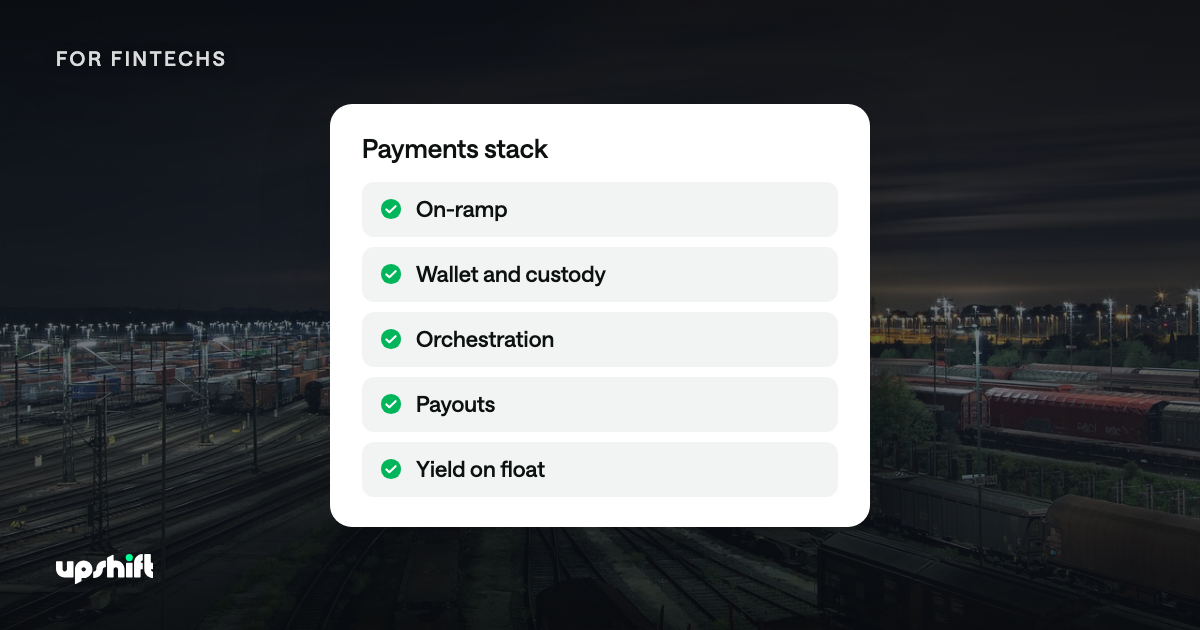
Crossmint says MoneyGram launched stablecoin remittances in 60 days on its stablecoin orchestration API, which replaces three to five separate vendors with one integration. Stablecoin orchestration is that single layer: one API that turns dollars into stablecoins, picks the chain and payout partner, screens each transfer and pays out in local currency. Bridge (owned by Stripe), BVNK (owned by Mastercard), zerohash, Crossmint, Merge and Circle Payments Network sell it, on top of issuers such as Circle and Paxos and custodians such as Fireblocks. Upshift sits next to the stack as the yield layer, where balances that wait between steps earn in a stablecoin vault.
Layer | What it does | Providers (own sites, checked 6 Oct 2026) | Balance that waits here |
On-ramp and off-ramp | Converts dollars or euros to stablecoins and back | Bridge, BVNK, zerohash, Circle Mint | Funds between bank wire and conversion |
Issuance | Mints and redeems the stablecoin against reserves | Circle (USDC, EURC), Paxos (USDG, PYUSD, coins for brands), Bridge Issuance | Reserves, which earn for the issuer |
Wallets and custody | Holds the keys and the operating balances | Fireblocks, Circle Wallets, Bridge Wallets, BVNK Store | Payout float before payday |
Compliance | Screens wallets and transfers, sends Travel Rule data | Chainalysis, Elliptic, Notabene | None |
Orchestration | Runs the layers above through one API and picks the route | Bridge, BVNK, Crossmint, Merge, Circle Payments Network | None of its own; it routes |
Payout APIs | Delivers local currency or stablecoins to recipients | BVNK, zerohash, Bridge, Crossmint | Prefunding at payout partners |
Cards | Lets a holder spend a stablecoin balance at merchants | Bridge Cards, BVNK Spend, Rain | Card float before settlement |
Treasury and yield | Holds idle balances and earns on them | Upshift (stablecoin vaults), Ripple Treasury, Fireblocks Earn, BVNK Earn | All three pools above |
Most enterprises buy two or three of these layers from one provider and add the rest. Stablecoin infrastructure companies profiles the issuers, custodians and payment APIs one by one, with charter status and size.
Wallets, payment APIs and yield: who sells which
A fintech that wants wallet infrastructure, stablecoin payment APIs and yield from one stack will find that few providers sell all three. The table lists what each one publishes on its own site.
Provider | Wallets | Payment APIs | Yield on balances |
Upshift | Plugs into the partner's wallet through the SDK; Fordefi Earn lists Upshift vaults | Not offered; works next to the payment provider | Stablecoin vaults from 24/7 tokenized money market funds to DeFi, in Conservative, Core and Enhanced bands |
Bridge (Stripe) | Wallets API | Orchestration, payouts, cards | Issuance reserves held in US Treasuries, which earn for the coin's issuer |
BVNK (Mastercard) | Store: fiat and stablecoin accounts | Send, Receive, Spend | Earn: monthly USDC rewards on balances; the page doesn't state the source |
Circle | Wallets | Circle Payments Network, Gateway, CCTP | USYC, a tokenized money market fund redeemable to USDC |
Fireblocks | Custody, wallet as a service, embedded wallets | Network for Payments, Flow | Earn: a Sentora-curated vault on Morpho, or Aave |
zerohash | Qualified custody | Payins, payouts, ramps, remittances | Staking and lending products for brokerage clients |
Step 1: dollars come in through an on-ramp
Follow one payment from start to finish: a US marketplace paying $50,000 to its sellers in Mexico. The money starts as dollars in the marketplace's bank account. An on-ramp takes a wire or ACH transfer and credits USDC, either by minting through the issuer (Circle Mint for USDC) or by converting through a provider like Bridge, BVNK or zerohash. The wire itself still runs on banking hours, which is why the first wait in the stack sits here (money that's left the bank but hasn't arrived as stablecoins). Stripe's stablecoin financial accounts, open to businesses in 101 countries, fold this step into a dashboard balance held in USDC or Bridge's USDB. The fiat-in, stablecoin-across, fiat-out pattern is the stablecoin sandwich.
Step 2: an issuer mints the stablecoin
Every stablecoin in the flow was minted by an issuer that holds reserves against it. Circle issues USDC and EURC, Paxos issues USDG and PayPal's PYUSD and sells issuance to other brands, and Bridge offers the same through its Issuance product. A payment company rarely deals with this layer directly unless it launches its own coin. Stablecoin issuance platforms compares the issuers that do this for brands.
Reserve income stays with the issuer. The GENIUS Act, signed on 18 July 2025, bars a permitted issuer from paying interest or yield to holders of a payment stablecoin. It takes effect on 18 January 2027 or 120 days after final rules, whichever is earlier, and the OCC proposed its rules in March 2026 and was aiming for a final rule by November. (General information, not legal advice.)
Step 3: a wallet or custodian holds the balance
Once minted, the USDC sits in a wallet the marketplace controls, either at an institutional custodian like Fireblocks or in an embedded wallet from Circle Wallets, Bridge or BVNK. Here it waits for the payout date. A marketplace that pays sellers weekly collects sales every day and pays them out once a week. Those sales wait in its wallet until payout day, about half a week of sales on average, and payroll companies hold the same kind of balance between employer funding and payday (stablecoin payroll works through those numbers). Wallet as a service providers compares 12 embedded and institutional wallet companies.
Step 4: compliance screens the transfer
Before the USDC moves, the sending wallet and the recipient get screened. Chainalysis KYT and Elliptic check addresses against sanctions lists and risky counterparties, and Notabene sends Travel Rule data (who's sending, who's receiving) between the two institutions. Notabene lists more than 2,000 crypto service providers in its network.
Orchestration providers usually bundle this layer. Crossmint lists KYC and KYB, AML screening, sanctions checks and Travel Rule support inside its API, and Merge runs screening during routing.
Step 5: the orchestration layer picks the route
For each payment the orchestration API picks the stablecoin, the chain, the payout partner and the off-ramp, and it switches to a backup partner if the first one fails. Merge calls orchestration "the control layer that determines how funds convert, route, settle, and exit". Crossmint routes across 50+ chains, including Stripe's Tempo and Circle's Arc. Circle Payments Network does the same job between member banks and payment companies settling in USDC and EURC. BVNK sells its version as Deploy, a self-managed orchestration setup, and Mastercard completed its purchase of BVNK in August 2026. The marketplace integrates one API in place of a contract with each partner along the route.
Step 6: a payout API delivers local currency
At the far end, a payout partner converts USDC to Mexican pesos and pays each seller's bank account, or sends USDC straight to a seller's own wallet. On its site, zerohash lists payins, payouts, on and off ramps and remittances, and sells stablecoin and multi-chain orchestration across them. Bridge, BVNK and Crossmint all sell payouts. The local leg still runs through banks in many markets, which means the payout partner needs a balance ready before the money arrives: prefunding. Cross-border prefunding prices that balance, and stablecoin payout APIs compares the providers by corridor.
Card programs add one more branch. A stablecoin card from Bridge, BVNK or Rain lets the holder spend a USDC balance at any merchant, and the program funds settlement with the card network after each purchase. Visa's stablecoin settlement volume passed a $20 billion annualised run rate in September 2026. Stablecoin card issuing platforms compares the issuers.
Step 7: balances that wait between steps earn in a stablecoin vault
Three balances in the flow sit still for hours or days: payout float in Step 3, prefunding in Step 6 and card float before settlement. Artemis put stablecoin B2B payments at a $76 billion annualised run rate in August 2025, with prefunding at $3.6 billion and card-linked payments at $18 billion (Artemis, Stablecoin Payments From The Ground Up). Some providers pay on balances held with them, such as BVNK Earn and Fireblocks Earn.
Upshift is onchain yield infrastructure that lets fintechs and asset managers offer yield inside their own products, from 24/7 tokenized money market funds to DeFi strategies. A payment company usually starts in the Conservative band, where the vault holds tokenized money market funds next to a USDC buffer and earns close to the T-bill rate on weekends too. The 13-week bill yielded 4.14% on 6 October 2026 (US Treasury daily bill rates). On $5 million of float, that's roughly $207,000 a year before fees (an illustration; rates move daily and vault yields aren't guaranteed). The integration is the @augustdigital/sdk package, one client for EVM chains, Solana and Stellar, and Tria and app.monad.xyz run on it.
Upshift works next to whichever orchestration provider moves the money, and the payment company keeps its own wallet and payment provider. A vault can be open to anyone or limited to allow-listed wallets, or to a single depositor, which keeps a company's float out of a shared exit queue (segregated vs co-mingled vault accounts covers the difference). All Upshift vaults process redemptions daily, each with its own lag, and most offer an instant exit for a fee, subject to available liquidity. Upshift has run 50+ vaults on more than 30 chains, with $550M+ deposited at peak.
The risks sit at the edges of each layer. A stablecoin can trade below $1 for a period, an off-ramp partner can lose its banking access, a vault or protocol contract can have a bug, and a large withdrawal may wait for liquidity. Upshift's contracts have been through 11 smart contract audits by 6 independent firms, and most finance and compliance teams run a vault provider review before moving float. Always make sure to do your own research and be aware of the above and any other risks before depositing.
Payment companies holding float between funding and payout can see how Upshift works for payments.
Holding stablecoin float between payment steps? Tell us how much sits in prefunding, payout float or card float, and we'll send back what it could earn in each risk band.
Frequently asked questions
What is stablecoin orchestration?
It's one API that runs the steps of a stablecoin payment for a business: converting fiat to stablecoins, choosing the chain and payout partner, screening the transfer and paying out in local currency. Bridge, BVNK, Crossmint, Merge and Circle Payments Network sell it in October 2026.
Which providers offer wallet infrastructure, stablecoin payment APIs and yield in one stack?
BVNK, Fireblocks and Circle sell wallets and payment APIs, and each has a yield product: BVNK Earn, Fireblocks Earn and Circle's USYC fund. Upshift adds stablecoin vaults to any of these stacks through its SDK, with a choice of Conservative, Core and Enhanced bands.
Best stablecoin payment infrastructure providers for enterprises
Enterprises usually combine an issuer (Circle or Paxos), an orchestration and payout provider (Bridge, BVNK, zerohash or Crossmint), a custodian (Fireblocks), compliance tools (Chainalysis, Elliptic, Notabene) and a yield layer such as Upshift for idle balances. BVNK sets a minimum of $500,000 a month in payments and six months of trading history.
How is stablecoin orchestration different from payment orchestration?
Card payment orchestration routes card transactions between acquirers and processors. Stablecoin orchestration routes value across chains, stablecoins and off-ramp partners, and it adds onchain checks such as wallet screening and the Travel Rule.
Can a business earn yield on stablecoins held with a payment provider?
Some providers pay rewards on balances they hold, such as BVNK Earn. A business can also move float into a stablecoin vault it controls, where it holds the vault shares and redeems them when payouts are due. The issuer itself can't pay interest under the GENIUS Act.
Where does prefunding sit in the stablecoin payments stack?
At the payout end. A payout partner needs local currency or USDC ready before the money arrives. Stablecoin top-ups can land on weekends, which cuts the days of cover it holds; in one illustrative corridor in what prefunding costs, cover drops from 5 days to 1.25.
Keep reading
- Stablecoin cross-border payments: corridor models and the float pools behind them.
- How card programs earn yield on customer float: settlement timing at the point of sale.
- What is PayFi: payment finance and where payment balances sit.
- Stablecoin treasury management: policy, custody and approvals for stablecoin balances.
Launch a vault with Upshift
Upshift builds custom, permissioned vaults for custodians, exchanges, neobanks and asset managers. Tell us what you are building and the team will follow up.
Create a vault with Upshift
Share your use case and we’ll get back to you shortly