Stablecoin card issuing platforms compared (2026)

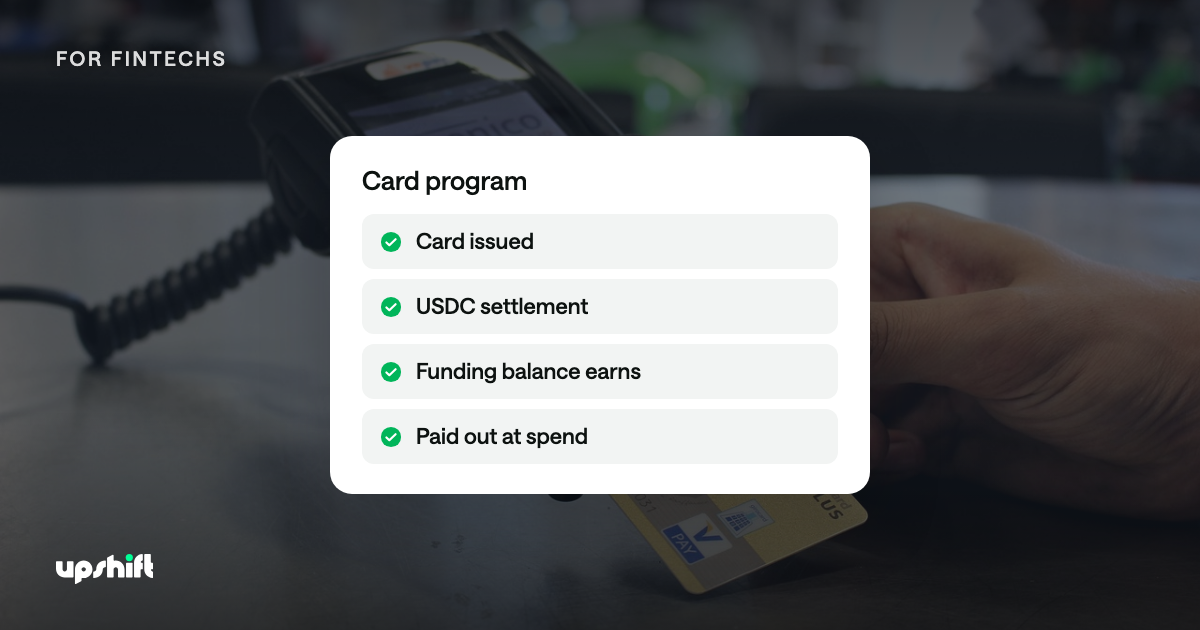
Card programs can now settle with Visa and Mastercard in USDC through issuers such as Rain, Reap and Bridge. The stablecoins that fund the cards can sit in a stablecoin vault and earn until the moment a customer spends.
On 8 September 2026 Visa said its stablecoin settlement had passed a $20 billion annualized run rate, more than 15 times the level a year earlier, with over 160 stablecoin-linked card programs on its network. The stablecoin card issuing platforms behind most of those programs are Rain (a Visa and Mastercard principal member), Reap (a Visa principal issuer owned by Kraken's parent Payward), Bridge (whose cards run on Stripe Issuing), Baanx (cards for self-custody wallets) and Immersve (a Mastercard principal member). A program can also work with a sponsor bank such as Lead Bank or Cross River, both of which settle with Visa in USDC.
Upshift works alongside any of these platforms. The stablecoin balance that funds a card program can sit in an Upshift stablecoin vault and earn until a purchase draws it down.
Stablecoin card issuing platforms at a glance
Provider | Role in the card stack | Networks | Regions | Settles with the network in | Who holds cardholder funds |
Upshift | Yield on the program's funding balance; works with any issuer below | Any, through the issuer | 30+ chains, including Solana and Stellar | Set by the issuer | The program or the cardholder, as vault shares |
Rain | Principal member: issuer, processor and program manager in one | Visa; Mastercard since May 2026 | Transactions in 100+ countries | USDC with Visa, 7 days a week | Stablecoin wallet accounts run by Rain |
Reap | Visa principal issuer; part of Payward since July 2026 | Visa | Licensed in Hong Kong and Mexico; programs in 100+ markets | Stablecoins (describes its stack as stablecoin-native) | Custody and liquidity through Payward |
Bridge (Stripe Issuing) | Program manager; Lead Bank issues the cards | Visa | 30 countries, 100+ planned by end of 2026 | Fiat or stablecoin, set per program | Bridge custody, the user's own wallet, or Stripe Financial Accounts |
Baanx | Card program provider; FCA-registered cryptoasset business | Visa, Mastercard | UK, EU, US | Not published on its site | The user's own wallet until the moment of spend |
Immersve | Mastercard principal member offering BIN sponsorship | Mastercard | Australia, New Zealand, UAE, UK, US | Not published on its site | Custodial, or non-custodial through smart contracts |
Lead Bank, Cross River | Sponsor banks that issue for program managers | Visa, Mastercard | US | USDC with Visa over Solana since December 2025 | Accounts at the bank, held for the program |
Figures come from each provider's site or announcement, checked 6 October 2026.
Step 1: choose where your program sits in the card stack
A card program has four layers, and a platform can cover one of them or all four:
- The network (Visa or Mastercard) authorises purchases and settles between issuers and acquirers.
- The issuer holds the BIN, the number range that identifies who stands behind the card. It's either a bank acting as BIN sponsor or a company that is itself a principal member of the network.
- The processor runs authorisation logic, card controls and fraud tools.
- The program manager owns the cardholder, the brand and the funding model.
Rain, Reap and Immersve are principal members, which lets them issue without a sponsor bank. Rain also runs the processor and can act as program manager, and a program signs one contract for all of it. Bridge splits the roles between Bridge Ventures, which manages the program, and Lead Bank, which issues the cards. Since April 2026 they've run on Stripe Issuing for physical cards, 3DS and fraud tools. A sponsor-bank setup gives the program more choice of processor. It also adds a counterparty to every compliance review, and the bank sets its own collateral terms. Our guide on how to start a neobank lists the vendors at each layer of the wider app.
Step 2: decide who holds the stablecoins before a purchase
In a custodial program, the platform holds customer stablecoins in wallets it controls and debits them when the card is used. Bridge offers this as its out-of-the-box option, and Rain runs stablecoin wallet accounts for its programs. In a self-custody program, the cardholder keeps stablecoins in their own wallet until they pay. MetaMask Card says users "retain self-custody of your funds right up until the moment you pay", and Baanx quotes MetaMask calling it "the first self-custodial, non top-up, debit card". A business card program usually prefunds instead, moving a pool of stablecoins to the issuer ahead of spend.
The custody model also sets what the balance is allowed to earn. Section 4(a)(11) of the GENIUS Act, signed on 18 July 2025, bars a permitted issuer from paying holders interest or yield. In the EU, Article 50 of MiCA bars issuers and crypto-asset service providers from granting interest on e-money tokens. A prepaid or e-money balance is a claim on the program, and safeguarding rules limit where that money can go. Stablecoins that remain the customer's property (held in custody on their instruction, or in their own wallet) are a different case, and exchange Earn products work on that basis.
The OCC aims to finalise its GENIUS Act rules by November 2026, and the Act takes effect on 18 January 2027 at the latest. The CLARITY Act failed a Senate cloture vote on 15 September 2026. None of this is legal advice. A program's counsel reads its own terms of service before any yield goes live, and FBO accounts and customer funds covers the dollar side of the same rules.
Step 3: choose stablecoin or fiat settlement with Visa and Mastercard
Each day an issuer owes the network the net value of its cardholders' purchases, and the network passes that money on to acquirers, who pay merchants. In the traditional setup the issuer wires dollars on business days. With stablecoin settlement the issuer, or the principal-member platform behind it, sends USDC to Visa over a supported blockchain instead. Visa's December 2025 announcement says the window runs seven days a week, including weekends and holidays. Cross River Bank and Lead Bank were the first US banks to settle this way, over Solana. In April 2026 Visa added five blockchains (Arc, Base, Canton, Polygon and Tempo) to Avalanche, Ethereum, Solana and Stellar, at a $7 billion run rate. The cardholder sees an ordinary card payment throughout.
Mastercard followed on 3 June 2026 with intraday, weekend and holiday settlement, in fiat or in regulated stablecoins, running alongside its existing fiat process. Issuers and acquirers opt in.
Network | Stablecoins | Blockchains | First participants | Volume |
Visa | USDC | Arc, Avalanche, Base, Canton, Ethereum, Polygon, Solana, Stellar, Tempo | Cross River, Lead Bank (US); Rain | $20B+ annualized run rate (Sep 2026) |
Mastercard | USDC, PYUSD, USDG, USDP, RLUSD, SoFiUSD | Arbitrum, Base, Ethereum, Polygon, Solana, XRPL | ARQ, CBW Bank, Cross River, Lead Bank, Nuvei (US and Latin America) | Not published |
Rain says it has moved all settlement for its Visa cards to USDC and settles "7 days a week, 365 days a year". For a program, weekend settlement shrinks the dollars it has to park at the bank on Friday to cover Saturday and Sunday spend. Card-linked stablecoin payments ran at an $18 billion annualised rate in August 2025, according to Artemis (out of $122 billion across all stablecoin payment types). Visa is also piloting a stablecoin revolving facility with Credit Coop that sizes funding from daily settlement files. Rain has financed about $2 billion through it since August 2023, according to The Block.
Step 4: size the collateral and prefunded balances
A card program holds money in several places before any of it reaches a merchant. Networks and sponsor banks ask the issuer to post collateral against settlement risk, and in the card programs we talk to that requirement is usually set per jurisdiction. Program managers on a sponsor bank prefund a settlement account. Customers in custodial and prefunded programs top up in round numbers and spend over weeks.
Each of those pools waits for spend, and most of it earns nothing while it waits. How card programs earn yield on customer float sets out how to split a pool between a liquid share and a deployed share, sized against peak draw. Programs that need one pool per client or per country can hold each in its own vault, with the liquidity trade-offs covered in segregated vs co-mingled vault accounts.
Step 5: put the funding balance in a stablecoin vault with atomic redemption
A queued redemption doesn't fit a card payment, which has to clear in seconds. Upshift's Atomic Redemption Vault pays out in the same transaction that asks for the money. When the program redeems, the vault runs five steps inside one transaction:
- The program calls redeem for the amount the card payment needs. No queue entry is created.
- The vault reads its oracle and prices the shares at current NAV, rejecting a stale or out-of-bounds price.
- If the working reserve is short, the vault pulls the gap back from Aave or Morpho lending positions, and from the curator's strategies where configured.
- Per-transaction rate limits, fee caps and spread bounds are checked.
- The shares are burned and USDC goes to the program.
If any step fails, the whole transaction reverts and nothing is half-settled. The balance earns until the moment of redemption.
A stablecoin card purchase: the vault pays out the exact amount when the card is used, and the issuer settles with the network in USDC.
Upshift is onchain yield infrastructure for fintechs and asset managers with stablecoin balances. For balances that don't need instant exits, such as network collateral, a card program can start with a Conservative vault holding 24/7 tokenized money market funds and add Core or Enhanced vaults later on the same integration. Professional curators run each vault inside set limits (Sentora is one; the others are typically hedge funds or asset managers). A vault can be limited to allow-listed wallets or a single depositor, which suits a program that wants its card collateral kept apart from other money.
The @augustdigital/sdk package gives one client for EVM chains, Solana and Stellar, where Upshift vaults held about $30 million and $9 million respectively on 4 October 2026. Upshift has reached $550M+ in peak deposits across 50+ vaults and more than 66,000 depositors. Its contracts have been through 11 smart contract audits by 6 independent firms. Vaults outside the atomic design process redemptions daily, each with its own lag, and most offer instant redemption for a fee, subject to liquidity.
Step 6: launch, then reconcile every day
Bridge says programs can launch "in as little as a few weeks across multiple markets" and keep 100% of interchange. Timelines stretch when a program adds countries, since each jurisdiction brings its own licence checks and collateral. Before signing with a card issuing platform, programs usually get written answers on these points:
- Which networks and countries the BIN covers today, and which are only planned.
- Whether settlement with the network runs in USDC at weekends, and on which chains.
- Who holds cardholder stablecoins between top-up and spend, and under which licence.
- What collateral the issuer requires per jurisdiction, and whether it can be posted in stablecoins or vault shares.
- How interchange is split, and the fees per card and per transaction.
After launch, the program reconciles card spend, network settlement and the vault position every day. Cards are one part of a wider PayFi stack. Programs that also pay contractors or merchants can compare stablecoin payout APIs, and our map of stablecoin orchestration shows where cards sit next to ramps and payouts.
Vault yields vary and aren't guaranteed. Vaults carry smart contract, oracle, strategy and liquidity risk, and stablecoins in a vault have no deposit insurance. An atomic redemption that breaches a rate limit or runs short of liquidity reverts, and the card program needs another source of funds for that payment.
Always make sure to do your own research and be aware of the above and any other risks before depositing.
Running a card program with idle collateral or prefunded balances? Tell us which issuer you use and how much sits waiting for spend, and we'll come back with a vault setup and redemption terms.
Frequently asked questions
Best stablecoin card issuing platforms
Rain, Reap, Bridge with Stripe Issuing, Baanx and Immersve are the main platforms as of October 2026, with Lead Bank and Cross River as sponsor-bank options. Rain is a principal member of both Visa and Mastercard. Reap and Immersve each hold principal membership with one network, and Bridge relies on Lead Bank as issuer.
How does Visa or Mastercard stablecoin settlement work for card issuers?
The issuer sends its daily net settlement amount to the network in a stablecoin, over a supported blockchain, and can do it at weekends. Visa takes USDC on nine chains. Mastercard lists six stablecoins, including PYUSD and RLUSD. Both run it next to fiat settlement, and issuers opt in.
What is the difference between a BIN sponsor and a principal member?
A BIN sponsor is a bank that issues cards under its own network membership for a program manager that has none. A principal member holds the membership itself. Rain announced its Visa principal membership alongside a $24.5 million round led by Norwest, and joined Mastercard as a principal member in May 2026.
Can a stablecoin card program earn yield on its float?
Yes, on balances the program owns, such as network collateral or a prefunded settlement pool, and on customer stablecoins that stay the customer's property. A vault with atomic redemption pays the card amount in the same transaction. E-money and prepaid balances fall under interest and safeguarding rules, which counsel checks first.
Do merchants receive stablecoins when a stablecoin card is used?
Usually not. The merchant's acquirer pays it as for any card payment, normally in local currency. Acquirers can opt into stablecoin settlement with Visa or Mastercard, though the merchant's checkout and payout stay the same unless the acquirer offers otherwise.
How long does it take to launch a stablecoin card program?
Bridge puts it at a few weeks for its own programs. Each extra country adds licence checks and collateral, and a sponsor bank adds its own onboarding. Bridge listed EU and APAC issuance as planned for 2026 when its cards page was checked on 6 October.
Launch a vault with Upshift
Upshift builds custom, permissioned vaults for custodians, exchanges, neobanks and asset managers. Tell us what you are building and the team will follow up.
Create a vault with Upshift
Share your use case and we’ll get back to you shortly