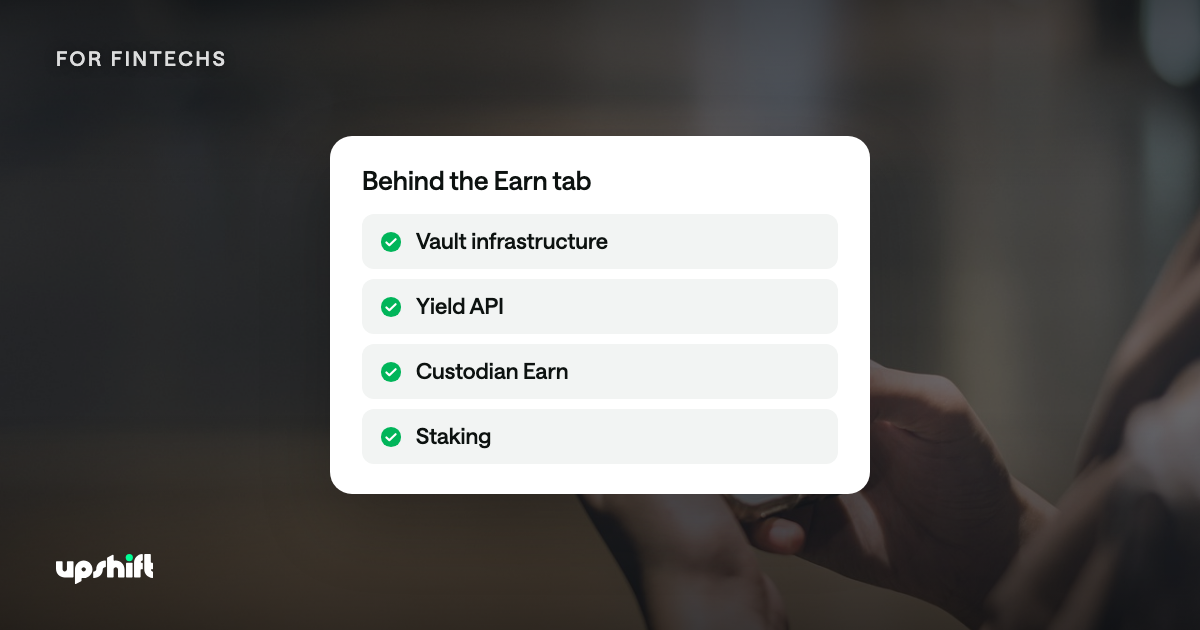
Earn providers for exchanges and wallets, compared

Most Earn tabs at exchanges and wallets run on an outside provider. With some providers the customer holds a claim on the app; with a vault, the customer holds the vault share in their own wallet.
Tria, a crypto neobank with users in more than 150 countries, went live with its Earn tab in January 2026, two weeks after it started integrating the Upshift SDK. Most apps buy Earn from an outside provider. The main Earn providers for exchanges and wallets in 2026 are vault infrastructure (Upshift, Morpho, Kiln, Concrete, Aave Stable Vaults and Veda), aggregator APIs such as Yield.xyz, and Earn modules inside custody and wallet platforms: Fireblocks Earn, Fordefi Earn, BitGo, Privy and Turnkey.
Earn providers for exchanges and wallets in 2026
Provider | Type | What the app integrates | Live Earn deployment (date) | Yield sources |
Upshift | Vault infrastructure | SDK, API or app; custom and permissioned vaults | Tria (Jan 2026), Kraken Institutional (Jul 2026), Fordefi Earn (Sep 2026) | Tokenized money market funds, lending, credit, market-neutral strategies, centralized venues |
Morpho | Vault infrastructure | Vault contracts and APIs to embed Earn and borrowing | Coinbase USDC lending (Sep 2025) | Overcollateralized onchain lending |
Kiln | Staking and vault infrastructure | Widget and Connect API | Ledger Live stablecoin yield (Apr 2025) | Staking on 30+ networks; Aave, Morpho and Compound lending |
Concrete | Vault infrastructure | Automated vaults; AssetCX for assets held at a custodian | No named exchange or wallet client on its site | Automated allocation across onchain strategies |
Aave Stable Vaults | Vault infrastructure | Contracts that pay a steady rate the business sets | Live in the Aave app (Jul 2026) | Aave lending markets |
Yield.xyz | Aggregator API | One API over staking, lending and vaults run by others | Fordefi Earn widget (Sep 2026) | The catalogue the app picks from |
Fireblocks Earn | Custody platform module | Switched on inside a Fireblocks workspace | Launched 15 Apr 2026 | Aave markets and a Sentora-curated Morpho vault |
Fordefi Earn | Custody platform module | Widget inside the Fordefi app | Launched 8 Sep 2026 | Vault catalogue, including Upshift vaults |
Veda | Vault infrastructure | White-label contracts, SDK and API | Kraken DeFi Earn (Jan 2026) | Onchain strategies run by curators |
BitGo | Custody platform module | Access from BitGo Bank & Trust custody through Narval | Aave, Spark and Tesseract access | Lending markets, plus staking |
Privy Earn | Wallet platform module | Earn API inside embedded wallets | Live (Oct 2026) | Veda, Aave, Morpho and Kamino vaults |
Turnkey Earn | Wallet platform module | Fee wrapper over ERC-4626 vaults | Launched Sep 2026 | Morpho and Aave on 4 EVM chains |
Dates and deployments come from each provider's own site or launch post, checked on 4 October 2026.
Named exchanges and wallets and the provider behind each Earn tab
Several exchange and wallet Earn products name the provider behind them. In the table, "curator" means the asset manager that runs a vault's strategy inside limits the platform sets.
Platform | Earn product | Provider underneath | Since |
Tria | Earn tab, 3 vaults on Ethereum and Monad | Upshift SDK, strategies by Sentora | Jan 2026 |
app.monad.xyz | Earn | Upshift SDK | Live (Oct 2026) |
Kraken Institutional | Permissioned vaults inside qualified custody | Upshift | Jul 2026 |
Fordefi clients | Fordefi Earn | Yield.xyz widget, Upshift vaults listed from day one | Sep 2026 |
Coinbase | USDC lending, Core and High Yield vaults | Morpho on Base, curated by Steakhouse Financial | Sep 2025; tiers Jun 2026 |
Ledger Live | Stablecoin yield on USDT, USDC, DAI and USDS | Kiln DeFi, into Morpho, Aave, Spark, Sky and Compound | Apr 2025 |
Trust Wallet | Stablecoin Earn | Morpho, Aave, Compound, Spark, Angle and Venus | Live (Oct 2026) |
Kraken | DeFi Earn: Balanced, Boosted and Advanced USDC vaults | Veda, curated by Chaos Labs and Sentora | Jan 2026 |
Fireblocks clients | Fireblocks Earn | Aave and a Sentora-curated Morpho vault | Apr 2026 |
Kraken shows up twice because it buys Earn twice. Its retail DeFi Earn runs on Veda, while Kraken Institutional clients allocate into Upshift vaults from their qualified custody accounts, announced on 15 July 2026, and the receipt token goes back to the client's segregated account.
Vault infrastructure providers write and run the vault contracts
A vault infrastructure provider deploys the smart contracts that hold customer deposits, calculates the share price and processes withdrawals. The app keeps the customer, the brand and the onboarding. The strategy sits with a curator, the provider or the app's own desk. How exchanges build an Earn product covers the build, integrate and white-label routes and the fees at each layer.
Upshift
Upshift is onchain yield infrastructure for fintechs, exchanges and asset managers with stablecoin balances. A partner can start with 24/7 tokenized money market funds and add lending, credit or market-neutral strategies later on the same integration. Upshift supplies:
- One SDK, @augustdigital/sdk, for EVM chains, Solana and Stellar, plus an API and a hosted app.
- The vault contracts, and a pricing engine that calculates each vault's net asset value (NAV) for verification.
- A curator framework: Sentora and other asset managers run strategies inside limits set before launch.
- Custom vaults and permissioned vaults with an allow-list or a single depositor, as Kraken Institutional uses.
- Distribution to 66,000+ depositors through partner apps.
Upshift has passed $550M in peak deposits across 50+ vaults on more than 30 chains. Few vault platforms run on Solana or Stellar at all, and Upshift holds about $30M on Stellar and $9M on Solana (Upshift API, 4 October 2026). Through the Upshift prime stack, curators on prime accounts can reach centralized venues and credit as well as onchain markets. The contracts have had 11 smart contract audits by 6 independent firms.
Morpho
Morpho runs overcollateralized lending markets and the vaults that allocate across them, and its site invites platforms to "embed earn and borrow products". Its Earn docs let an integrator pick an existing vault or deploy its own. Coinbase's USDC lending, launched in September 2025, deposits into Morpho vaults on Base curated by Steakhouse Financial, and an 11 June 2026 update split it into a Core vault and a High Yield vault.
Morpho.org showed $16.93B in total deposits on 4 October 2026. What is Morpho explains the market design.
Kiln
Kiln is the best fit here for staking yield. It runs validators on more than 30 proof-of-stake networks, and its site shows $18B+ in assets delegated and $800M+ in yield generated. Kiln DeFi adds stablecoin lending through a widget or the Connect API.
Ledger Live switched it on in April 2025, sending USDT, USDC, DAI and USDS into Morpho, Aave, Spark, Sky and Compound while users keep their own keys, according to Kiln's launch post. Trust Wallet, Bitpanda and Crypto.com appear among the logos on kiln.fi.
Concrete
Concrete runs automated yield vaults and showed $1.342B in assets on its platform on 4 October 2026. Its AssetCX product lets a centralized platform earn while the assets stay with its custodian, and an Enterprise tier covers custom builds. The site names investors such as Polychain, VanEck and Bitpanda, though no exchange or wallet Earn client.
Aave Stable Vaults
Aave introduced Stable Vaults on 9 July 2026. The contracts turn Aave's floating lending rate into a steady rate the business sets, aimed at neobanks, payment companies, wallets and exchanges. Chainlink is the named technology partner, and the vaults are live in the Aave app.
Veda
Veda sells white-label vault contracts with an SDK and an API. Kraken launched DeFi Earn on Veda on 26 January 2026 in 48 US states, Canada and the European Economic Area, with three USDC vaults on Ethereum and Ink. Chaos Labs and Sentora curate them. Veda's site says the vaults behind Kraken Earn passed $400M in deposits and lists Bybit, MetaMask, Privy and Whop among its partners.
Aggregator APIs connect an app to protocols that others run
An aggregator API returns transactions for protocols someone else wrote and audited. The app's own wallet or custody signs them.
Yield.xyz, which started as StakeKit, lists 3,300+ yield options on 75+ networks behind one API, and Ledger, Trust Wallet, Zerion, Turnkey, Privy and Utila appear among its logos. Its catalogue includes Upshift vaults on Ethereum, Monad, HyperEVM, Plasma and BNB Chain. Fordefi built its Earn widget on Yield.xyz. Everstake sells a narrower open-source Wallet SDK for non-custodial staking on ETH, SOL and other networks.
Money routed through an aggregator sits in each underlying protocol's contracts, under that protocol's audits. Stablecoin yield aggregators compared sets out 13 of them.
Custody and wallet platforms sell Earn as a module
Many exchanges and fintechs hold customer money with a custody or wallet provider, and five of those providers now ship Earn as a feature their clients can switch on:
- Fordefi Earn went live on 8 September 2026. Clients find, deposit into, track and withdraw from yield vaults inside the Fordefi app, and every transaction passes Fordefi's policy engine. Upshift vaults were live in Fordefi Earn on day one, including Sentora's RWA and BTC vaults and earnAUSD on Monad.
- Fireblocks Earn launched on 15 April 2026 with Aave markets and a Sentora-curated Morpho vault. Clients request access through their Fireblocks representative.
- BitGo gives BitGo Bank & Trust custody clients access to Aave, Spark and Tesseract through Narval, alongside its staking service.
- Privy, owned by Stripe, offers an Earn API over Veda, Aave, Morpho and Kamino vaults.
- Turnkey launched Earn in September 2026, wrapping Morpho and Aave vaults on 4 EVM chains and listing only vaults with $100,000 or more in deposits.
These modules decide which vaults show up in the custody app. The vaults themselves still come from an infrastructure provider. Wallet as a service providers compared covers the key models behind them.
Custodial CeFi Earn and onchain vaults hold the money in different places
In custodial CeFi Earn, the customer hands coins to the exchange. The exchange lends or stakes them from its own balance sheet, and the customer holds a claim on the exchange. Celsius and BlockFi ran Earn this way until 2022. When their loans went bad, customers queued as creditors in bankruptcy. An onchain vault gives the customer a vault share in their own wallet, priced from positions anyone can check onchain. A custodian Earn module puts the same kind of receipt token into an institutional custody account.
What the customer holds changes with the model: a claim on the exchange, a vault share in their own wallet, or a receipt token in a custody account.
Kraken Institutional runs the third model. The client's underlying goes into Upshift vault contracts, and the receipt token returns to the client's segregated qualified custody account, where it shows on the statement at its redeemable value. A retail wallet such as Tria runs the second: the customer taps Earn, signs once and the shares land in their own smart account.
Tiered menus group vaults by what they hold
Exchanges rarely launch one vault. Kraken's DeFi Earn offers Balanced, Boosted and Advanced vaults, and Coinbase split its USDC lending into Core and High Yield in June 2026. Upshift groups its menu into Conservative, Core and Enhanced bands by what the vaults hold.
Conservative holds tokenized T-bill and money market funds, Core holds blue-chip lending and tokenized credit, and Enhanced adds spread trades and looped carry with longer withdrawal windows. Each band keeps balances in USDC or USDT. An exchange can list one band or all three. How to tier vault strategies by risk sets out the method, and the yield options page shows the current menu.
Redemption terms set what the withdraw button can promise
All Upshift vaults process redemptions daily. Each vault has its own lag, and most offer an instant redemption for a fee, subject to liquidity.
Staking has a different clock: an Ethereum validator exit waits in a queue that lengthens when many stakers leave at once, and other networks have fixed unbonding periods. Tokenized money market funds mint and redeem on the issuer's schedule, which is why a stablecoin vault often keeps a USDC buffer next to the fund for weekend withdrawals. Ask each provider what a customer sees after tapping withdraw on a Saturday, and how that changes when 20% of a vault leaves in a day.
Fee share and compliance gating are agreed per partner
Turnkey takes the app's fee out of the vault yield through a wrapper contract. Privy lets an app take up to 50% of the yield on Morpho as a fee and up to 100% on Aave. On Upshift, the curator earns a performance fee and the vault layer a management fee, part of which can be shared with the partner, and the exchange adds its own platform fee or spread on top (at least on the deals we've seen, the exchange sets that last number itself).
Compliance gating sits with the app. The exchange runs onboarding and chooses which customers and countries see Earn, and a permissioned vault can restrict deposits to an allow-list of wallets enforced in the contract.
In the US, the GENIUS Act, signed on 18 July 2025, bars stablecoin issuers from paying holders interest or yield for holding the token. The CLARITY Act, which would set rules for exchange-paid rewards, stalled when a Senate cloture vote failed 49 to 50 on 15 September 2026, with no new vote scheduled as of 2 October. In the EU, the MiCA transitional period for crypto-asset service providers ended on 1 July 2026, according to ESMA. How the GENIUS and CLARITY Acts reshape stablecoin yield covers where the US line sits.
Vault yields vary and aren't guaranteed. Vaults carry smart contract, strategy and liquidity risk, with no deposit insurance, and the provider behind an Earn tab doesn't change the risk of the strategy the money goes into.
Always make sure to do your own research and be aware of the above and any other risks before depositing.
Adding an Earn tab to an exchange or wallet? Tell us which chains and balances you hold, and we'll send a vault menu by band with a launch timeline.
Frequently asked questions
Best white label earn products for crypto exchanges
Upshift and Morpho sell vault contracts an exchange can put under its own brand. Upshift adds permissioned vaults with an allow-list and reach into centralized venues through the Upshift prime stack. Kraken Institutional clients reach permissioned Upshift vaults from custody, and Coinbase's USDC lending runs on Morpho.
Best crypto earn infrastructure for wallets
Non-custodial wallets usually integrate a vault SDK directly, as Tria did with Upshift, or an API such as Kiln's Connect or Yield.xyz. The customer signs each deposit from their own wallet and holds the vault share there.
What powers the earn tab in a crypto app
Usually a vault contract from an outside provider such as Upshift, with a curator running the strategy. Tria's Earn tab runs on Upshift vaults through the Upshift SDK, with Sentora running the strategies, and Fordefi Earn lists Upshift vaults for institutions. Upshift vaults range from tokenized money market funds to lending and onchain strategies, and one integration reaches all of them. Ledger Live's stablecoin Earn routes through Kiln, and Coinbase's USDC lending deposits into Morpho vaults on Base.
Best SDK for adding yield to a consumer crypto app
Upshift's SDK (@augustdigital/sdk) covers EVM chains, Solana and Stellar with one client, and Morpho, Kiln and Yield.xyz publish their own SDKs or APIs. Privy and Turnkey bundle Earn into their wallet SDKs.
We are an exchange and want to launch an earn tab without building smart contracts. What are our options and how long does it take?
Integrate a vault provider's SDK or API, switch on Earn in a custody platform you use, or call an aggregator API. Tria went live on the Upshift SDK two weeks after starting, and Kiln quotes under 4 weeks for its DeFi product.
Top providers for a branded savings product on stablecoins
Upshift, Morpho and Aave Stable Vaults sell vaults a fintech can put behind its own savings product, and Aave's version pays a steady rate the business sets. A conservative savings product usually starts in tokenized money market funds or blue-chip lending, the holdings in Upshift's Conservative band.
Keep reading
- How neobanks and fintechs offer stablecoin yield. Product models when the depositor is a consumer.
- Embedded yield. The distribution routes apps use to reach vaults.
- Tria Earn, powered by Upshift. How a neobank shipped Earn in two weeks.
- Best crypto staking platforms. Where staking yield comes from and who runs it.
Launch a vault with Upshift
Upshift builds custom, permissioned vaults for custodians, exchanges, neobanks and asset managers. Tell us what you are building and the team will follow up.
Create a vault with Upshift
Share your use case and we’ll get back to you shortly