Why a stablecoin vault beats issuing your own stablecoin

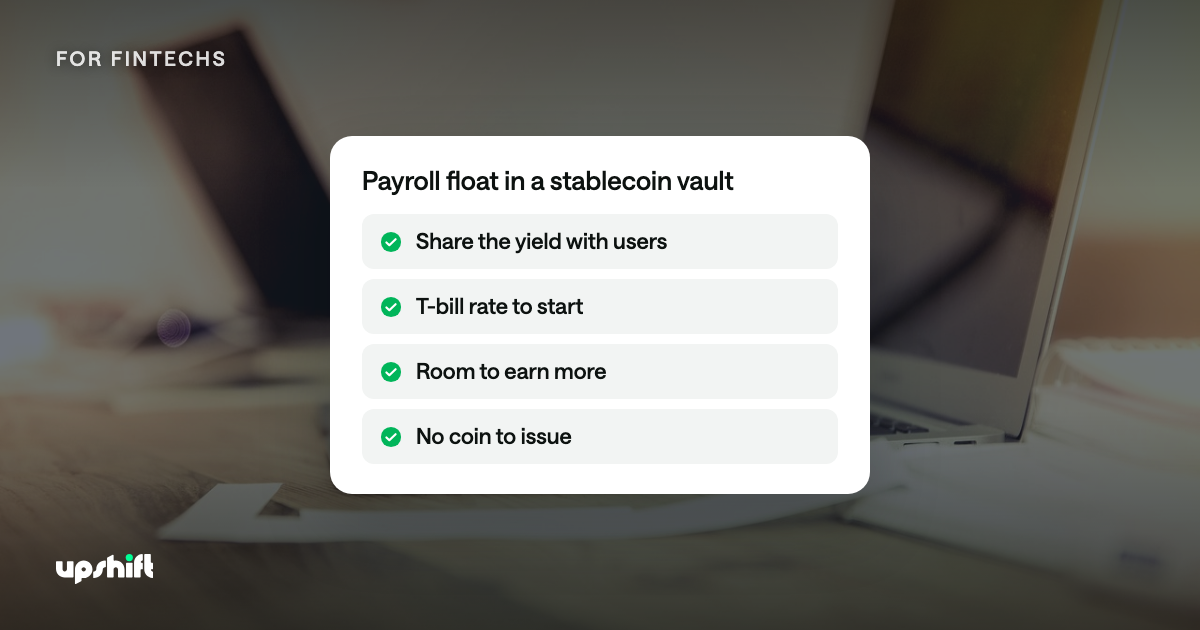
A stablecoin issuer can't pay holders yield, and Deel added a separate Earn product to reward its contractors. A stablecoin vault lets a platform share the yield with users and leaves room to earn more.
Deel, the payroll and contractor platform, launched DLUSD in Argentina on 3 June 2026: a branded stablecoin its contractors hold inside the Deel app. It's issued through Bridge's Open Issuance platform, settles on Tempo, sits in Privy embedded wallets and offers optional rewards through Morpho, according to Stripe's announcement. The reserves sit in Treasury bills, and Deel keeps that income after a fee to Bridge. The coin can't pay contractors anything, because the GENIUS Act bars payment stablecoin issuers from paying holders, and Deel added a separate Earn product to reward them. A payroll, contractor-payment or marketplace platform that holds its float in a stablecoin vault, such as Upshift, can choose to keep the yield, share some or pass all of it to users as vault shares. The vault starts with 24/7 tokenized money market funds at about the T-bill rate, and it has room to earn more through Core or Enhanced strategies on the same integration.
What did Deel build with DLUSD?
Deel's help centre describes DLUSD as "a closed-loop digital balance available exclusively within Deel, always redeemable 1:1 for USD value on the platform". Contractors move money between their Deel balance and DLUSD in seconds, with no fee, and Deel covers the gas. On 17 August 2026 Deel said the wallet was live in more than 80 countries, 11 weeks after the Argentina launch (The Defiant). The US, the UK, the EU and Australia are excluded.
The coin itself pays contractors nothing. To give them a return, Deel added an opt-in Earn Vault, and Tempo's launch post says this "Morpho-powered earn product runs on Tempo". Deel's help centre gave a "promotional target rate" of up to 4% APY at launch, variable and not guaranteed, and calls the rewards "promotional incentives, not interest or investment returns".
Deel powers payroll for 40,000+ businesses in 150 countries, per Tempo, and Fintech Blueprint puts its payroll volume at $22 billion a year. Fintech Blueprint also wrote that DLUSD's reserves sit in Treasury bills yielding roughly 3.6% in June 2026. It added that "Deel keeps the full amount after a small issuance fee paid to its partner Bridge". Bridge's issuance page doesn't publish that fee.
How does a stablecoin vault compare with issuing your own coin?
Branded stablecoin (the DLUSD route) | USDC in a stablecoin vault | |
Sharing yield with users | The issuer can't pay holders (GENIUS Act s.4(a)(11)); a separate Earn product is needed | The platform chooses: keep the yield, share some, or pass all of it to users as vault shares |
What the float earns | Reserve income near the T-bill rate (roughly 3.6% in June 2026, per Fintech Blueprint) | Conservative tokenized money market funds at an indicative 3-4% before fees |
Room to earn more | None; reserves are limited to the assets in s.4(a)(1)(A) | Core (indicative 5-7%) and Enhanced (8%+) vaults on the same integration |
Who takes a cut | The issuing partner, from reserve income (split not published) | Vault management and performance fees, disclosed per vault |
Float needed before it pays off | Large float that mostly stays inside the platform | Any float, from the first deposit |
Where the balance works | Where the issuer and its partners support the coin; DLUSD exits through Deel | USDC, accepted across exchanges, off-ramps and card programs |
Exit | 1:1 redemption through the issuer | Daily redemptions, or instant for a fee subject to liquidity |
Reporting and brand exposure | The issuing partner handles reserve reports and attestations; the peg and its reputation carry your brand, tied to one issuer | Circle issues USDC; the vault publishes its share price onchain |
Time to launch | Token in "a few days" on Bridge, then commercial terms, KYB and reserve setup | An SDK or API integration; Tria went live two weeks after starting |
Figures as of 6 October 2026. Vault bands are indicative rates from Upshift's yield options page, with no return guaranteed. Bridge's "a few days" is from its Open Issuance launch post of 26 September 2025, and Tria's timeline is from the Tria case study.
Can you share the yield with your users?
Section 4(a)(11) of the GENIUS Act, signed on 18 July 2025, says no permitted or foreign payment stablecoin issuer "shall pay the holder of any payment stablecoin any form of interest or yield (whether in cash, tokens, or other consideration) solely in connection with the holding, use, or retention" of the coin. The OCC's proposed rule of 2 March 2026 would presume a breach where an issuer pays an affiliate or related third party that then pays holders. Comptroller Jonathan Gould said the OCC wants a final rule out by November (PYMNTS). The Act takes effect on 18 January 2027 or 120 days after final rules, whichever comes first.
DLUSD needed the Earn Vault for that reason: Deel issued a coin to keep the reserve income, then still had to run a separate product to pay its contractors anything. A stablecoin vault puts that choice in one position. The contractor balances sit in one vault, and the platform picks who earns on them. It can hold every share and keep the yield, give each contractor the shares for their own balance, or pass the yield through minus a fee it sets. The split can change later without a new integration, because both sides earn from the same vault.
A vault share is a different product from a payment stablecoin. It represents a claim on the assets the vault holds, such as tokenized fund shares or loans, and its return comes from those assets. Whether an Earn product needs a licence, disclosure or eligibility check in a given country is for the platform's own counsel (general information, not legal advice). The CLARITY Act, which would have limited stablecoin rewards paid by platforms, failed a Senate cloture vote 49-50 on 15 September 2026 and is stalled (Orrick, October 2026). How the GENIUS and CLARITY Acts reshape stablecoin yield covers the US debate.
Can a stablecoin vault earn more than a stablecoin's reserves?
The GENIUS Act fixes what a US payment stablecoin can hold. Section 4(a)(1)(A) sets the list. Reserves can be cash and Federal Reserve balances, demand deposits, Treasury bills, notes or bonds with "a remaining maturity of 93 days or less", repo and overnight reverse repo backed by Treasuries, and registered government money market funds that hold only those assets. Every one of those earns close to the short-term Treasury rate. When the Fed cuts, the reserve income drops with it, and the issuer has no other asset it can move into. Where stablecoin issuers keep their reserves shows how the large issuers fill that list.
A stablecoin vault starts in the same place and has room to earn more. Upshift's Conservative vaults hold 24/7 tokenized money market funds with a USDC buffer, at an indicative 3-4% a year before fees on Upshift's yield options page (6 October 2026). The core balance that rarely leaves a payroll platform can sit in a Core vault (indicative 5-7%) or an Enhanced vault (8%+), using the same SDK calls and a different vault address. Higher bands carry lending and strategy risk that a T-bill fund doesn't, and no band's return is guaranteed. Stablecoin payroll splits payroll float into net pay, withheld tax and the core balance.
What else changes when you issue your own coin?
Fees and minimum size
The brand keeps reserve income minus the issuing partner's share. The partner takes a share of reserve income for running the reserves, banking and compliance, and none of the white-label issuers publishes its split or a minimum size. At 3.6%, $50 million of float earns about $1.8 million a year in reserve income before that share. A coin that stays inside the app needs no market makers, because holders leave by 1:1 redemption through the issuer. Paid liquidity (market makers, exchange listings, DEX pools) comes in only when the coin has to trade outside the app, in DeFi or on exchanges. A closed-loop coin still carries setup and running costs: legal review, KYB, ledger and wallet work, and a redemption step on every cash-out. Most of those costs stay the same whatever the float. Spread across Deel's balances they're small, while on $20 million of float paid out weekly they take a large share of the income. A vault has no setup cost of that kind and earns from the first dollar deposited. It does charge management and performance fees, set per vault and disclosed before deposit, and the platform can add its own fee on top. How stablecoins make money breaks issuer revenue down further.
Where the coin works
Contractors can use a branded coin only where the issuer and its partners support it. DLUSD can't be sent to an outside wallet yet. Contractors move it back to their Deel balance and withdraw from there, while onchain withdrawals as USDC or USDT sit on Deel's roadmap. USDC trades on major exchanges, settles through off-ramps in most payout corridors and funds stablecoin card programs. A contractor holding vault shares redeems to USDC daily, or instantly for a fee subject to liquidity, and can then use it anywhere USDC works. Cross-border prefunding covers the corridor side of that float.
Issuer and brand risk
Section 3 of the GENIUS Act makes it unlawful for anyone other than a permitted payment stablecoin issuer to issue a payment stablecoin in the US. Section 2 limits that status to a subsidiary of an insured bank, an OCC-approved federal qualified issuer, or a state qualified issuer, and the state route is open only up to $10 billion of coins outstanding. Platforms such as Deel go through a partner for that reason. Bridge received preliminary conditional OCC approval for Bridge National Trust Bank on 12 February 2026 (Corporate Decision #1365). The issuing partner publishes the monthly reserve reports and arranges the attestations that Section 4(a) requires.
The coin still carries the platform's name. If a branded coin slips below $1 on thin liquidity, or the issuer runs into trouble, the headline and the support tickets name the brand, and moving every holder to another issuer means a migration. With USDC in a vault, Circle stays the issuer, and the platform's exposure is the vault, whose share price and holdings are visible onchain.
Time to launch
Bridge says a token can go live in "a few days", and the commercial agreement, KYB and reserve setup come after that. A vault integration runs through the SDK or API, and Tria went live on Upshift vaults two weeks after starting its integration.
An issued coin earns reserve income for the issuer and the brand, and users need a second product to earn. A stablecoin vault pays the platform and its users from one position.
What could Deel have done with a stablecoin vault?
The same product, built on USDC:
- The employer funds payroll in dollars or USDC, and the platform converts dollars to USDC through a ramp partner.
- The platform deposits the float into a Conservative stablecoin vault under its own name, holding 24/7 tokenized money market funds and a USDC buffer.
- The contractor balances sit in one vault, and the platform picks who earns on them: it keeps the yield, gives each contractor the shares for their own balance, or passes the yield through minus a fee it sets.
- The core balance that rarely moves goes into a Core vault later, on the same integration.
- Contractors redeem to USDC daily, or instantly for a fee, and spend or off-ramp it outside the app.
An illustration on $50 million of float, using the rates above and no other assumptions. Issued as a branded coin at 3.6%, it earns about $1.8 million a year, minus the issuer's unpublished cut, and contractors earn nothing unless the platform adds a second product. In a vault, $40 million in a Conservative vault at 3-4% earns $1.2 million to $1.6 million. Another $10 million of core balance in a Core vault at 5-7% earns $0.5 million to $0.7 million. That's about $1.7 million to $2.3 million before vault fees. The vault figures use indicative rates, which move with markets and aren't guaranteed.
Upshift is onchain yield infrastructure for fintechs and asset managers with stablecoin balances. Partners integrate through the SDK (npm package @augustdigital/sdk), the API or the Upshift app and set the fee and who can deposit. A vault can be open to anyone, limited to allow-listed wallets or reserved for one depositor. A curator, typically a hedge fund or asset manager, runs each vault inside limits set in the contract. Every Upshift vault processes redemptions daily, with its own lag, and most offer instant redemption for a fee, subject to liquidity. The contracts have had 11 smart contract audits by 6 independent firms, and Upshift has reached $550M+ in peak deposits across 50+ vaults on 30+ chains, for 66,000+ users. Holding tokenized treasuries through a stablecoin vault compares the vault with buying funds such as BUIDL directly, and segregated vs co-mingled vault accounts covers keeping each client's float apart.
When does issuing a coin still make sense?
Issuing makes sense when the balances are large and closed-loop. That means most of the money stays inside the platform: users hold it, pay each other and spend it in the app, and only a small share ever leaves for a bank. With a large float that stays put, the reserve income can cover the issuer's cut and the cost of supporting a new ticker. PayPal's PYUSD, which Paxos issues and PayPal users can hold and send inside its apps, had more than $4 billion in circulation in 70+ markets according to Paxos (6 October 2026). Even then holders need a vault to earn, and an issuer can run that Earn layer through a stablecoin vault. Stablecoin issuance platforms compared and how to create a stablecoin cover the issuing route.
Risks
- Vault risk: smart contract, oracle and liquidity risk, and returns that vary with markets.
- Strategy risk in Core and Enhanced vaults, which lend or run strategies a T-bill fund doesn't.
- No deposit insurance on a stablecoin or a vault position. Dollars in a bank FBO account are a separate balance, covered in FBO accounts and customer funds.
- Rules still moving: the OCC's final GENIUS rule isn't out, and MiCA applies to coins offered in the EU.
Always make sure to do your own research and be aware of the above and any other risks before depositing.
Holding payroll or payout float in USDC? Tell us the average balance and how often it turns over, and we'll send a vault menu with redemption terms.
Frequently asked questions
Should a payroll platform issue its own stablecoin or use a stablecoin vault?
Most platforms do better with a stablecoin vault. The platform can keep the yield or share it with contractors as vault shares, which a stablecoin issuer can't pay them. A Conservative vault earns about the T-bill rate, with Core or Enhanced vaults as room to earn more. Issuing fits a large float that mostly stays inside the platform.
Can we build a branded stablecoin?
Yes, through a licensed issuer that mints the coin under your name, as Bridge does for DLUSD; Paxos, Brale and Agora offer similar programs. In the US, issuing on your own means becoming a permitted payment stablecoin issuer, and the OCC aims to start processing applications in 2027.
White-label stablecoin vs USDC: which should a fintech use?
Most fintechs are better served by USDC. A white-label coin starts with no exchange listings, ramps or lending markets, and its issuer takes part of the reserve income. A fintech holding USDC can earn on it in a stablecoin vault and keep the coin its users can spend anywhere.
How do payroll companies earn on float?
Large payroll companies invest client funds between funding and payout; ADP reports interest on client funds in its quarterly results. On stablecoin rails, a platform can deposit USDC float into a stablecoin vault and redeem it daily, or instantly for a fee, before payday.
What is DLUSD?
Deel's dollar stablecoin for contractors, launched on 3 June 2026 in Argentina and live in 80+ countries by 17 August. Bridge issues it, Tempo settles it and Privy provides the wallets. It isn't offered in the US, the UK, the EU or Australia.
Who keeps the yield on DLUSD's reserves?
Deel, after a fee to Bridge, according to Fintech Blueprint; Bridge doesn't publish the split. Contractors earn only if they opt into the Earn Vault, which Deel describes as a promotional incentive at a variable rate.
Keep reading
- Stablecoin payroll. How providers earn on the float between funding and payout.
- How card programs earn yield on customer float. Settlement balances in card programs.
- Stablecoin yield for neobanks and fintech apps. Earn tabs on customer balances.
- Where stablecoin issuers keep their reserves. The assets behind USDC, USDT and PYUSD.
Launch a vault with Upshift
Upshift builds custom, permissioned vaults for custodians, exchanges, neobanks and asset managers. Tell us what you are building and the team will follow up.
Create a vault with Upshift
Share your use case and we’ll get back to you shortly