Global payouts: how they work and 10 providers (2026)

Global payouts move money from one funded balance to recipients' bank accounts, cards and wallets in their own currency. Many providers want that balance funded before the run, and the money waits there until the payouts go out.
Picture a hypothetical case (illustrative figures only). A marketplace wires $500,000 to its payout provider on a Wednesday, so that 2,000 sellers in 40 countries get paid in their own currencies on Friday. That run is a global payout: one funded balance paid out to many recipients abroad, each over a local rail.
Nium, which announced USDC funding for global payouts on 27 August 2026, describes the problem as "capital trapped in pre-funded accounts" (Kuberan Marimuthu, VP of Digital Assets, Nium newsroom). Providers on 14 October 2026 include Payoneer, Tipalti, Trolley, PayPal Payouts, Stripe Global Payouts, Wise Platform, dLocal, Nium, Rapyd and Thunes, plus stablecoin payout APIs such as Bridge and BVNK. Many of them pay out of a balance the business tops up before each run.
Which companies provide global payouts?
Provider | Best for | Payout methods | Coverage (provider's figures) | Funding model |
Mass payout platforms | ||||
Tipalti | Finance teams paying suppliers and partners who need tax forms collected | 50+ methods, including SEPA, BACS, EFT, global ACH, SWIFT wire, PayPal and US checks | 200+ countries, 120+ currencies | Not published on its product pages |
Trolley | Platforms that want published per-payout fees | Bank transfer, wire and PayPal | 210+ countries and regions | Not published on its product pages |
Payoneer Mass Payouts | Paying marketplace sellers and freelancers into a Payoneer account or card | Payoneer account, local bank account, Payoneer Mastercard | 190+ countries and territories, 70+ currencies | Prefund: the business sends the total from a corporate bank account before the run |
Payment networks and wallets | ||||
PayPal Payouts | Paying recipients by email address, phone number or PayPal ID | PayPal; Venmo in the US, in USD only | 96 countries, 24 currencies | Prefund: the PayPal balance has to cover the payout total plus fees |
Stripe Global Payouts | US and UK businesses that hold their own money transmitter licence | Bank account, debit card, paper check (preview), USD stablecoins to Link (preview) | 160+ countries | Prefund: a funded Stripe Treasury financial account |
Wise Platform | Companies building cross-border transfers into their own product | Local, global and mass payouts | 160+ countries, 40+ currencies; direct access to domestic payment systems in 8 markets | Not published on its product page |
Emerging markets and real-time rails | ||||
dLocal Payouts | Recipients in emerging markets paid by Pix, UPI, mobile money or cash | Bank transfer, Pix, UPI, mobile money, cash | 60+ emerging markets | Fund in USD, EUR or stablecoins, or pay out of a dLocal collection balance |
Nium | Real-time corridors without a prefunded account in each country | Bank account, card or wallet, in fiat or stablecoin | 190+ countries, 100+ currencies, 100+ real-time corridors | Just-in-time funding; USDC funding for eligible corporate clients since 27 Aug 2026, converted to USD |
Rapyd Disburse | Card payouts at any hour through Visa Direct and Mastercard Send | Bank transfer, real-time rails, cards, eWallets, stablecoins | 190+ countries, 120+ currencies | Prefund through virtual accounts (vIBANs) |
Thunes | Payouts to mobile wallets | 145 mobile wallet brands, bank accounts, cards, stablecoin wallets | 140 countries, 90 currencies | Liquidity held in 90 currencies through SmartX Treasury; prefunding terms not published |
Stablecoin payout APIs | ||||
Bridge, BVNK, Conduit, zerohash and others | Platforms that hold USDC or pay recipients in stablecoins | Stablecoins converted to local currency, or sent to a wallet | Compared in Stablecoin payout APIs | Varies by provider |
Coverage, methods and funding come from each provider's own site or docs on 14 October 2026. Tipalti and Trolley publish their plan prices, and Stripe lists per-payout fees by country on its payouts page.
How we chose
Every provider here sells payouts to many recipients across borders from one integration and publishes its coverage. The criteria were:
- Countries and currencies, as the provider states them.
- Payout methods, from bank rails to cards, mobile wallets and cash.
- How the payout balance gets funded, and when.
- Whether stablecoins appear anywhere in the flow, on the funding side or the recipient side.
How does a global payout run work?
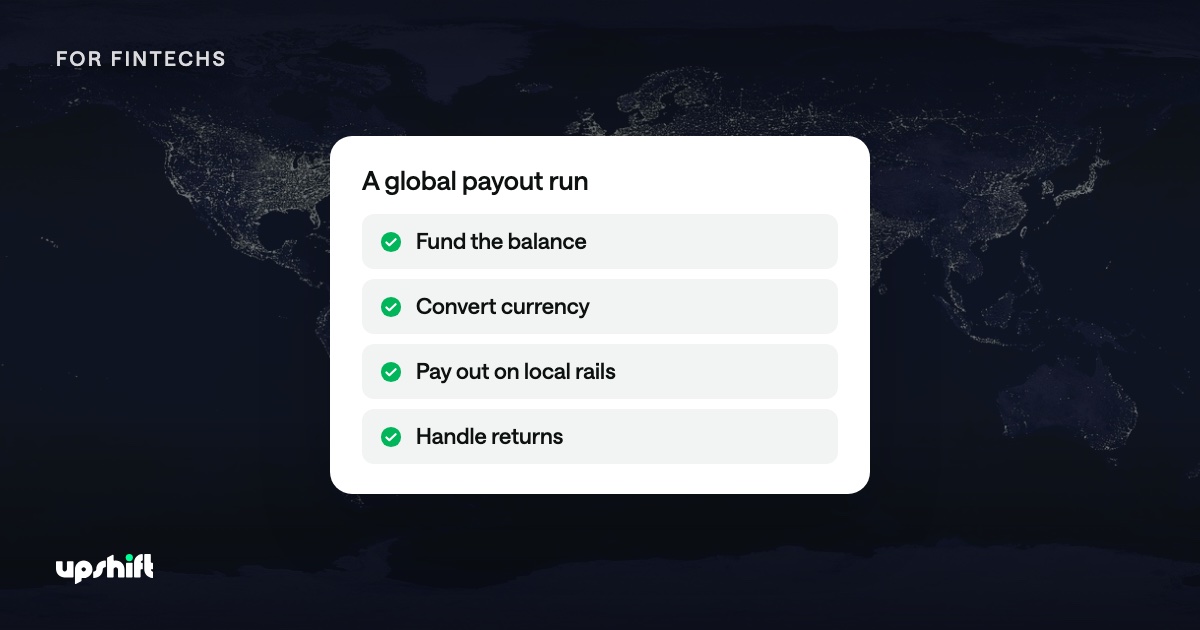
A payout run passes through four stops: the company's bank account, the payout provider's balance, a currency conversion and local rail, and the recipient's account. Failed, returned and unclaimed payouts travel back to the provider balance.
Step 1: fund the payout balance
Payoneer has the business send the full payout amount from a corporate bank account. PayPal tells senders to "add enough to cover your payout total, including fees" to their PayPal balance. Stripe pays from a Treasury financial account, and a scheduled payout fails if that account is short on the day. Rapyd issues virtual IBANs for the same job. An international wire takes 1 to 5 business days and costs $20 to $50, according to Ramp.
Step 2: check recipients and lock the rate
Stripe runs a Confirmation of Payee name check before each GBP payout to a UK bank account. Tipalti collects W-9 and W-8 tax forms and DAC7 data from payees. On cross-border payouts, Stripe's docs say "the rate on the review page is the finalized rate".
Step 3: pay out over a local rail
Stripe's docs list the rails it uses: ACH, Fedwire or RTP for US payouts, Faster Payments in the UK, SEPA or SEPA Instant in the eurozone, and a local network or SWIFT for cross-border payouts. Rapyd says real-time networks such as Pix and SEPA Instant settle in seconds, and it pushes card payouts through Visa Direct and Mastercard Send 24/7. dLocal's payouts page shows payouts over Pix and UPI.
Step 4: handle returns and unclaimed funds
Some payouts come back. Stripe says a returned payout typically lands back within 2 to 3 business days, longer in some countries, and its docs trace most returns to wrong bank details, such as a closed account. A cross-border payout can't be reversed once it has posted. At PayPal an unclaimed payout expires after 30 days, and PayPal returns the funds to the sender. Both kinds of money wait in the payout balance for the next run.
Where do stablecoins fit into global payouts?
On the funding side, Nium converts incoming USDC to USD for its payouts, and dLocal takes stablecoins next to USD and EUR. The recipient still gets local currency. On the recipient side, Rapyd and Thunes can pay into stablecoin wallets, and Stripe is previewing USD stablecoin payouts to Link accounts. Stablecoin payout APIs compares 8 stablecoin-native providers on corridors, chains, licences and pricing.
What does the funded balance cost between runs?
A prefunded payout balance holds money for four reasons:
- Lead time. The batch sits in the account from the day the funding wire lands until the run.
- Weekends. Fedwire closes from 7pm Friday to 9pm Sunday, US Eastern time. A platform paying out on Saturday and Sunday funds both days by Friday, and Weekend payouts and stablecoin liquidity sizes that balance.
- Returns. 2 to 3 business days at Stripe, 30 days for unclaimed PayPal payouts.
- Buffer. A cushion for re-sends and a late wire.
Here is a second illustration, with hypothetical figures. A platform funds a $500,000 batch 2 days before each weekly run and keeps a $250,000 buffer all year. On an average day it holds about $393,000: the $250,000 buffer plus $500,000 for 2 of every 7 days. Most of that is buffer.
The 13-week Treasury bill yielded 4.19% on 13 October 2026, per the US Treasury, and at that rate the balance would earn about $16,500 a year. The T-bill rate is a reference point for this example, not a vault yield. Companies that prefund in several countries carry one balance per corridor, which Cross-border prefunding prices with a calculator.
Can a prefunded payout balance earn between runs?
Upshift helps fintechs and asset managers with stablecoin balances add stablecoin yield to their product, from 24/7 tokenized money market funds to DeFi. A platform that keeps its payout buffer in USDC can hold it in a stablecoin vault between runs and send it to the payout provider when a batch is due.
Nium accepts USDC funding for eligible corporate clients, and dLocal accepts stablecoin funding. In both cases the money can go from the vault to the provider without a bank wire. Upshift runs the vaults, and asset managers and curators run the strategies inside them.
- A Cash band vault holds tokenized money market funds next to a USDC buffer. Core and Enhanced vaults add lending and active strategies on the same integration (see yield options).
- Most vaults use a 72-hour withdrawal period. A withdrawal requested 3 days before the run lines up with it.
- Instant exit is available up to the vault's USDC buffer, for a fee set per vault (0 to about 0.2%).
- A vault can be limited to the platform's own wallets, which keeps the buffer out of a shared exit queue. Segregated vs co-mingled vault accounts explains the trade-off.
Dollars in a bank account held for customers follow the bank's program agreement instead, which FBO accounts and customer funds covers. Upshift's contracts have been through 11 smart contract audits by 6 independent firms.
Risks
- A stablecoin can trade below $1 for a period.
- A vault contract or oracle can have a bug.
- A withdrawal larger than the USDC buffer waits for the withdrawal period, and vault yields move daily and aren't guaranteed.
- A payout provider or its local partner can delay or reject a run.
Always make sure to do your own research and be aware of the above and any other risks before depositing.
Add stablecoin yield to your product, from 24/7 tokenized money market funds to DeFi. Send us your weekly payout volume and how many days ahead each batch is funded, and we'll size what the balance could earn and a withdrawal schedule to match.
The payments use case page shows the setup for a payout business.
Frequently asked questions
What are global payouts?
Global payouts are payments one business sends to many recipients in other countries, in each recipient's local currency. Stripe's version reaches more than 160 countries and pays people who don't hold a Stripe account, such as contractors or claimants.
What companies use global payments?
Stripe names marketplaces paying sellers, insurers paying claims, fintechs sending loan payouts and cash-outs, platforms paying creators and affiliates, and government agencies distributing relief funds. Stripe's product also sends vendor reimbursements and refunds to an email address.
Is Global Payments a real company?
Yes. Global Payments Inc. is a payment technology company listed on the New York Stock Exchange as GPN. "Global payouts" is the general name for cross-border mass payments, sold by Payoneer, Stripe, Nium and others.
How long do international payouts take?
An international wire takes 1 to 5 business days, according to Ramp, and Stripe quotes 2 to 3 days for a bank payout on its Netherlands page and minutes for a debit card. Real-time rails such as Pix pay within seconds, and Nium lists more than 100 real-time corridors.
Do I need to prefund a payout account?
With Payoneer, PayPal and Stripe, yes: the payout total has to sit in the provider balance before the run. Rapyd offers prefunding through virtual accounts. Nium sells just-in-time funding instead, without a prefunded account in each country.
How much do global payouts cost?
Tipalti's Mass Payments plan starts at $249 a month plus transaction fees. Trolley lists $2,399 a year for its Standard plan, $1 per US ACH payout, $10 per wire with FX and a 2.00% currency conversion margin. Payoneer, Wise, dLocal, Nium, Rapyd and Thunes didn't list payout prices on their product pages on 14 October 2026.
Launch a vault with Upshift
Upshift builds custom, permissioned vaults for custodians, exchanges, neobanks and asset managers. Tell us what you are building and the team will follow up.
Create a vault with Upshift
Share your use case and we’ll get back to you shortly