White label crypto exchange: 12 providers compared (2026)

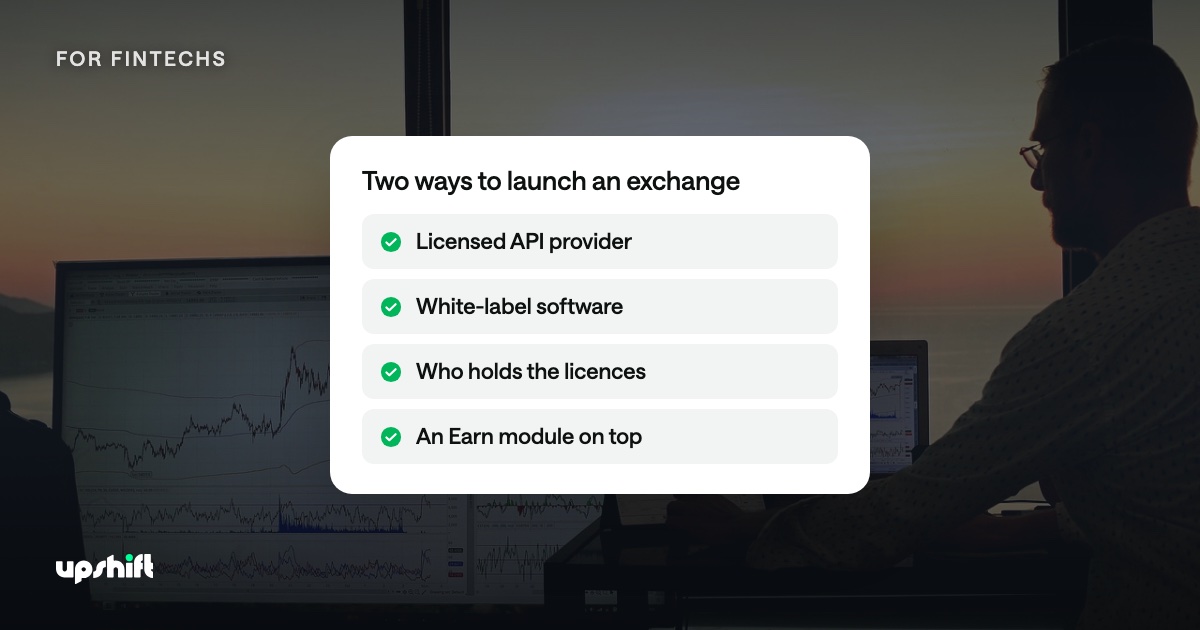
A white label crypto exchange comes in two forms: a licensed API provider that holds the licences and the coins for you, or software you run under your own licences. Vendor launch times cover the software, and the licences come on top.
Take a US fintech that wants its users to buy $500 of bitcoin inside its app. With a licensed API provider such as Zerohash, Paxos, Coinbase or BitGo, the order goes to the provider, which holds the licences and keeps the coins, while the fintech shows its own buy button.
With white label crypto exchange software such as AlphaPoint, HollaEx or Shift Markets, the fintech runs the venue itself, picks a custodian and gets its own licences before the first trade. Both get sold as a white label crypto exchange, and both turn up when buyers search for crypto exchange as a service. The 12 providers in the table split into those two groups, as of 14 October 2026.
White label crypto exchange providers compared
Provider | Model | Who holds the licences | Custody | Named clients | Best for |
Zerohash | Licensed API | Zerohash: US money transmitter licences, NY BitLicense, MiCA and EMI licences in the EU | Held by the provider | Not named on its licence page | One provider for US and EU users |
Paxos | Licensed API | Paxos, federally chartered by the OCC | Paxos custodies, or the client picks a custodian | Revolut (2020), PayPal (2020) | Regulated firms that want to pick custody and liquidity |
Coinbase | Licensed API | Coinbase, Inc.: NY virtual currency licence | Coinbase subcustody | PNC (announced July 2025) | Banks adding crypto for their customers |
BitGo | Licensed API | BitGo Bank and Trust (OCC), plus EU MiCA and Singapore licences | BitGo custodial wallets | Fold | Wide asset coverage, with staking |
Alpaca | Licensed API | Alpaca Crypto LLC, FinCEN-registered money services business | Wallets secured by Fireblocks | None named | US apps that also offer stock trading through an API |
Bakkt | Licensed API | Bakkt Financial Solutions: NY BitLicense, state money transmitter licences | Third-party custodians (BitGo, Coinbase Custody, Fireblocks Trust) | None named | US crypto trading next to stablecoin payments |
Talos | Software | The client | The client's custodian | Abra, OSL, Anchorage Digital (quotes) | Licensed brokerages that price and hedge their own flow |
AlphaPoint | Software | The client | Third-party custody integrations | Wenia (Grupo Bancolombia), Chivo, Coinext | Banks and public bodies running their own venue |
Shift Markets | Software | The client, with compliance tools from Shift | Not stated | None named; 150+ exchanges launched | Exchanges that want market making bundled in |
HollaEx | Software | The client | HollaEx hot and cold wallets | None named on the product page | Small teams testing a venue on a free trial |
ChainUp | Software | The client (ChainUp sells licensing services) | Hot, warm and cold wallets, or MPC wallets | None named; 500 exchanges launched | Venues that want spot, futures and earn products in one stack |
B2Broker | Software | The client | Not stated | None named | Brokers that want a published monthly price |
How we chose
Every provider here sells crypto trading under the client's brand, and every fact comes from the provider's own site or a public filing, checked on 14 October 2026. The criteria were:
- Who holds the licences: the provider, or the client.
- Where customer coins sit.
- Named clients, where the provider or a filing names them.
- Published pricing and launch times, quoted as the provider states them and never estimated.
Licensed API providers hold the licences and the coins
A licensed API provider, sometimes sold as crypto as a service, executes the trade and holds the customer's coins under its own licences. The client's app calls the API, shows prices and balances, and passes KYC data through. In the US that usually means state money transmitter licences plus a New York BitLicense, held by the provider. The client still has work to do (a contract, onboarding reviews by the provider's compliance team, disclosures in the app), though it skips applying for state licences of its own.
- Zerohash lists money transmitter licences across most US states plus a New York virtual currency licence (number 0000017) for zerohash llc. In May 2026 it added an EMI licence from the Dutch central bank on top of its MiCA authorisation, which covers the European Economic Area.
- Paxos says it is now federally chartered by the OCC and custodies assets on a fiduciary basis; the OCC gave conditional approval in December 2025. Clients choose where assets sit and which liquidity providers see their flow. Revolut was its first brokerage client in July 2020, and PayPal followed that October.
- Coinbase sells a Crypto-as-a-Service platform to banks, brokers, exchanges, fintechs and payment firms, with client assets held in Coinbase subcustody. PNC agreed in July 2025 to use it to offer crypto to PNC clients.
- BitGo covers 1,400+ assets on 40+ chains through one API, with trading, staking and wallets. Its custodial wallets are insured up to $250 million, and it licenses through BitGo Bank and Trust, N.A., MiCA in the EU and a Major Payment Institution licence in Singapore.
- Alpaca offers 20+ coins through its broker API, 24/7. Alpaca Crypto LLC is a FinCEN-registered money services business, and it keeps customer coins in wallets secured by Fireblocks MPC.
- Bakkt describes itself in its 10-Q for the quarter to 30 June 2026 as a regulated financial technology company that builds and operates infrastructure for digital asset trading, programmable finance and cross-border payments. Clients connect through APIs and switch on only the modules they need, including stablecoin payments. Its subsidiary Bakkt Financial Solutions holds a New York BitLicense and money transmitter licences in every state where its business requires one, and uses BitGo, Coinbase Custody and Fireblocks Trust as custodians.
Software vendors leave the licences with the buyer
White label crypto exchange software hands the client a matching engine or brokerage stack, an admin back office and a branded front end. The client becomes the operator. That means the client applies for its own licences, signs its own custody contract and runs its own compliance program.
Talos states it outright: its white label offering "is a SaaS technology platform only" and does not provide registrations or satisfy KYC/AML obligations. Talos also doesn't create a standalone order book for the client; the client prices its own customers and hedges across 100+ liquidity providers on the Talos network. Shift Markets supplies "compliance tools" alongside the platform, and ChainUp sells regulation and licensing services as a separate line.
- AlphaPoint exposes 500+ APIs, a FIX gateway and an SDK, connects to third-party custodians and holds a SOC 2 report. Its case studies include Grupo Bancolombia's Wenia, El Salvador's Chivo wallet and the Brazilian exchange Coinext.
- Shift Markets bundles a trading engine, market making, payment integrations and a back office. It reports 150+ exchanges launched and $2 trillion+ in total volume traded.
- HollaEx offers a 2-week free operator trial, and its Enterprise Cloud plan takes a 15% revenue share. The product page says a team can launch "within a day".
- ChainUp covers spot and futures modules, an on-ramp and "Earn Products" (lending, staking and asset management), and says it has customised and launched 500 exchanges.
- B2Broker publishes B2CORE pricing of $1,000 to $20,000 a month with free setup, plus a processing fee of 0.10% to 1.00% depending on the plan. B2CORE is the client portal and back office.
Vendor launch times leave out licensing
Every launch time on the vendor pages describes the software. HollaEx says within a day, ChainUp says within a few weeks, and Shift says clients go live "in weeks rather than months", adding that the timeline depends on compliance requirements. None of them counts the licences.
In the US a money transmitter licence is granted state by state, a New York BitLicense is a separate application to the NYDFS, and a business that transmits value also registers with FinCEN as a money services business. In the EU a crypto-asset service provider needs MiCA authorisation from a national regulator.
A software buyer adds those applications to the vendor's launch time. A licensed API provider has done that work already, and the client's timeline becomes the provider's onboarding and the app integration. In exchange, the client offers the assets the provider lists, and the customers' coins sit with the provider.
This is general information, not legal advice.
Stablecoin balances can earn through an Earn module
Users of a crypto exchange or trading app park money between trades, and some of it sits in USDC or other stablecoins. Those balances earn yield only if the platform offers an Earn product. Of the 12 providers, BitGo and Coinbase list staking in their crypto-as-a-service products, and ChainUp lists earn products.
Upshift runs stablecoin vaults that a platform can offer under its own brand through the Upshift SDK or API, and the platform keeps a share of the fees. Asset managers and curators, such as Sentora, run the strategies inside each vault. Vaults sit in three risk bands: Cash vaults hold T-bills and tokenized money market funds, Core vaults run blue-chip lending, and Enhanced vaults run market-neutral strategies.
Most vaults use a 72-hour withdrawal period, with instant exit available up to the vault's USDC buffer for a fee. Earn providers for exchanges and wallets compares the vendors that build these programs, and stablecoin yield infrastructure compared covers the vault platforms behind them.
Add stablecoin yield to your product, from 24/7 tokenized money market funds to DeFi. Tell us the stablecoin balances your users hold and the chains they sit on, and we'll show you which vaults fit your users.
See how Upshift works for exchanges and wallets and for neobanks and fintech apps.
Frequently asked questions
What is a white label crypto exchange?
A white label crypto exchange lets a business offer crypto trading under its own brand on another company's technology. With a licensed API provider such as Zerohash or BitGo, the provider holds the licences and the coins. With software such as AlphaPoint or HollaEx, the business runs the venue and holds the licences itself.
How much does it cost to set up a white label crypto exchange?
Few providers publish prices. B2Broker lists its B2CORE back office at $1,000 to $20,000 a month with free setup, plus a processing fee, and HollaEx's Enterprise Cloud plan takes a 15% revenue share.
Which white label crypto exchange is the best?
No single provider fits every buyer. A fintech without its own licences usually needs a licensed API provider such as Zerohash, Paxos, Coinbase or BitGo, while a licensed exchange or bank can run software from AlphaPoint, Shift Markets or Talos.
What is crypto-as-a-service?
Crypto-as-a-service is the licensed API model: a provider runs trading and custody, and a bank, broker or app offers it to customers. Coinbase and BitGo sell it under that name, and PNC signed up for Coinbase's version in July 2025. The model works much like banking as a service, where a licensed bank sits behind a fintech's accounts.
Do I need a licence to run a white label crypto exchange?
On a software platform, yes: Talos says its white label product provides no registrations and doesn't satisfy KYC/AML obligations. US operators typically need state money transmitter licences, a New York BitLicense for New York users and FinCEN registration, and EU operators need MiCA authorisation. A licensed API provider holds those licences for its clients.
Can a white label exchange offer staking or yield?
Some can. BitGo and Coinbase list staking, ChainUp lists earn products, and an exchange can add an Earn module from a separate provider for stablecoin balances. Any yield depends on the strategy behind it and is never guaranteed.
Launch a vault with Upshift
Upshift builds custom, permissioned vaults for custodians, exchanges, neobanks and asset managers. Tell us what you are building and the team will follow up.
Create a vault with Upshift
Share your use case and we’ll get back to you shortly