Stablecoin remittances: live programs, corridors and rules

MoneyGram, Remitly, Western Union and Félix now move part of their remittance money in stablecoins. The dollars they park with payout partners and in customer wallets can earn while they wait.
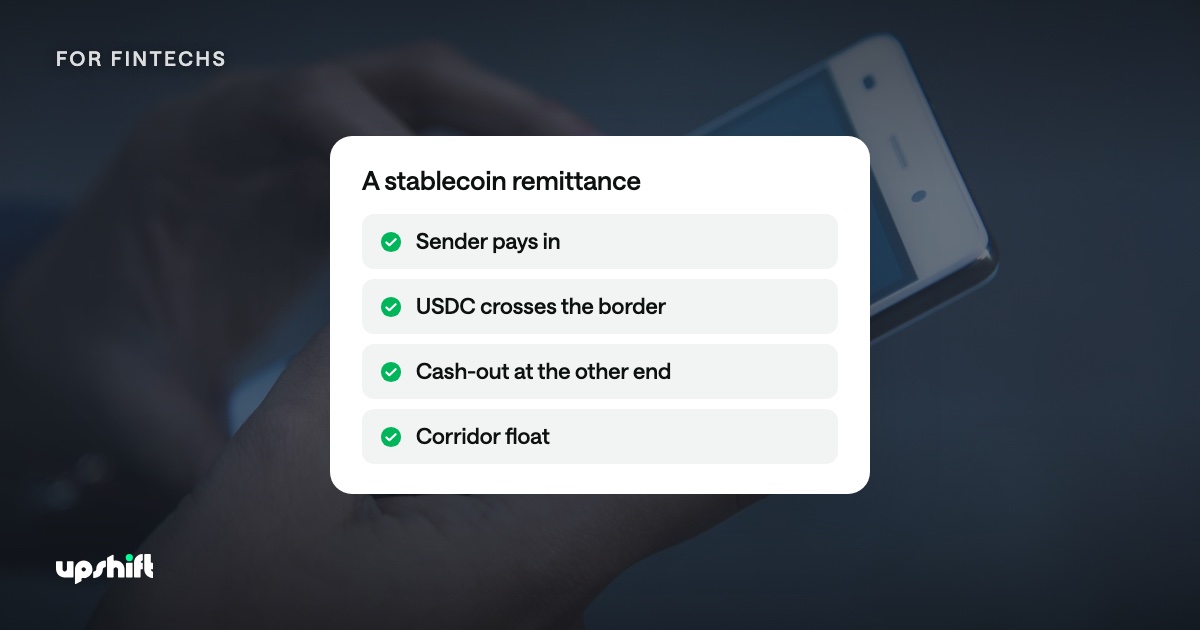
A Félix customer in the US pays by debit card or ACH, a processor converts the dollars into USDC through Circle Mint, the USDC crosses to Bitso on the Stellar network, and Bitso pays out Mexican pesos to a local bank account over SPEI, according to Circle's Félix case study. Félix cut its fee on that send from $4.98 to $2.99.
That's the shape of most stablecoin remittance programs today: the sender pays in dollars, the recipient gets local currency, and a dollar stablecoin carries the cross-border leg in between. The World Bank's Remittance Prices Worldwide Q3 2025 report put the global average cost of sending remittances at 6.36% of the amount sent, against the UN's SDG target 10.c of less than 3% by 2030.
Stablecoin remittance programs, by operator
Operator | What runs on stablecoins | Coin and chain | Corridors named | Date (source) |
Félix (Felix Pago) | WhatsApp sends settled in USDC | USDC on Stellar | US to 11 Latin American countries | $200M raise, 2 Sep 2026 (Finovate) |
Remitly | Treasury moves, Remitly Wallet and USDC payouts | USDC | US to Argentina and Nigeria for USDC payouts | 4 Aug 2025 and 3 Dec 2025 (Remitly) |
MoneyGram | App balance held in USDC; cash-out at MoneyGram stores announced as a coming feature | USDC on Stellar, wallets by Crossmint | Colombia first | 17 Sep 2025 (MoneyGram) |
Western Union | USDPT for agent settlement and the Stable by Western Union consumer product | USDPT on Solana, issued by Anchorage Digital Bank | 40+ countries planned for 2026 | 4 May 2026 (Western Union) |
Zepz (Sendwave, WorldRemit) | Sendwave Wallet in digital dollars | USDC on Solana | 100+ countries | 22 Oct 2025 (Zepz) |
Bitso | Exchange and payout partner for remittance firms | USDC (Félix flow) | US to Mexico | 2024 volume (Dallas Fed, 15 Oct 2025) |
Yellow Card | Partnership with Mastercard to explore remittance and B2B settlement uses | Not stated | Eastern Europe, Middle East and Africa | 7 May 2026 (Mastercard) |
Chipper Cash | Partnership with Stable for sends and receives in USDT (announced) | USDT on Stable | 9 African countries | 10 Dec 2025 (Chipper Cash) |
Airtm | USDC wallet; employers pay workers in USDC through Bridge | USDC on Stellar | 150+ countries | Bridge payouts since Mar 2024 (Stellar) |
Félix, Bitso and Western Union's agent settlement keep the stablecoin between companies, and the customer never sees it. MoneyGram, Remitly, Zepz and Airtm also let the recipient hold dollars in a wallet, which turns a one-off send into a balance that stays in the app.
Corridors with documented stablecoin volume
US to Mexico has the clearest numbers. Bitso says it processed over $6.5 billion in remittances in 2024, according to the Dallas Fed, which was more than 10% of the total between the two countries. Mexico took in about $68 billion in remittances in 2024, second only to India's $129 billion, out of $685 billion sent to low- and middle-income countries (World Bank, December 2024).
Remitly's USDC payouts covered two routes in December 2025, US to Argentina and US to Nigeria. MoneyGram picked Colombia, where families receive more than 22 times the money they send abroad, according to its September 2025 launch release. Chipper Cash and Yellow Card have announced stablecoin partnerships focused on Africa.
Cash-out is where most of the cost sits
Banxa splits a stablecoin remittance into on-ramp, transfer and off-ramp, and says only the middle leg is nearly free. Each program handles the last leg its own way:
- Félix uses Bitso to sell USDC for pesos and push them over SPEI, Mexico's instant bank transfer system.
- MoneyGram says app users in Colombia will be able to cash out at its retail locations, which number nearly 500,000 worldwide.
- Airtm lists 500+ local payment methods, including bank transfers, cash pickup and mobile wallets.
- Zepz routes Sendwave Wallet withdrawals through its existing payout partners.
The spread on that final conversion is where a thin local currency market eats the saving. The stablecoin sandwich covers the two FX legs in detail.
US rules for stablecoin remittances
A 1% federal excise tax has applied to remittance transfers since 1 January 2026. It sits in section 4475 of the Internal Revenue Code, added by the One Big Beautiful Bill Act on 4 July 2025. It applies only when the sender gives the provider "cash, a money order, a cashier's check, or any other similar physical instrument".
Transfers funded from an account at a US financial institution, or with a US-issued debit or credit card, are exempt. Treasury and the IRS published proposed regulations on 13 April 2026 that add traveler's checks. Comments closed on 12 June 2026. No final rule had appeared in the Federal Register by 14 October 2026. The proposed rule doesn't mention stablecoins, digital assets or virtual currency anywhere, which leaves a stablecoin-funded send unclear.
Consumer protection is also open. The CFPB withdrew its January 2025 proposed interpretive rule on emerging payment mechanisms, which had discussed stablecoins, in May 2025, and we haven't found guidance applying the Regulation E remittance rule (disclosures, cancellation, error resolution) to stablecoin sends. This is general information, not legal advice.
Prefunding and float
Money transfer operators keep prefunded accounts in destination countries to pay out quickly, as the Dallas Fed notes. Stablecoins shrink those balances without removing them. Circle says USDC settling on nights and weekends reduced Félix's pre-funding requirements in Mexico, and Western Union names round-the-clock agent settlement "to reduce idle balances" as one of four uses for USDPT. Remitly says it moved USDC into its treasury operations to move value across time zones and weekends. Our guide to cross-border prefunding counts the days of cover each rail needs.
Wallets add a second pool. When MoneyGram holds a customer's USD balance in USDC, or Zepz holds Sendwave Wallet dollars, the operator holds one pool of user balances and picks who earns on it: the operator keeps the yield, shares it with users, or passes it through minus a fee.
Where Upshift fits
Remittance firms prefund corridors and hold float. That float can earn in a stablecoin vault while it waits for the next payout. Upshift runs the vaults, and curators (typically asset managers) run the strategies inside them. Cash vaults hold tokenized money market funds, and Core vaults add lending and private credit.
Most vaults use a 72-hour withdrawal period, with instant exit up to the vault's USDC buffer for a fee. That fits a corridor reserve better than the payout balance a partner draws on every hour. Add stablecoin yield to your product, from 24/7 tokenized money market funds to DeFi. Yields move and none is guaranteed, and every vault carries smart contract risk.
Holding corridor float in stablecoins? Tell us the corridors, the balance and how fast you need it back, and we'll show you which vaults fit.
See how Upshift works for payments companies, or compare the bands on yield options.
Frequently asked questions
What is a stablecoin remittance and how does it work?
The sender pays in local money, a licensed provider converts it to a dollar stablecoin such as USDC, the stablecoin moves onchain in seconds, and a payout partner converts it to the recipient's currency. Some apps let the recipient keep the dollars in a wallet. The full corridor flow is in stablecoin cross-border payments.
Are stablecoin remittances cheaper than Western Union or Remitly?
Western Union and Remitly run stablecoins inside their own networks, for agent settlement and USDC payouts. The price a sender pays still depends on the off-ramp spread in the destination country, plus each firm's own fee.
How does the recipient cash out stablecoins?
In programs like Félix's, the recipient never touches the coin: a partner such as Bitso sells it and pays local currency into a bank account. Wallet users withdraw through payout partners or local payment methods, depending on the app.
Does the 1% US remittance tax apply to stablecoins?
The tax in 26 U.S.C. 4475 applies only when the sender provides "cash, a money order, a cashier's check, or any other similar physical instrument". Transfers funded from an account at a US financial institution, or with a US-issued debit or credit card, are exempt. The Treasury and IRS proposed rule of 13 April 2026 adds traveler's checks. Neither text mentions stablecoins. As of 14 October 2026, no final IRS rule appears in the Federal Register. How it applies to a specific product is a question for tax counsel.
Can remittance companies earn yield on prefunded balances?
Yes, on the part that doesn't have to pay out within hours. A corridor reserve held in USDC can sit in a stablecoin vault with a 72-hour withdrawal period, while the working payout balance stays in plain USDC at the partner. The GENIUS Act, signed on 18 July 2025, bars stablecoin issuers from paying holders interest, which is why any yield comes from what the vault holds.
Keep reading
- Stablecoin payout APIs. The providers that run the last leg.
- Nostro vostro vs stablecoin settlement. What changes when a nostro balance becomes USDC.
- Weekend payouts and stablecoin liquidity. Funding payouts when banks are shut.
- Stablecoin treasury management. Sizing each pool of float.
Launch a vault with Upshift
Upshift builds custom, permissioned vaults for custodians, exchanges, neobanks and asset managers. Tell us what you are building and the team will follow up.
Create a vault with Upshift
Share your use case and we’ll get back to you shortly