How stablecoin payments work: rails, fees and rules (2026)

A stablecoin payment turns dollars into a token, moves the token onchain in seconds and turns it back into local money at the other end. The middle leg runs 24/7, while the bank legs keep their own hours and hold money while they wait.
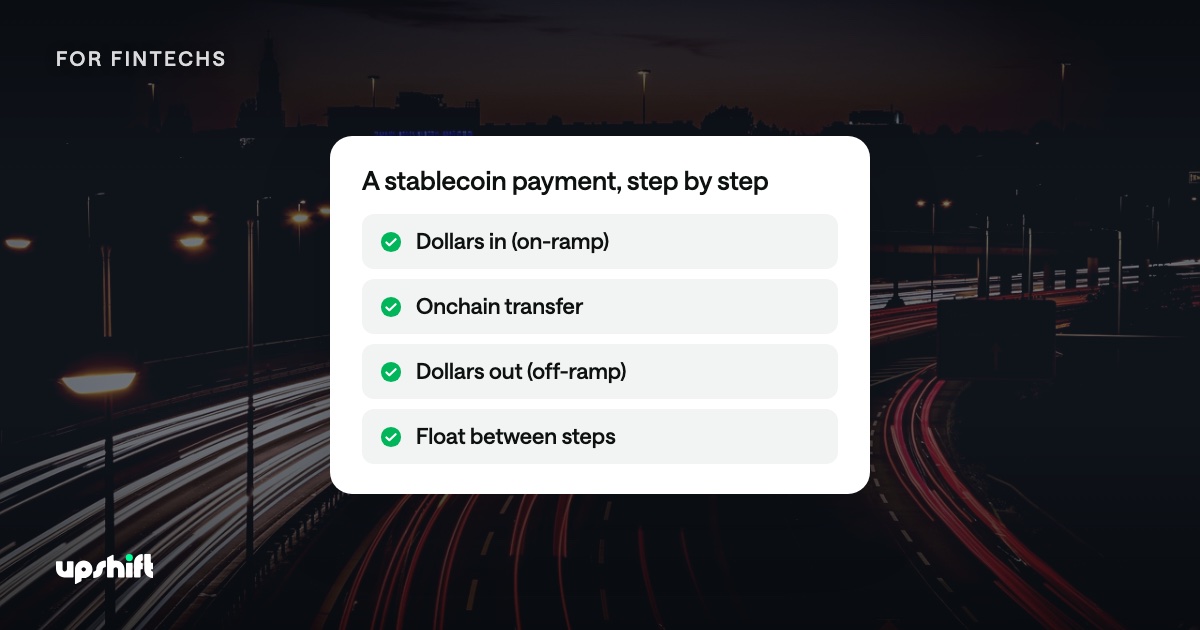
On 8 September 2026, Visa said its stablecoin settlement had passed a $20B annualised run rate, up more than 15x in a year, across more than 160 stablecoin-linked card programs (The Block). Stablecoin payments like those follow four steps.
An on-ramp turns bank dollars into a stablecoin such as USDC, the coin moves onchain in seconds, and an off-ramp turns it back into local money. The payment is final when the recipient is credited. The stablecoin payment rails in the middle run 24/7, while the bank rails at each end keep their own hours.
Take a US company paying a $50,000 invoice to a supplier in Mexico on a Friday evening. It wires dollars to a provider that turns them into USDC, the USDC reaches a partner in Mexico in under a minute, and the partner pays the supplier in pesos over SPEI, Mexico's bank transfer system.
The four steps of a stablecoin payment
In words: the payer's bank sends dollars to an on-ramp, which mints or buys USDC. The USDC crosses a blockchain to an off-ramp partner, which sells it and pays the recipient on a local bank rail. Money waits at three points: collections float, prefunded payout balances and local currency reserves.
A stablecoin payment works a lot like a prepaid travel card. You load dollars at home, carry the card across the border and swap it for local cash when you land, and the card itself never cares what time it is.
Step | What happens | Time | Cost |
1. On-ramp | Dollars arrive by ACH, wire or RTP; a provider mints the stablecoin or buys it on an exchange | Bank hours; Fedwire runs 22 hours a day, Monday to Friday | The provider's ramp fee |
2. Transfer | The stablecoin moves onchain; the sender pays gas in the chain's own token | About 400ms on Solana to about 13 minutes for full finality on Ethereum | Under a cent to about $20, by chain (early 2026) |
3. Off-ramp | A local partner sells the stablecoin and pays out on SPEI, Pix or SEPA | The local rail's hours | Ramp fee plus the FX spread |
4. Finality | The recipient is credited; the onchain transfer can't be reversed by a chargeback | When the local credit lands | None beyond the steps above |
Providers such as Cross River take ACH, wire and RTP deposits and return USDC, and payout networks such as Bridge list SPEI, Pix and SEPA among their local rails. The pattern is often called the stablecoin sandwich. Only step 2 runs every hour of every day. The Federal Reserve plans to open Fedwire on Sundays and weekday holidays no earlier than 2028. Saturdays stay closed.
Chains and fees on stablecoin payment rails
A sender pays gas in the chain's native token (ETH on Ethereum, TRX on Tron, SOL on Solana) and needs a small balance of it next to the stablecoin (FXC Intelligence). Fee estimates per USDC or USDT transfer from the Spark fee calculator (early 2026) and Eco:
- Ethereum: $2 to $20, with blocks about every 12 seconds and full finality in about 13 minutes.
- Tron: $1 to $3 for USDT on Spark's estimate, or about $0.80 to $1.40 on Eco's; a wallet holding enough energy and bandwidth pays zero TRX.
- Solana: $0.001 to $0.01, final in about 400ms.
- Base and Polygon: $0.01 to $0.05.
- Arbitrum: $0.01 to $0.10.
Gas is only one line on the bill. Ramp fees, the payment provider's margin and the FX spread on the off-ramp add to it, and FXC says these fees narrow the cases where stablecoins undercut other cross-border payments, particularly in developed markets. A February 2026 Harvard Business School paper finds gas economically negligible for large transfers, and finds the clearest stablecoin cost edge in emerging-market corridors with capital controls.
Stablecoin supply and payment volume in 2026
Dollar stablecoins in circulation reached $309.8B on 14 October 2026, led by USDT at $183.9B and USDC at $73.0B (DefiLlama). By chain, Ethereum held $144.3B (47.6%) and Tron $94.6B (31.2%), with Solana at $15.8B and BNB Chain at $13.1B.
Circle, citing Visa Onchain Analytics, reported $1.23 trillion of stablecoin transaction volume in December 2025 alone. McKinsey, filtering Artemis data for real payments, put the annualised run rate at about $390B in December 2025. Artemis broke an August 2025 run rate of $122B down by type, with B2B at $76B, card-linked spend at $18B, prefunding at $3.6B and B2C at $3.3B.
Stablecoin payment use cases
Cross-border payments. A payment company replaces a chain of correspondent banks with one onchain hop and two local ramps. Corridors, costs and the providers that run them sit in stablecoin cross-border payments. Stripe's 2024 annual letter says SpaceX uses Bridge to repatriate funds from Starlink sales in Argentina, Nigeria and other markets.
Payouts. Marketplaces and gig platforms pay sellers and workers in many countries, in stablecoins or local money. Stablecoin payout APIs compares the vendors.
Payroll. Payroll platforms pay contractors abroad in USDC, or fund local payroll through a stablecoin leg. Stablecoin payroll covers the flow and the float it creates between funding day and pay day.
Card settlement. Visa settles in USDC with US issuers through Cross River and Lead Bank on Solana, 7 days a week (16 December 2025). In June 2026, Mastercard said it plans to offer issuers and acquirers weekend, holiday and onchain settlement in regulated stablecoins (CoinDesk). Card programs hold customer balances between load and spend, and how card programs earn yield on customer float follows that money.
Orchestration. An orchestration layer routes each payment across ramps, chains and liquidity providers by price and speed. Stablecoin orchestration breaks the stack down.
Prefunding. A remittance or payout company keeps money in each destination market before customers send it. On 30 September 2025, Visa Direct announced a pilot that tests stablecoins as a funding source for payouts, and said it expected limited availability by April 2026. Costs and fixes are in cross-border prefunding.
Bank settlement. Banks settle foreign payments through nostro and vostro accounts, with a prefunded balance at a partner bank in each currency. Nostro vostro vs stablecoin settlement shows what changes when one USDC balance replaces several of them.
Merchant acceptance. Stripe lets merchants accept USDC on Tempo, Ethereum, Solana, Polygon and Base and settles the payment to their Stripe balance in local currency, with a $10,000 cap per transaction. Other gateways appear in best crypto payment gateways.
Where money waits between the steps
The onchain leg settles in seconds, while bank cut-offs, batches and weekends hold money for longer. A payment company collects customer dollars during the day and sweeps them to a ramp in batches, which leaves collections float sitting for hours. Before it can pay out, it loads balances at its own PSP or at an off-ramp partner, and that payout prefunding can sit for days, longer over a weekend or a public holiday.
Off-ramp partners also keep local currency reserves in each corridor, sized to cover the payouts they expect and topped up between them. Artemis tracked $3.6B of annualised prefunding flow in August 2025. Funding weekend payouts covers the timing problem in more detail.
Stablecoin payment regulation as of October 2026
In the US, the GENIUS Act was signed on 18 July 2025. It takes effect on the earlier of 18 January 2027 or 120 days after the federal regulators issue final rules, and section 4(a)(11) bars issuers of payment stablecoins from paying holders interest or yield. No implementing rule was final on 14 October 2026. Each one was still a proposed rule or an interim final rule (Federal Register search, 14 October 2026):
- Proposed rule: the OCC published its proposed rule on 2 March 2026. On 19 August 2026, the Comptroller said a final rule would be out "by November" (OCC). It was not final on 14 October 2026.
- Proposed rule: the FDIC published its proposed issuer standards on 10 April 2026.
- Proposed rule: Treasury published proposed rules on payment stablecoin issuance, offer and sale on 18 August 2026.
- Proposed rules: the Federal Reserve published two proposed rules on 29 September 2026, on its GENIUS Act responsibilities and on application procedures. Comments are due 30 November 2026.
- Interim final rule: Treasury issued an interim final rule on state certification on 30 September 2026. It took effect on that day, and comments run to 30 November 2026 (Willkie, 5 Oct 2026).
The CLARITY Act, which covers wider crypto market structure, failed a cloture vote 49-50 on 15 September 2026. In the EU, MiCA requires e-money tokens to be issued by credit institutions or e-money institutions (Article 48) and bars interest on them (Article 50), and the transitional period for existing crypto-asset service providers ended on 1 July 2026 at the latest (ESMA).
Country rules are in stablecoin regulation, and the yield rules in how the GENIUS Act and CLARITY Act reshape stablecoin yield. This is general information, not legal advice.
Where idle payment float can earn
The GENIUS Act bars payment stablecoin issuers from paying holders yield. The business holding the stablecoins chooses where its idle float sits. The 13-week Treasury bill yielded 4.19% on 13 October 2026 (US Treasury, coupon equivalent). As an illustration of that T-bill rate only: $5M of prefunded balances at 4.19% comes to about $210,000 a year, before fees. This figure is the Treasury bill rate. It is not a quote for any vault's rate, and vault yields are not guaranteed.
Upshift runs stablecoin vaults for payment companies, fintechs and asset managers, and curators (typically asset managers) run the strategies inside them. Add stablecoin yield to your product, from 24/7 tokenized money market funds to DeFi. Most vaults use a 72-hour withdrawal period, and instant exit is available up to the vault's USDC buffer for a fee. More on the setup for PSPs is on the payments use case page and in yield options.
Holding prefunded or settlement balances in USDC? Tell us the size, the chains and how fast payouts need the money back, and we'll show you which stablecoin vaults fit.
Frequently asked questions
What are stablecoin payments?
Stablecoin payments move value as a dollar-pegged token, usually USDT or USDC, across a blockchain. A business payment often starts and ends in bank money, with the stablecoin carrying only the cross-border or out-of-hours leg.
Who accepts stablecoin as payment?
Merchants on Stripe can accept USDC, plus USDP and USDG in the US, and receive local currency in their Stripe balance. Visa lets issuer and acquirer partners settle in USDC with no change to the consumer card experience.
What are the top 4 stablecoins?
By supply on 14 October 2026, the four largest dollar stablecoins were USDT ($183.9B), USDC ($73.0B), USDS ($7.1B) and Ethena's USDe ($4.8B), per DefiLlama.
How long does a stablecoin payment take to settle?
The onchain leg takes about 400ms on Solana, about 3 seconds on Tron and about 13 minutes to full finality on Ethereum. The full payment takes as long as its slowest bank leg, which can mean waiting until Monday when a ramp's bank is closed.
How much does it cost to send a stablecoin payment?
Network fees run from a fraction of a cent on Solana to $2 to $20 on Ethereum in normal conditions (Spark, early 2026). Ramp fees, provider margin and FX spreads usually cost more than gas.
Are stablecoin payments legal in the US?
The GENIUS Act, signed 18 July 2025, sets a federal framework for payment stablecoin issuers and takes effect by 18 January 2027 at the latest. Its implementing rules were still proposals or interim rules on 14 October 2026, and the CLARITY Act on wider market structure has not passed.
Launch a vault with Upshift
Upshift builds custom, permissioned vaults for custodians, exchanges, neobanks and asset managers. Tell us what you are building and the team will follow up.
Create a vault with Upshift
Share your use case and we’ll get back to you shortly