Stablecoin yield SDKs and APIs: 10 providers compared

A stablecoin yield SDK lets an app offer Earn without writing vault contracts. The main difference between providers is whose vaults the SDK connects to.
In January 2026, Tria, a crypto neobank with users in more than 150 countries, switched on stablecoin and BTC Earn two weeks after it started integrating Upshift's TypeScript SDK. The stablecoin yield SDK and API providers a fintech, exchange, wallet or treasury team can build on in October 2026 are Upshift, Morpho, Yield.xyz, Kiln, Concrete, Lagoon, Veda and IPOR Fusion, with Coinbase Developer Platform and Bridge offering yield features next to their wallet and stablecoin APIs.
Seven of the ten build the vault contracts their SDK talks to, and Upshift's API also works as an aggregator over its catalogue of curated vaults. Yield.xyz is an aggregator API that routes into protocols other teams wrote, and Coinbase and Bridge sell wallets, payments and stablecoin issuance with yield as one feature among several.
Stablecoin yield SDKs and APIs compared
Provider | Type | SDK or API | Deposits and redemptions | Vault data and NAV | Chains (own docs) |
Upshift | Vault infrastructure and aggregator API | TypeScript SDK (@augustdigital/sdk), REST API, CLI, read-only MCP server | Deposit, queued or instant redemption request, claim | Positions, allocations, PnL, NAV oracle type, governance and timelocks | 30+, including Solana and Stellar in one client |
Morpho | Vault infrastructure | TypeScript SDK on viem, GraphQL API | Deposit, withdraw, redeem, in-kind redeem | Total assets, share price, curated allocations | Every EVM chain Morpho runs on |
Yield.xyz | Aggregator API | REST API for yields, balances and actions | Enter, exit and manage, returned as unsigned transactions | Balances by state: active, pending, claimable, locked | 80+ networks, EVM and non-EVM |
Kiln | Vault infrastructure | Kiln Connect API, JS SDK, white-label widget | Deposit and withdraw, one vault per protocol, asset and chain | Positions, rewards and withdrawals via the Connect API | EVM chains; Tron and Solana under review |
Concrete | Vault infrastructure | Earn V2 SDK (@concrete-xyz/sdk) with React and Wagmi hooks | Approve, deposit, redeem, withdrawal forecast | APY, TVL, deposit caps, transparency stats | 6 |
Lagoon | Vault infrastructure | TypeScript SDKs (v0-core, v0-viem), GraphQL API | Request-based deposits and redemptions, instant where the curator allows | Vault state, user positions, share valuation, APR | 13 mainnets |
Veda | Vault infrastructure | Veda API and Console, for vault owners | Depositors call the vault's Teller contract; withdrawals instant or queued | Positions, fees, accounting and rebalance calldata for your own vaults | 16, including Solana |
IPOR Fusion | Vault infrastructure | Python SDK, read-only API, hosted MCP server | Vault creation and strategy actions through a signer | Vault configuration, roles and oracle setup | 10 |
Coinbase Developer Platform | Wallet platform | Wallet APIs, example apps for Morpho and Aave | Through the protocol you integrate | From the protocol you integrate | Base and other chains CDP wallets support |
Bridge | Stablecoin issuance | Bridge API | Mint and burn your own stablecoin | Reward summaries and reward rates on reserves | Not a vault product |
Sources: each provider's own developer docs, read on 4 October 2026. Chain counts use each provider's own definition.
What a stablecoin yield SDK covers, and what stays with your team
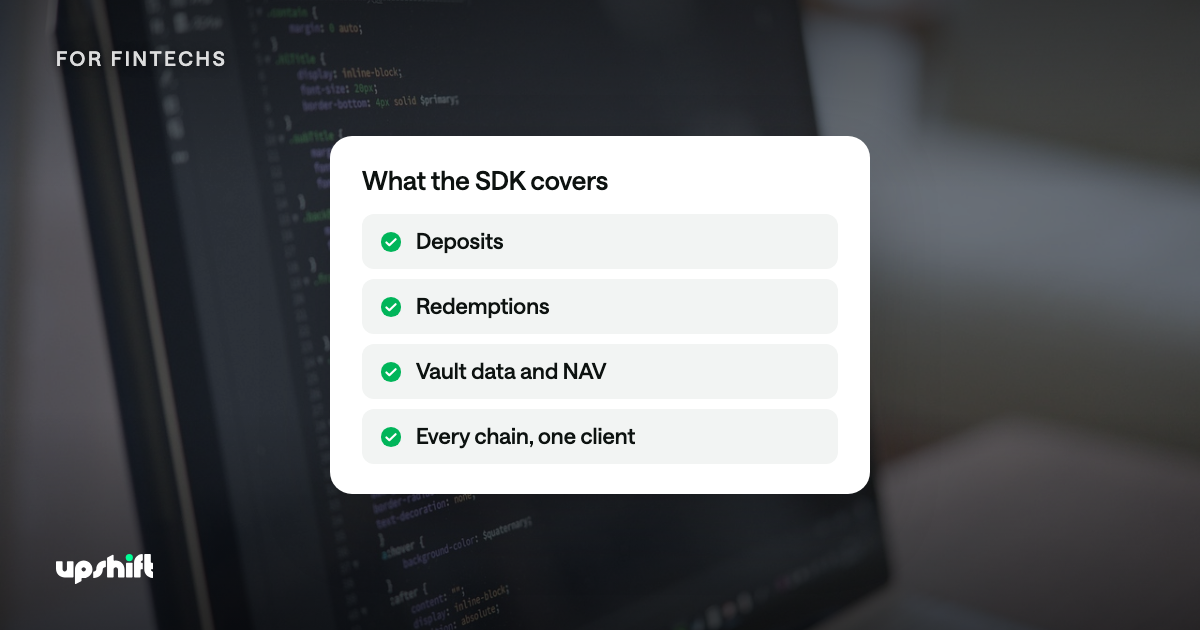
An SDK sits between your app and a vault contract. It reads data (balances, share price, positions, history) and builds the transactions a depositor needs: approve the token, deposit, request a redemption and claim it once it settles. Your wallet or custodian then signs and sends each transaction. Every vault SDK in the table works this way, and none of them holds the signing keys.
The SDK sits between your app and the vault. It reads data and builds transactions; your wallet signs them, and the vault and curator do the rest.
Job | Covered by a vault SDK | Left with your team |
Deposits and redemptions | Builds approve, deposit, redeem and claim transactions | Signing, through your MPC wallet, smart account or custodian |
Balances and yield shown to customers | Share balances, share price, APY and position history | How the Earn tab looks and what it promises |
Strategy and risk limits | Enforced in the vault contract the SDK calls | Choosing which vaults and risk bands to list |
Customer onboarding | Allow-lists on permissioned vaults, on some platforms | KYC, customer terms and disclosures |
Money in and out of the app | Stablecoin transfers only | Fiat on and off ramps |
Records | Transaction history and PnL reads | Tax reporting, accounting and support |
A vault SDK from Upshift, Morpho or Concrete gives you share tokens in that provider's own ERC-4626 vaults, where a curator or allocator sets the strategy. An aggregator API returns a menu of yields from many protocols, and your product team chooses which ones to show. Who does what in an onchain vault covers the curator, owner and operator roles behind each share token.
Vault infrastructure SDKs
Seven providers write the vault contracts and ship the SDK that calls them. On each, a deposit lands in a vault the provider audited and runs, and redemptions follow that vault's own rules.
Upshift: vault infrastructure and an aggregator API in one client
Upshift is onchain yield infrastructure for fintechs and asset managers with stablecoin balances. Its TypeScript SDK installs from npm as @augustdigital/sdk and works as one typed client across every chain Upshift runs on. Partners launch vaults under their own name through the SDK, the API or the Upshift app, and take a share of the fees.
The same client works as an aggregator API over Upshift's catalogue. One integration lists curated vaults from several curators, such as Sentora and Gamma Research, across the Conservative, Core and Enhanced bands and on EVM chains, Solana and Stellar. A product team switches on the vaults it wants to show and adds more later without new integration work. Every vault in the catalogue runs on the same contracts, policy engine and reporting.
- Transactions: deposit, request a redemption and claim it. The EVM actions detect whether a vault takes one asset or several and pick the right contract call, and a single flag requests an instant redemption on vaults that offer one.
- Vault data: positions, allocations across DeFi, CeFi and OTC venues, PnL, historical share price, fees, the NAV oracle classification, vault roles, pending timelocks and the governance audit log. These reads mirror the transparency page on the Upshift app.
- Other surfaces: a REST API with a public, unauthenticated tier and an institutional tier keyed per integration; a read-only CLI whose exit codes can alert a cron job when a redemption queue looks wrong; and a read-only MCP server with 70 tools for AI agents.
- Range: partners usually start with a Conservative vault holding 24/7 tokenized money market funds and add Core and Enhanced vaults on the same integration, including strategies that reach centralized venues through the Upshift prime stack.
Upshift has held more than $550M in deposits at peak across 50+ vaults on more than 30 chains, for over 66,000 users.
Few vault platforms run on Solana or Stellar with real money in them. Upshift's vaults held about $30M on Stellar and about $9M on Solana on 4 October 2026, by its own API (the Stellar launch covers earnUSDC and earnXLM). Tria and app.monad.xyz run Earn on the SDK, and institutions on Fordefi reach Upshift vaults through Fordefi Earn.
Morpho: TypeScript SDK on viem for curated lending vaults
The Morpho SDK (@morpho-org/morpho-sdk) builds ready-to-send viem transactions for Vault V2 deposits, withdrawals, redemptions and in-kind redemptions, and handles token approvals, Permit2 signatures and share-price protection on deposits. Since version 6.0.0 it routes every write through Morpho Bundles; the latest release on npm was 6.4.0 on 4 October 2026.
Morpho also runs a GraphQL API. Its homepage showed $16.87B in total deposits that day, and the yield comes from borrowers in Morpho lending markets (what is Morpho covers the markets).
Kiln: Connect API, JS SDK and a widget
Kiln Connect covers staking on 23 proof-of-stake protocols and also serves Kiln DeFi, where each protocol, asset and chain combination gets its own vault. Kiln's supported protocols page lists 11 lending protocols on EVM chains and says Tron and Solana are under review. A wallet can embed Kiln's widget in place of a custom front end. Kiln is best for staking yield, and Ledger Live and Trust Wallet both run Earn on it.
Concrete: Earn V2 SDK with React and Wagmi hooks
Concrete's Earn V2 SDK covers vault details, approvals, deposits, redemptions and conversion previews, plus reads for live APY, deposit caps, withdrawal cooldowns and a forecast of when a queued withdrawal will clear. It runs on viem, ships React and Wagmi hooks in the same package and lists six chains: Ethereum, Arbitrum, Berachain, Katana, Corn and Morph.
Lagoon: TypeScript SDKs for request-based vaults
Lagoon vaults use ERC-7540, where deposits and redemptions are requested and then settled by the curator, with an instant path when the curator turns it on. The Lagoon SDKs come as two packages, a framework-agnostic core and a viem extension, and a keyless GraphQL API returns vault state, positions and event history.
Veda: an API and Console for vault owners
The Veda API is tenant-scoped: an API key created in the Veda Console sees only its own organization's vaults, and the endpoints cover rebalancing, positions, fees and accounting. Depositors interact with each vault's Teller contract, and withdrawals are instant when the vault's buffer has the liquidity or go through a queue that third-party solvers fill. Veda's chain support page lists 16 chains, Solana among them.
IPOR Fusion: a Python SDK for vault operators
IPOR's Python SDK (pip install ipor-fusion) creates vaults, encodes strategy actions and submits them through a configured signer. It's the only Fusion interface that can write. The public API and a hosted MCP server are read-only. The docs aim the SDK at vault creators and the "Alpha" role that executes strategies, with 10 chains listed.
Aggregator APIs
Yield.xyz calls itself a non-custodial yield API for wallets, custodians, neobanks and AI agents. It covers 80+ networks. One schema spans staking, Aave and Morpho lending, RWA yields and vaults. The API returns full transaction sequences for enter, exit and manage actions, and the integrator signs them. Balances come back by state (active, pending, cooling down, claimable or locked). Its docs name Ledger, Zerion and Tangem as platforms it powers.
A product team picks which yields to switch on for its API key and can add deposit, performance or management fees, or send deposits to Yield.xyz's own allocator vaults. The aggregator model hands your team the choice of protocols, and each deposit sits in that protocol's contracts under its own audits.
Upshift's API gives a product team the same kind of menu, drawn from vaults on Upshift's own contracts. The choice is between curators and risk bands, and one set of audits and one reporting format covers every vault on the list.
Stablecoin yield aggregators compared splits the wider group into business APIs and retail apps.
Wallet and issuance platforms with yield features
Two stablecoin developer platforms offer yield next to their main product.
- Coinbase Developer Platform publishes an example app that connects CDP wallets to a Morpho vault on Base, plus a similar one for Aave. The yield comes from the protocol you choose, and CDP supplies the wallet.
- Bridge, owned by Stripe, pays rewards on the treasury reserves behind a stablecoin a company issues through it, minus issuance fees. API endpoints report accrued rewards and reward rates, and the issuer chooses whether to keep them or pass them to users. Cash reserves generally earn nothing.
Chains, CeFi reach and risk controls
Yield.xyz covers 80+ networks through one API. Morpho's SDK runs on every EVM chain Morpho is deployed on, and Upshift's single client covers EVM chains plus Solana and Stellar, which need separate programs and their own audits. Veda lists 16 chains, Lagoon 13, IPOR Fusion 10 and Concrete six. A chain in the docs and a chain with a live vault aren't always the same, and the vault infrastructure comparison sets docs against live deployments.
Two providers here reach beyond onchain venues. Upshift curators on an Upshift prime account can run lending and exchange strategies next to onchain positions. A policy engine limits each curator by chain, protocol, token and contract function. Concrete lets assets sit with a qualified custodian through its AssetCX product. The other SDKs here document onchain venues only. Coinchange, outside this list, sells CeFi and DeFi strategies by API.
Risk controls live mostly in the vault contract, with a few in the SDK itself:
- Upshift's policy engine rejects any call outside the protocols, tokens and functions approved for a vault, each vault's owner is a Gnosis Safe multisig, and contract upgrades need 4 of 6 signers split between the asset issuer, Upshift and the curator. The contracts have been through 11 smart contract audits by 6 independent firms.
- Morpho's SDK enforces a maximum share price on deposits against inflation attacks, and Vault V2 timelocks curator changes.
- Yield.xyz offers Shield, a transaction validation layer for its integrations.
- Concrete's SDK reads deposit caps and withdrawal cooldowns before a user transacts.
- Veda vaults only execute manager calls on a Merkle-tree allowlist.
Smart contract audit firms for vaults compares who audits which platform.
How long an SDK integration takes
Two providers publish a figure. Tria went live with Upshift vaults two weeks after starting the SDK integration, according to the Tria case study, and has routed more than $25M through three vaults on two chains since. Kiln quotes under four weeks on its DeFi page. Morpho, Yield.xyz, Concrete, Lagoon, Veda and IPOR don't publish a standard timeline.
In our experience the code is rarely the slow part. Listing decisions, fee terms and due diligence on the contracts and the curator take longer. Vault provider due diligence has the question list. An exchange that lists an existing vault moves faster than one that commissions a new strategy, at least on the launches we've run.
Adding Upshift vaults through the SDK
Most partners start with one Conservative stablecoin vault holding tokenized money market funds, then add Core or Enhanced vaults as customers ask for more. You set the vault name, the fee and who can deposit, and depositors hold their shares in their own wallets.
All Upshift vaults process redemptions daily, each vault has its own redemption lag, and most offer instant redemption for a fee, subject to liquidity. Today's stablecoin interest rates tracks what lending markets and vaults pay, and treasury teams can read crypto treasury management for the custody and accounting side.
Vault yields vary and aren't guaranteed. Vaults carry smart contract, strategy, counterparty and liquidity risk, with no deposit insurance.
Always make sure to do your own research and be aware of the above and any other risks before depositing.
Building Earn into a wallet, neobank or exchange? Tell us your chains and which stablecoins your users hold, and we'll send SDK access, a vault menu and a launch timeline.
Frequently asked questions
What are the best stablecoin yield SDKs for fintechs?
Fintechs building Earn on vaults use Upshift, Morpho, Kiln, Concrete, Lagoon and Veda, and those wanting a catalogue of yields use Yield.xyz or Upshift's catalogue of curated vaults. Upshift's SDK is the one that also covers Solana and Stellar vaults in the same client.
What are the best SDKs for launching yield products quickly?
Tria launched on Upshift's SDK in two weeks, and Kiln quotes under four weeks. Kiln's widget and the Upshift app let a partner list vaults before its own front end is finished.
Which SDKs support both CeFi and DeFi yield?
Upshift runs CeFi and DeFi strategies in one vault through the Upshift prime stack. Concrete reaches custodied assets through AssetCX, and Coinchange sells CeFi and DeFi strategies through an API.
Which yield infrastructure SDKs support multi-chain deployment?
Yield.xyz lists 80+ networks and Morpho supports every EVM chain it's deployed on. For non-EVM vaults, Upshift covers Solana and Stellar and Veda's API covers Solana.
Which stablecoin SDK providers have built-in risk controls?
Upshift checks every curator transaction against a policy engine, Veda and Gauntlet's Aera use Merkle-tree allowlists, and Morpho caps each market a vault can lend into. Yield.xyz's Shield validates transactions before they're signed.
Which stablecoin SDK providers serve institutions?
Upshift serves Kraken Institutional clients through permissioned vaults in qualified custody, and IPOR Fusion counts Tesseract, a MiCA-authorised firm, as a client. Concrete names BitGo as a custody partner.
What is the best institutional SDK for wallet providers offering yield features?
Wallets on this list run Earn through Upshift (Tria, Fordefi Earn), Kiln (Ledger Live, Trust Wallet) and Yield.xyz (Ledger, Zerion, Tangem). Embedded yield shows how apps distribute vaults.
Keep reading
- How neobanks and fintechs offer stablecoin yield. Product patterns when the depositor is a consumer.
- How exchanges build an Earn product. Building in-house, integrating a protocol or white-labelling.
- What is ERC-4626? The vault standard most of these SDKs speak.
- Tokenized money market funds vs stablecoin vaults. The most conservative options side by side.
Launch a vault with Upshift
Upshift builds custom, permissioned vaults for custodians, exchanges, neobanks and asset managers. Tell us what you are building and the team will follow up.
Create a vault with Upshift
Share your use case and we’ll get back to you shortly